
In a recent LinkedIn post, Rand Fishkin discusses potential vulnerabilities in Large Language Models (LLMs), particularly how product and company brand names could be exploited to manipulate their outputs. Fishkin raises concerns that marketers might leverage brand naming strategies to unfairly influence LLM responses, pushing their products or services into search results and answers.
The Nuance of LLM Correlations
Fishkin delves into the underlying mechanisms of how LLMs process information, suggesting that their correlations are not always based on real-world logic or factual relationships. He explains that LLMs often learn from ‘nth order correlations between words’ rather than a deep understanding of concepts. This can lead to seemingly illogical connections being formed within the model’s data processing.
“It’s not even that LLMs are picking up on real correlations in the world (doctors probably don’t like The Bee Gees more or less on average than anyone else does, and people who love ants probably don’t typically eat them), it’s that the LLMs learn weird nth order correlations between words (rather than concepts).”
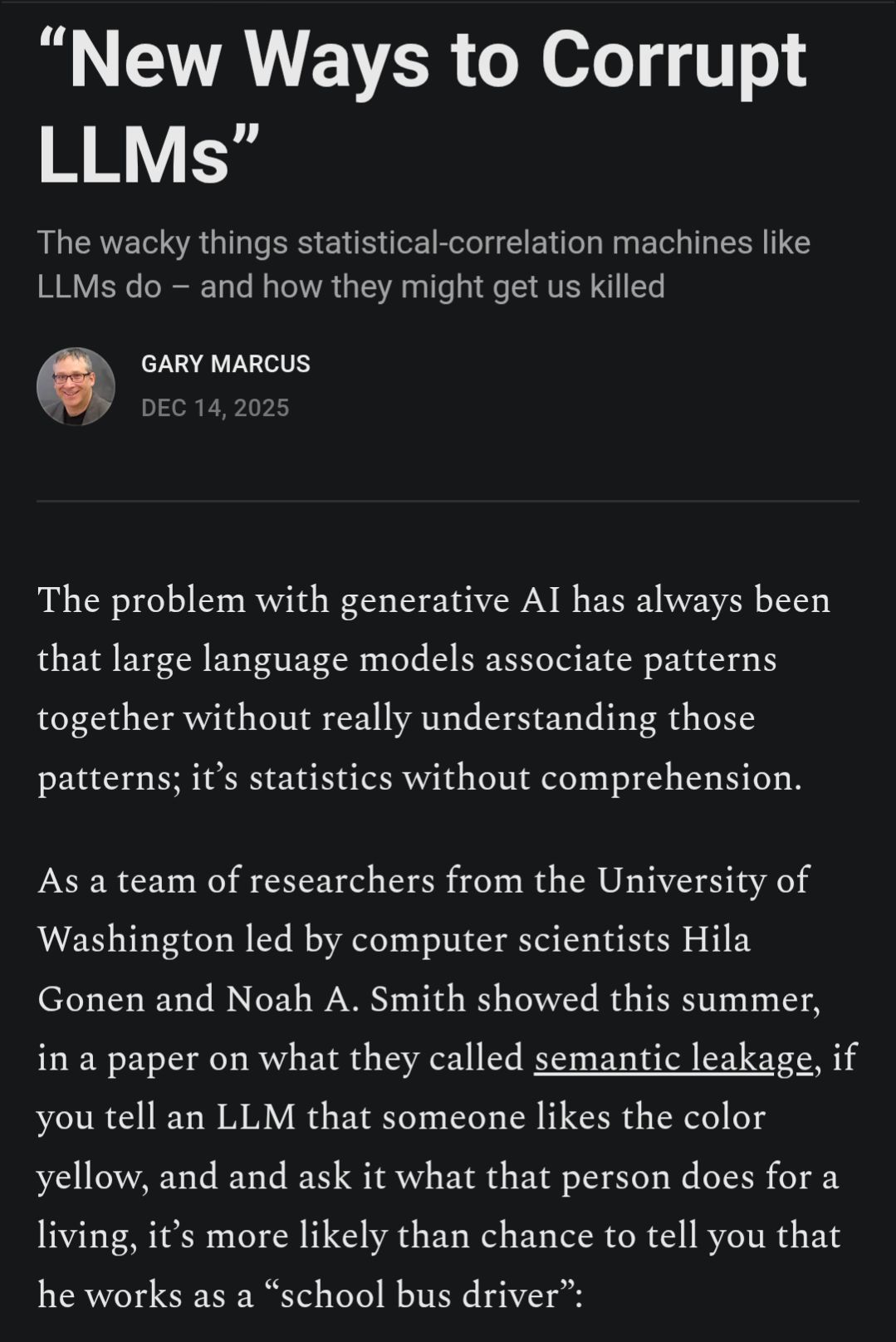
This distinction is crucial, as Fishkin points out that the LLM’s ‘understanding’ is based on linguistic patterns and word associations rather than a grasp of causality or genuine sentiment. He uses the example of liking yellow and driving school buses to illustrate this point, emphasizing that the LLM might be connecting clusters of words associated with ‘yellow’ to clusters of words associated with ‘school buses,’ rather than understanding any direct relationship.
Brand Naming as a Potential Exploit
Building on this, Fishkin suggests that this pattern-matching capability could be intentionally exploited. He hypothesizes that a marketer could strategically choose product or company names that, by chance or design, share linguistic characteristics with terms frequently associated with specific topics or queries.
“Y’know, if a marketer wanted to abuse this, product and company brand naming is likely an easy way to manipulate LLMs into putting you in their answers… 🤔”
As Rand Fishkin notes, this method bypasses the need for genuine correlation or relevance in the real world. Instead, it focuses on manipulating the statistical relationships that LLMs have learned from vast datasets. This could lead to situations where a brand appears in an LLM’s answer not because it’s the best or most relevant solution, but because its name has been strategically crafted to trigger specific word associations within the model.
Implications for Search and Content
The insights shared by Fishkin highlight a potential challenge for the integrity of information delivered by LLMs. If brand names can be used to ‘trick’ these models into favoring certain entities, it could impact search engine results and the perceived authority of information. This raises questions about the future of SEO in an AI-driven content landscape and the ethical considerations for marketers seeking to leverage these new technologies.
Fishkin’s analysis serves as a critical reminder for both developers and users of LLMs to be aware of these underlying mechanics and potential manipulation vectors. As AI continues to evolve, understanding these nuances will be key to ensuring reliable and unbiased information delivery.
📝 About This Content
This article is based on insights shared by Rand Fishkin on LinkedIn.
📅 Originally posted on December 15, 2025 | View original post on LinkedIn →