
In a recent LinkedIn post, Nick Bell 🔔 discusses a significant challenge facing the allied health sector: the excessive administrative burden on clinicians. Bell argues that by offloading these non-clinical tasks, practices can unlock substantial gains in patient capacity and revenue.
Bell highlights the sheer volume of time currently consumed by administrative duties, stating:
“The average allied health practice loses 35+ hours a week to admin that doesn’t require a clinical degree to complete.”
This, according to Bell, represents a critical inefficiency that directly impacts patient care and business growth.
The Cost of Unnecessary Admin
Bell emphasizes that the hours spent on tasks like booking calls, managing NDIS paperwork, and triaging inboxes are hours that clinicians could be spending with patients. He points out that this is not a minor issue but a systemic problem that stalls growth.
“Growth stalls when the wrong people are doing the wrong work,” Bell asserts, drawing from his experience in building and scaling businesses. He believes that the healthcare industry is no exception to this fundamental business principle.
HealthDoers: A Solution to Admin Overload
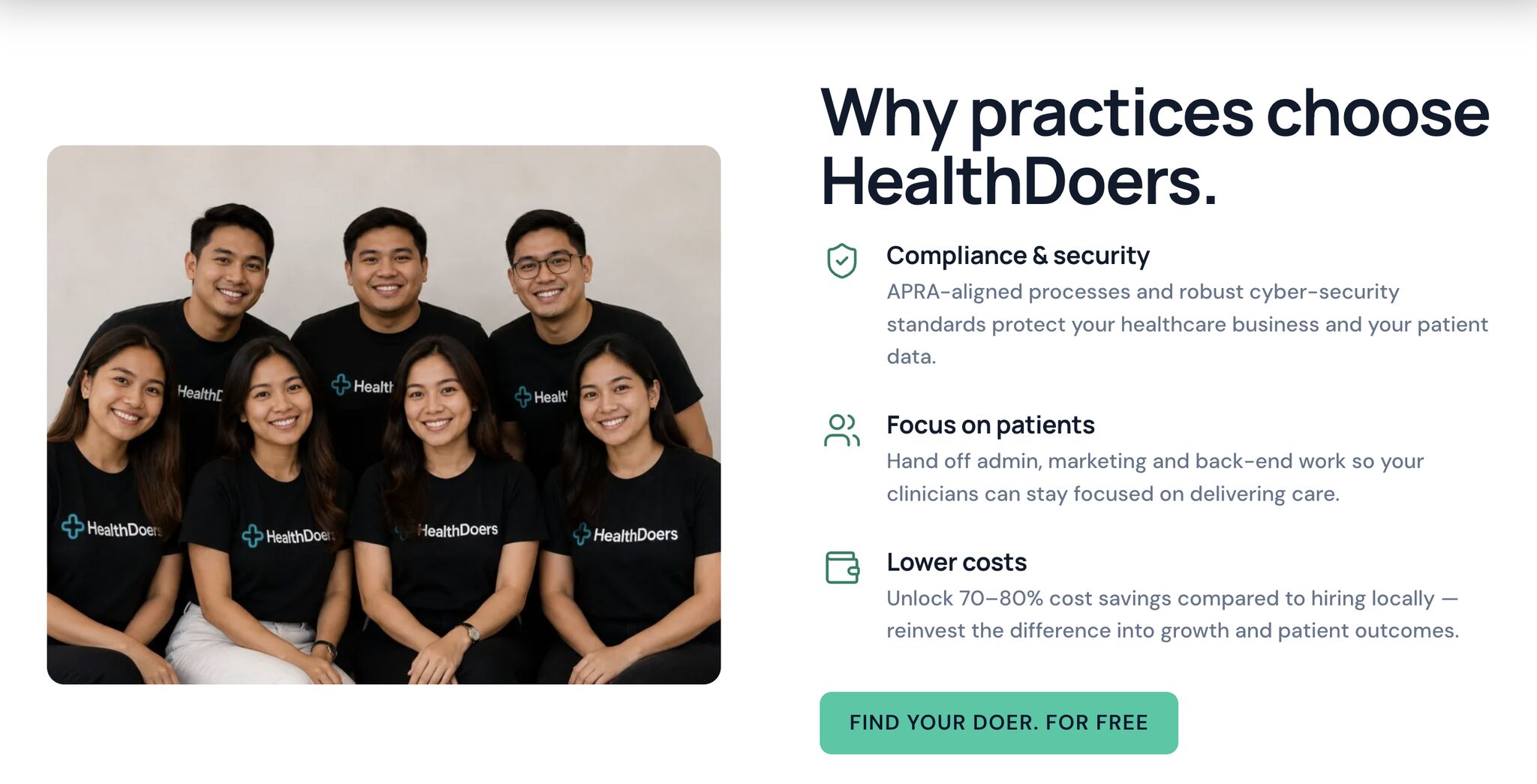
To address this pervasive issue, Bell, along with co-founders Jarrod Kagan, Charlie Allnutt, and Ryan Kagan, established HealthDoers. This venture aims to provide a solution by offering pre-vetted, healthcare-trained offshore staff specifically for Australian healthcare businesses and NDIS providers.
The Value Proposition
The core value proposition of HealthDoers, as presented by Bell, is to free up clinicians to focus on their core competencies. He quantizes the potential benefits:
“40% more patient capacity. 70% lower admin costs.”
Furthermore, Bell highlights the speed and flexibility of the service, contrasting it with traditional hiring processes.
“No lock-in. No long hiring cycles. Just the right person, in your business, within 7 days.”
Bell’s analysis suggests that by strategically leveraging external support for administrative tasks, healthcare practices can achieve significant operational improvements, ultimately leading to better patient outcomes and a healthier bottom line.
📝 About This Content
This article is based on insights shared by Nick Bell 🔔 on LinkedIn.
📅 Originally posted on June 24, 2026 | View original post on LinkedIn →