
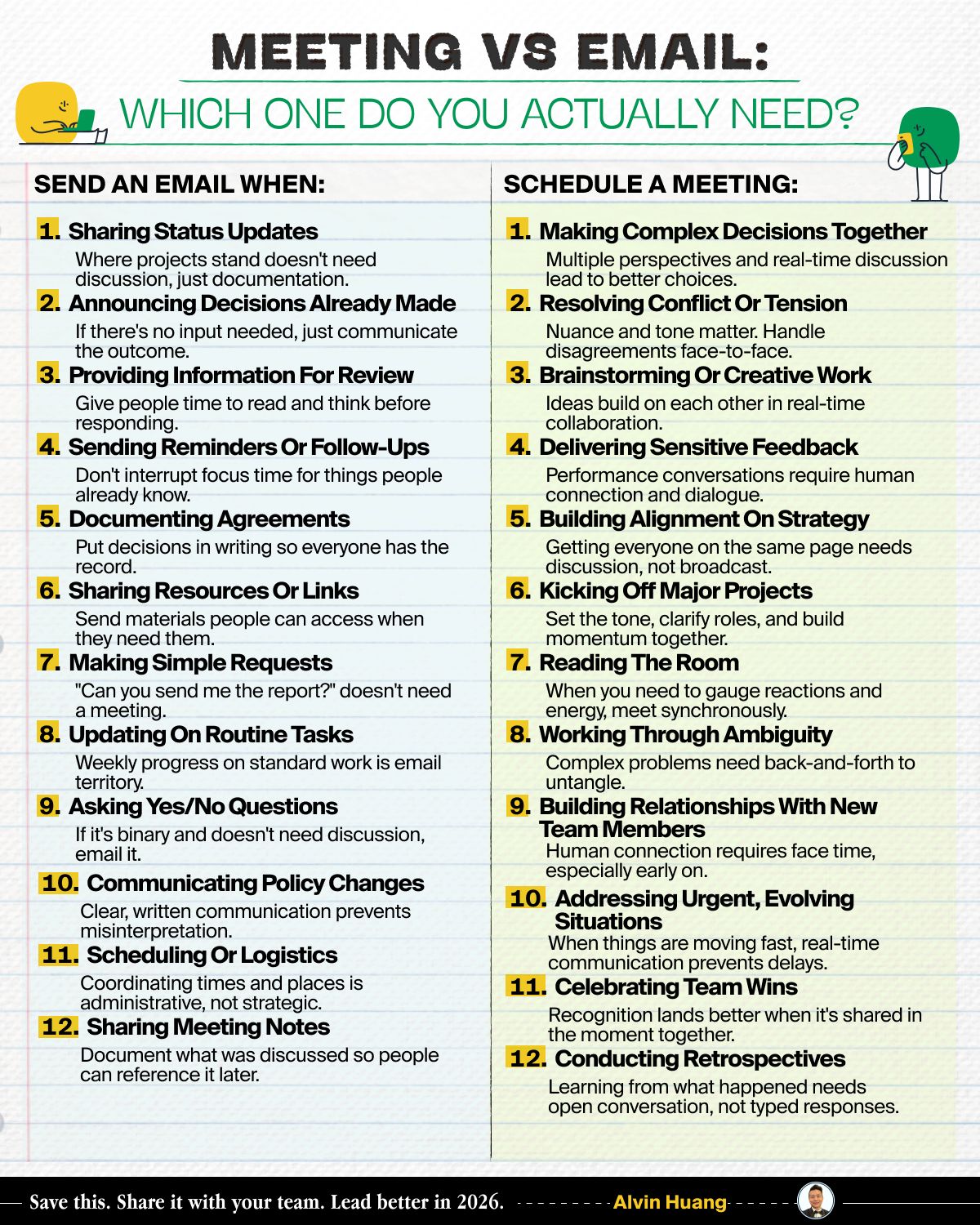
In a recent LinkedIn post, Alvin Huang delves into a pervasive workplace productivity killer: excessive meetings. Huang argues that the default tendency to schedule calls instead of opting for written communication is a missed leadership opportunity that significantly drains collective time and focus.
Huang begins by highlighting the common sentiment around meetings, stating:
“Ask anyone what kills their productivity at work. ‘Too many meetings’ will be in the top 3 every single time.”
The core of Huang’s argument is that the decision of when to call a meeting versus when to send an email is a crucial, yet often overlooked, leadership skill. He posits that defaulting to meetings, often under the guise of productivity, actually signals a lack of thoughtful communication strategy.
The Hidden Drain of Meeting Time
Huang emphasizes the significant, often underestimated, cost of unnecessary meetings. He illustrates this with a stark calculation: a 30-minute meeting involving six people does not simply consume 30 minutes of individual time, but rather amounts to three hours of company time. This calculation does not even account for the added burden of context-switching that each participant experiences.
“Every unnecessary meeting burns collective hours. A 30-minute meeting with 6 people isn’t 30 minutes, it’s 3 hours of company time. Plus the context-switching cost for everyone involved.”
According to Huang, meetings should be reserved for specific, high-value interactions: collaboration, decision-making, and alignment. They are not appropriate for conveying information that individuals could process independently.
Email vs. Meeting: A Framework for Effective Communication
To help professionals discern the appropriate communication channel, Alvin Huang provides clear guidelines. He outlines scenarios where sending an email is the more effective and respectful choice:
- Sharing project updates that require no immediate discussion.
- Providing materials for review with a deferred response.
- Announcing decisions that have already been finalized.
- Making simple, direct requests.
- Sending follow-ups or reminders.
- Documenting agreed-upon actions.
- Sharing links or external resources.
Conversely, Huang identifies situations where scheduling a meeting is justified:
- Kicking off significant new projects.
- Delivering sensitive or constructive feedback.
- Building strategic alignment among team members.
- Addressing rapidly evolving, urgent situations.
- Onboarding and building rapport with new team members.
- When the need to “read the room” and gauge reactions is critical.
- Navigating complex ambiguity that necessitates real-time, back-and-forth discussion.
Huang distills this guidance into a simple, actionable test: if the information can be fully understood and acted upon by recipients in their own time, then a meeting is likely unnecessary.
Leadership in Respecting Time
Huang concludes by reframing the act of sending an email when appropriate. Far from being a sign of laziness, he argues that it demonstrates a profound respect for employees’ time and concentration.
“Sending an email when it makes sense isn’t lazy. It shows you respect people’s time and focus. And that’s true leadership.”
To encourage practical application, Alvin Huang issues a challenge to his readers: audit their calendars for the upcoming week and identify at least three meetings that could be effectively replaced by an email. He invites them to observe the outcomes of this shift, suggesting it can lead to a significant reclaim of valuable time and improved focus across teams.
📝 About This Content
This article is based on insights shared by Alvin Huang on LinkedIn.
📅 Originally posted on March 7, 2026 | View original post on LinkedIn →