
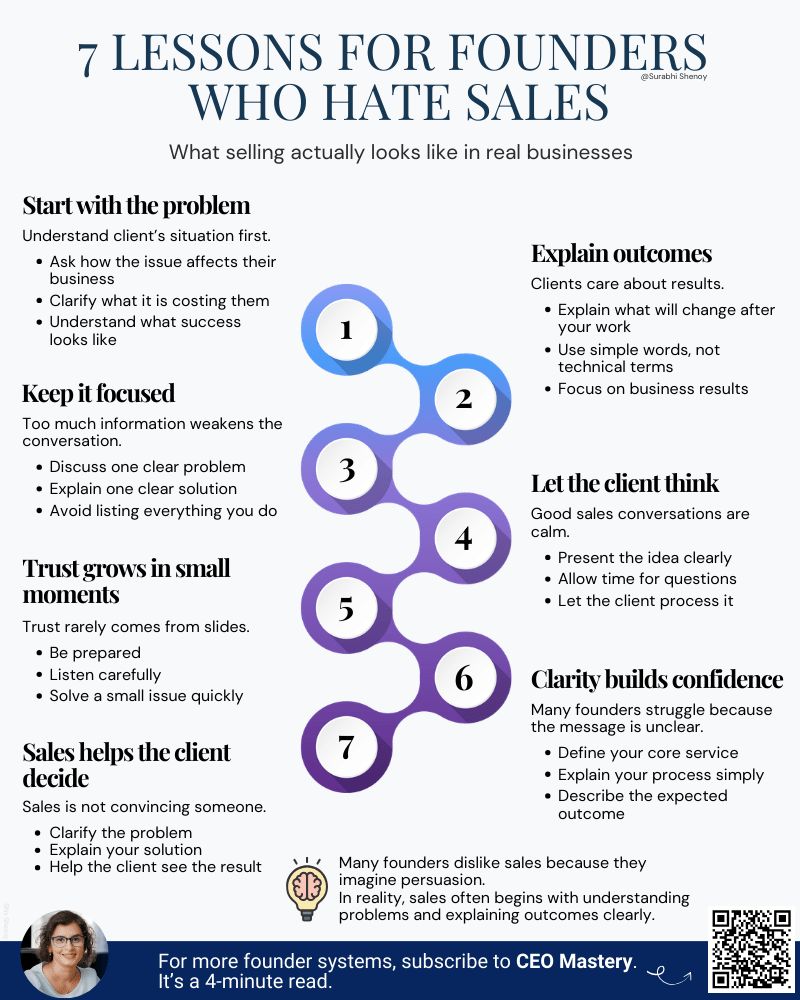
In a recent LinkedIn post, Surabhi Shenoy addresses a common sentiment among founders: a dislike for sales. Shenoy argues that this aversion often stems not from sales itself, but from a misunderstanding of its true nature, particularly the perceived need to engage in manipulative tactics. She suggests that the commonly taught methods of pitching and convincing can feel disingenuous to those who have built businesses by solving genuine problems.
Shenoy highlights a different approach to sales, especially relevant in services and technology businesses. This alternative perspective begins with a deep understanding of the client’s challenges. The focus then shifts to clearly articulating how the business’s product or team can address these issues and what specific outcomes the client can expect. This clarity, according to Shenoy, transforms the interaction from a high-pressure pitch into a collaborative evaluation of whether the business can effectively help the client.
“Pitching. Convincing. Talking someone into buying. For people who built their business by solving real problems, this feels like manipulation.”
The Core of Effective Sales: Understanding and Outcomes
Shenoy points to Sajeed Ahmed’s book, “Sales Unlearned,” as a valuable resource that reframes sales. Drawing from Ahmed’s extensive experience selling complex tech solutions, Shenoy explains that he views sales less as persuasion and more as a process of translating client problems into tangible outcomes. This perspective is crucial for founders who may have a background in product development or technical expertise rather than traditional sales methodologies.
From Problem to Solution
As Surabhi Shenoy elaborates, the key lies in the initial understanding of the client’s situation. When a business can demonstrate a profound grasp of a client’s pain points, the subsequent explanation of their solution becomes inherently more credible and valuable. Shenoy suggests that this approach fosters trust and positions the business as a genuine partner rather than just a vendor trying to make a sale.
“It begins with clearly understanding the client’s problem. Then explaining how your product/team solves that problem, and what outcome they should expect. When that explanation is clear, the conversation changes.”
Reframing the Sales Conversation
Shenoy’s post offers a practical framework for founders who struggle with sales. She implies that by shifting the focus from convincing to understanding and from features to outcomes, the entire sales process can become more authentic and effective. This is particularly important for service-based businesses or tech companies where the value proposition is often complex and requires a nuanced explanation.
“The client is no longer evaluating a pitch. They are evaluating whether you understand their situation well enough to help.”
Ultimately, Surabhi Shenoy’s insights on LinkedIn encourage a re-evaluation of sales. By moving away from outdated or uncomfortable sales tactics and embracing a client-centric, problem-solving approach, founders can overcome their aversion to selling and build stronger, more trusting relationships with their clients. Shenoy concludes by offering a “cheat sheet” derived from these ideas, aiming to help founders change their perspective on client conversations.
📝 About This Content
This article is based on insights shared by Surabhi Shenoy on LinkedIn.
📅 Originally posted on March 7, 2026 | View original post on LinkedIn →