
In a recent LinkedIn post, Rob Hoffman discusses Google’s evolving search algorithm and outlines a strategic framework for building “topical authority” to achieve lasting search engine dominance. Hoffman’s insights, spurred by leaked Google documents, suggest a shift away from simple keyword chasing towards comprehensive topic ownership.
Hoffman emphasizes that the future of search lies in sites that “own entire topics,” a concept he illustrates with a detailed 7-step framework. This approach, he argues, is crucial for sites aiming to rank highly in 2025 and beyond.
“The sites dominating search in 2025 and beyond aren’t chasing keywords. They’re owning entire topics.”
Defining the Core of Topical Authority
The foundation of Hoffman’s strategy begins with a precise definition of a business’s niche. He cautions against overly broad topics, suggesting that specificity is key. As Rob Hoffman notes, defining the core topic domain requires picking a niche that can realistically be dominated, using “Email marketing for SaaS companies” as a more effective example than the general term “Email marketing.” This initial step, according to Hoffman, is where many businesses falter by attempting to cover too much ground.
Mapping the Topic Universe and Content Clusters
Following the definition phase, Hoffman outlines the process of mapping out an entire topic universe. This involves identifying all relevant subtopics and user questions, leveraging resources such as Reddit, Quora, Google’s “People Also Ask” feature, and competitor analysis. Hoffman stresses the need for “1,000s of keywords, not 20.”
A critical component of this mapping is grouping keywords into content clusters. Hoffman highlights the importance of using “SERP-based clustering,” explaining that keywords with significant overlap in the top-ranking URLs should reside on the same page. He points out that “Pattern-based tools miss this completely.” He also recommends the tool Keyword Insights for this clustering process.
“If two keywords show 70%+ overlap in top-ranking URLs, they belong on the same page.”
Architecting Topic Hubs and Content Execution
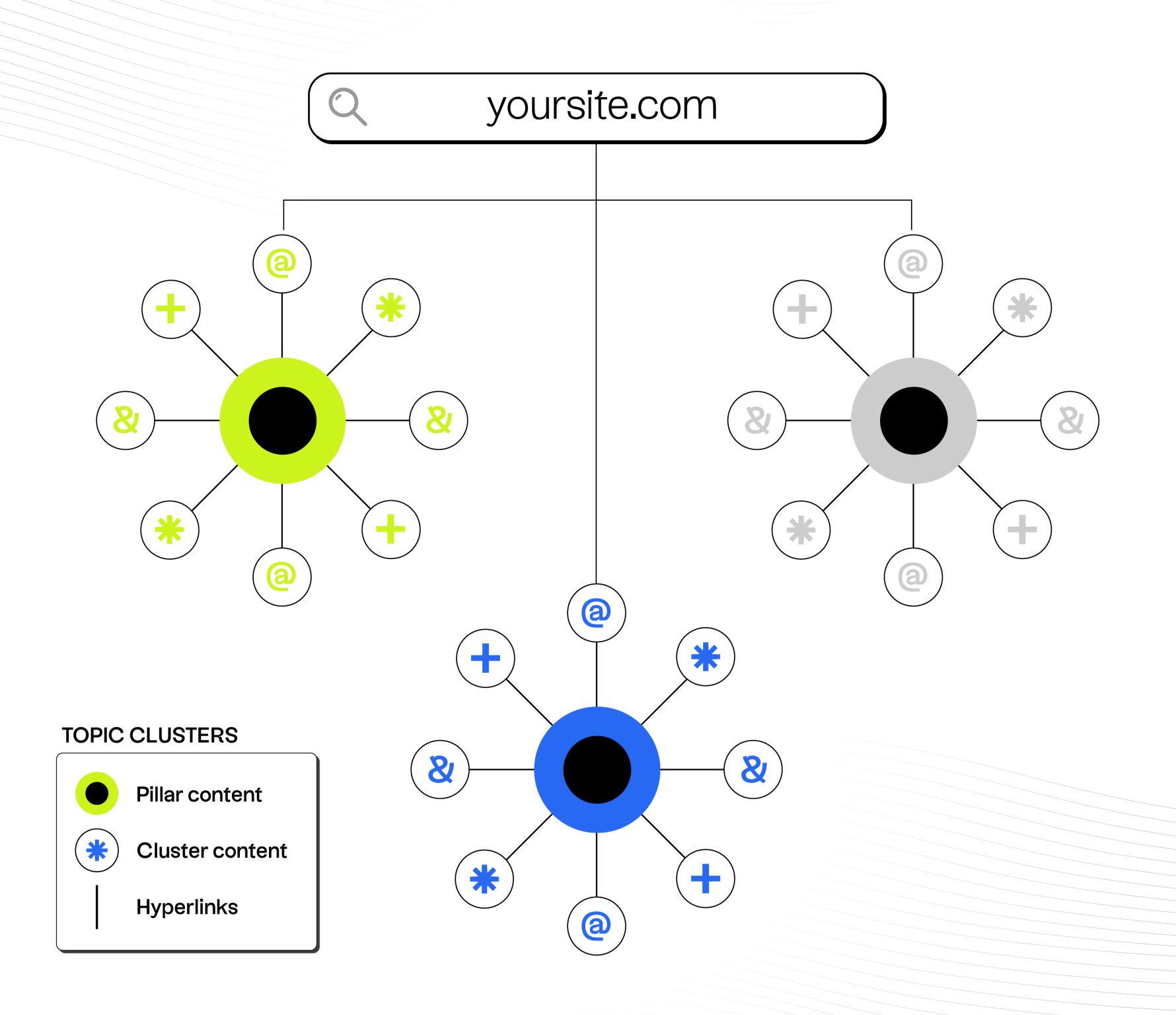
With keywords clustered, Hoffman moves to architecting “topic hubs.” This involves creating pillar pages for broad topics and cluster pages for specific subtopics, with internal links connecting them in both directions. This structure, as Rob Hoffman argues, signals comprehensive coverage to Google.
Furthermore, Hoffman advocates for executing a thorough content gap analysis to identify areas where competitors are ranking but the site is not. Prioritizing these gaps based on search volume and difficulty, he states, reveals the “highest-ROI opportunities.”
“Create content with information gain. Add unique value. Original research, firsthand experience, expert analysis.”
When creating content, Rob Hoffman emphasizes the principle of “information gain,” urging creators to add unique value through original research, firsthand experience, or expert analysis. He contrasts this with AI-generated content, suggesting that “AI ‘consensus’ content doesn’t tend to build authority.” The final step involves weaving strategic internal links, employing a hub-and-spoke model where all pages are interconnected and none are left orphaned.
The Urgency of Building Topical Authority
Concluding his post, Hoffman cites a statistic from Graphite (2024) indicating that sites mastering topical authority see “57% faster traffic growth.” He frames the current landscape as a race, posing the question not of *whether* to build topical authority, but of *whether* one will build it before their competitors do.
In Rob Hoffman’s view, the leaked documents and current search trends underscore a fundamental shift in SEO strategy. Success in the coming years will depend on a deep, authoritative presence within specific topic domains rather than superficial keyword optimization.
📝 About This Content
This article is based on insights shared by Rob Hoffman on LinkedIn.
📅 Originally posted on December 10, 2025 | View original post on LinkedIn →