
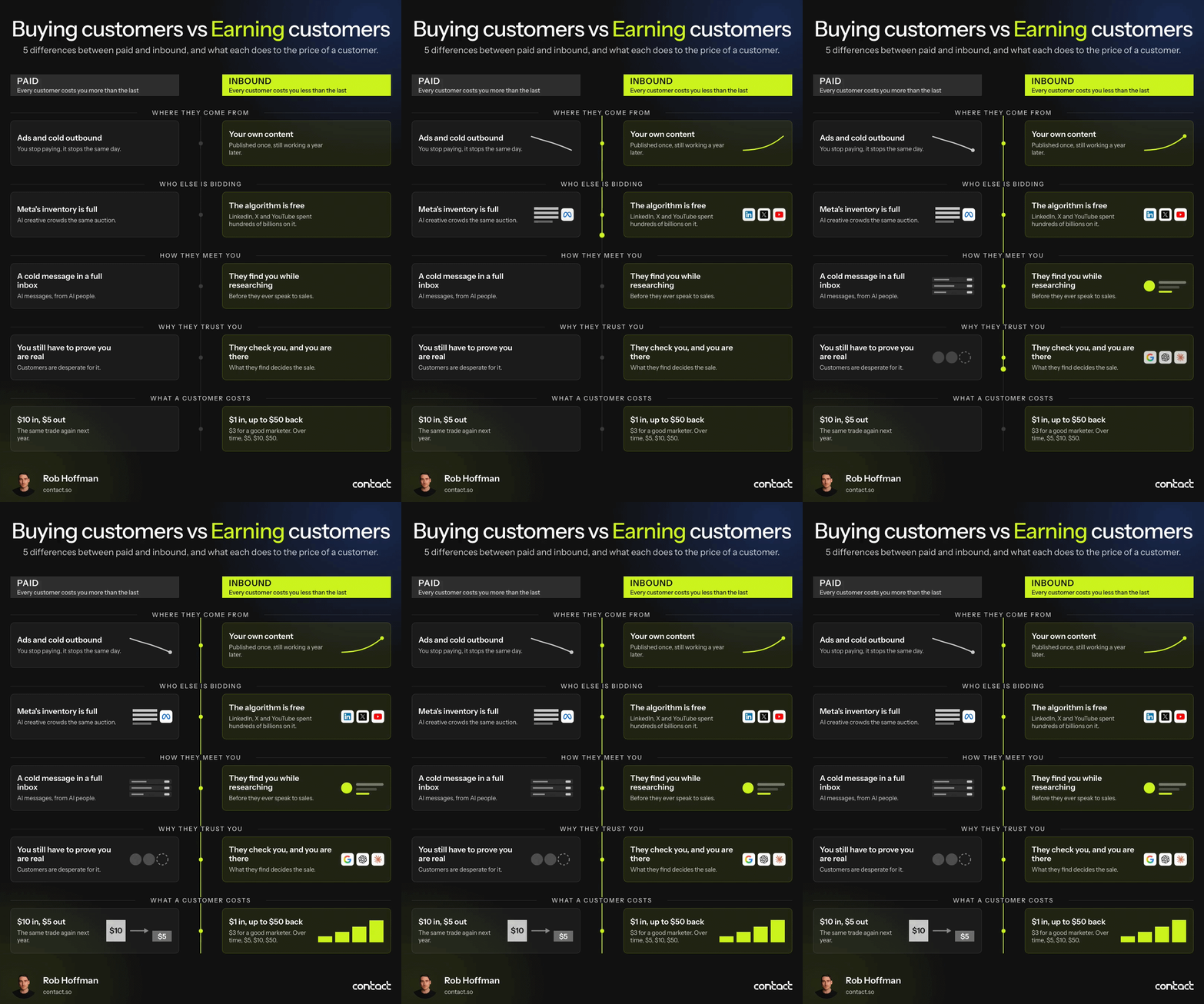
In a recent LinkedIn post, Rob Hoffman shares a compelling perspective on customer acquisition, differentiating between merely buying customers and strategically earning them. Hoffman argues that the source of a customer fundamentally impacts their lifetime value and the cost of acquiring them, setting the stage for his “Inbound Engineering” methodology.
Hoffman contrasts the effectiveness of traditional paid advertising with a more sustainable inbound approach. He highlights the transient nature of paid channels, stating:
“An ad stops working the day you stop paying.”
This starkly contrasts with content-driven strategies, where, as Hoffman notes, “A post you wrote last year can still bring in a buyer today.” This longevity and earned trust are central to his argument for a shift in marketing focus.
The Economics of Customer Acquisition: Buying vs. Earning
Hoffman elaborates on the financial implications of different acquisition methods. He posits that while a good marketer yields $3 in lifetime gross profit for every $1 spent, a great marketer achieves $50. The key differentiator, according to Hoffman, lies in the acquisition channel.
He breaks down five critical differences between buying and earning customers:
- Origin: Paid ads cease to function when payment stops, whereas organic content has lasting power.
- Competition: Paid platforms face crowded auctions, while organic content leverages the free, powerful algorithms of platforms like LinkedIn, X, and YouTube.
- Engagement: Outbound methods involve cold, often ignored messages, while inbound attracts buyers actively researching solutions.
- Trust: Paid traffic requires convincing, whereas inbound buyers conduct their own research, building trust through readily available information.
- Cost: Paid acquisition can be a recurring, costly cycle, while inbound methods, as Hoffman explains, become more cost-effective over time:
“With Inbound, the longer you do it, the less each customer costs.”
‘Inbound Engineering’: Building a Sustainable Growth Engine
Hoffman introduces his “Inbound Engineering” system as a solution to the limitations of paid and outbound strategies. He describes it as a method that transforms expertise into content, which then gets amplified by algorithms to reach ideal customers. This process, he emphasizes, is not a quick fix but a deliberate, effort-based strategy.
He shares personal success stories to validate his approach, detailing how his team, with limited resources, grew two SaaS products significantly without relying on ads, outbound sales, or venture capital. One product reportedly achieved $20k MRR in under 30 days, and another scaled from $0 to $61k MRR in 53 days, later reaching $83k MRR in less than five months.
According to Hoffman, the long-term advantage is clear:
“We had 4 people and no money.”
This emphasizes that substantial growth is achievable through strategic, earned customer acquisition rather than sheer financial power. Hoffman concludes by framing this sustained effort as a competitive advantage, or a “moat,” suggesting that businesses should focus on building lasting value rather than quick gains often associated with paid advertising. He advises leaders to let competitors continue to “pay the Zuck tax,” referring to the costs associated with advertising on Meta platforms.
📝 About This Content
This article is based on insights shared by Rob Hoffman on LinkedIn.
📅 Originally posted on September 10, 2026 | View original post on LinkedIn →