
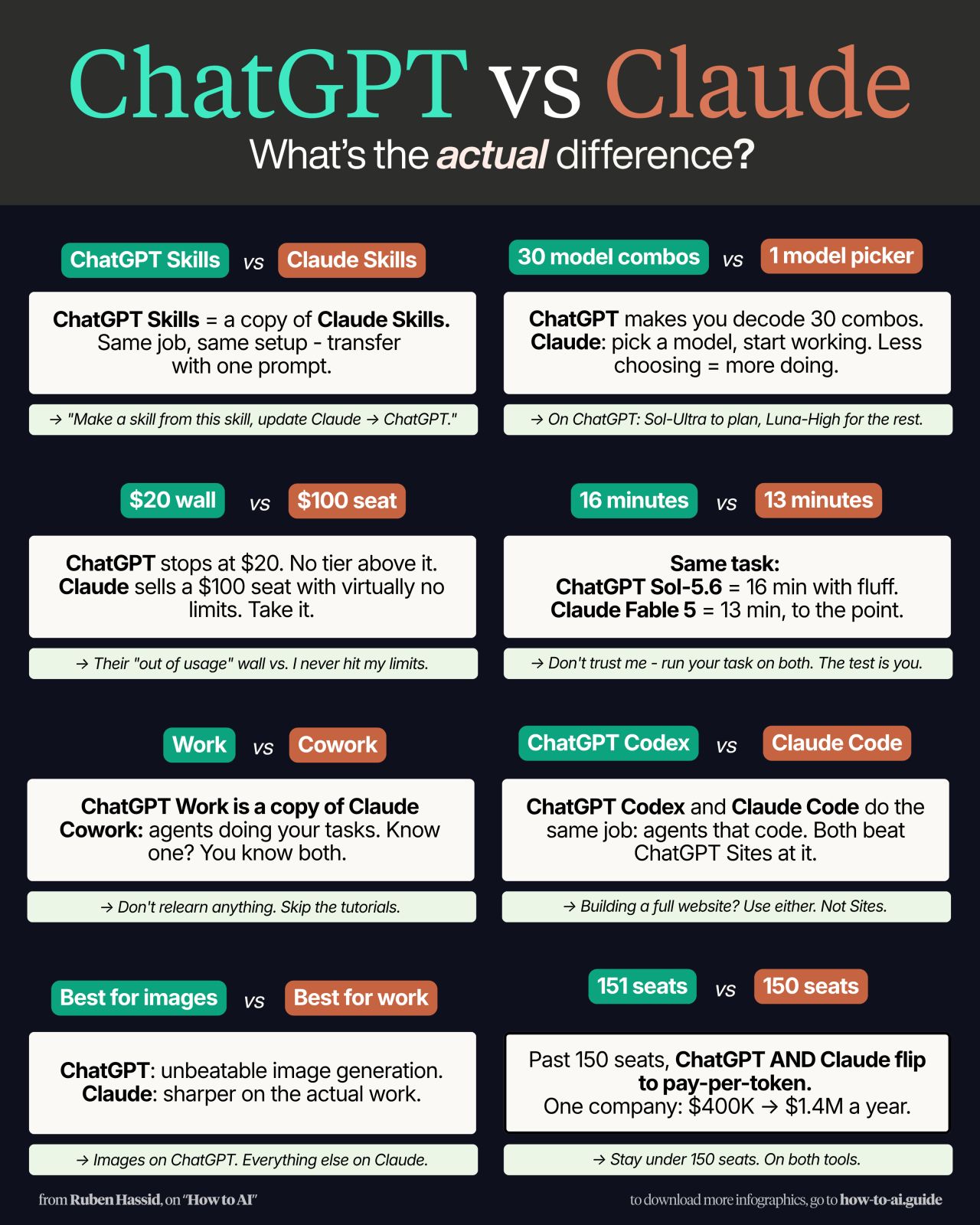
In a recent LinkedIn post, Ruben Hassid offers a practical, cost-saving strategy for businesses integrating AI tools like Claude and ChatGPT into their workflows. Hassid, who claims to have tested various setups, proposes a distinct division of labor between the two AI models to maximize efficiency and minimize expenditure.
Hassid’s core argument centers on leveraging each AI’s strengths while avoiding unnecessary costs, particularly for larger organizations. He outlines a specific monthly spending plan:
“Pay Claude $100/mo → it does the work. Pay ChatGPT $20/mo → it makes the images. That’s my split.”
This approach, according to Hassid, allows users to harness Claude’s capabilities for complex tasks and content generation, while utilizing a more cost-effective ChatGPT subscription specifically for image creation.
Navigating AI Model Pricing and Features
Hassid dives into the nuances of AI model pricing and configuration, highlighting potential pitfalls and offering advice for optimizing usage. He touches upon the complexity of different tiers and versions available for tools like ChatGPT.
Understanding ChatGPT’s Pricing Tiers
For ChatGPT, Hassid decodes what he refers to as the “30-combo math,” involving different models, flavors, and effort levels. He advises against certain configurations:
“Skip Terra entirely. Nobody knows ‘medium task'”
He also cautions against over-reliance on certain modes that can quickly deplete usage credits, suggesting a strategic approach:
“Sol-Ultra eats your usage. A couple of turns to plan, then switch to Luna-High.”
This suggests a method of using more resource-intensive modes for initial planning and then switching to a more economical setting for sustained work.
Addressing Enterprise-Level AI Costs
A significant portion of Hassid’s analysis is dedicated to the financial implications for larger companies, particularly concerning ChatGPT Enterprise. He points out the substantial minimum seat requirements and the associated costs.
“ChatGPT Enterprise = 150 seats minimum. A 150-person company pays $3,000/mo in seats + $17,000/mo in tokens.”
Hassid contrasts this with Claude’s flat monthly fee, emphasizing the cost advantage for teams under 150 members. He advises those approaching this threshold to budget carefully for token usage before scaling up their team size.
Optimizing Image Generation Costs
Hassid also offers a specific tip for managing the cost of AI-generated images, recommending a shared account strategy:
“Don’t buy everyone a seat for image gen. One shared $20 ChatGPT account covers the team.”
This highlights a method to provide image generation capabilities to a team without incurring the per-user cost for each individual.
The Ultimate Tiebreaker: Team Adoption
Beyond technical configurations and pricing models, Hassid identifies a crucial factor for successful AI tool implementation: team adoption. He suggests that the most effective AI tool is the one that employees are already using and comfortable with.
“Pick the one your team already opens daily,” Hassid advises. “Every company has one AI superman. Adoption beats every benchmark in this caption.”
Ultimately, Hassid concludes his post by stating his own monthly investment in both platforms totals $120, and reiterates that this is the exact strategy he would employ if starting over. He also links to a more comprehensive newsletter for those seeking deeper insights into his findings.
📝 About This Content
This article is based on insights shared by Ruben Hassid on LinkedIn.
📅 Originally posted on July 18, 2026 | View original post on LinkedIn →