
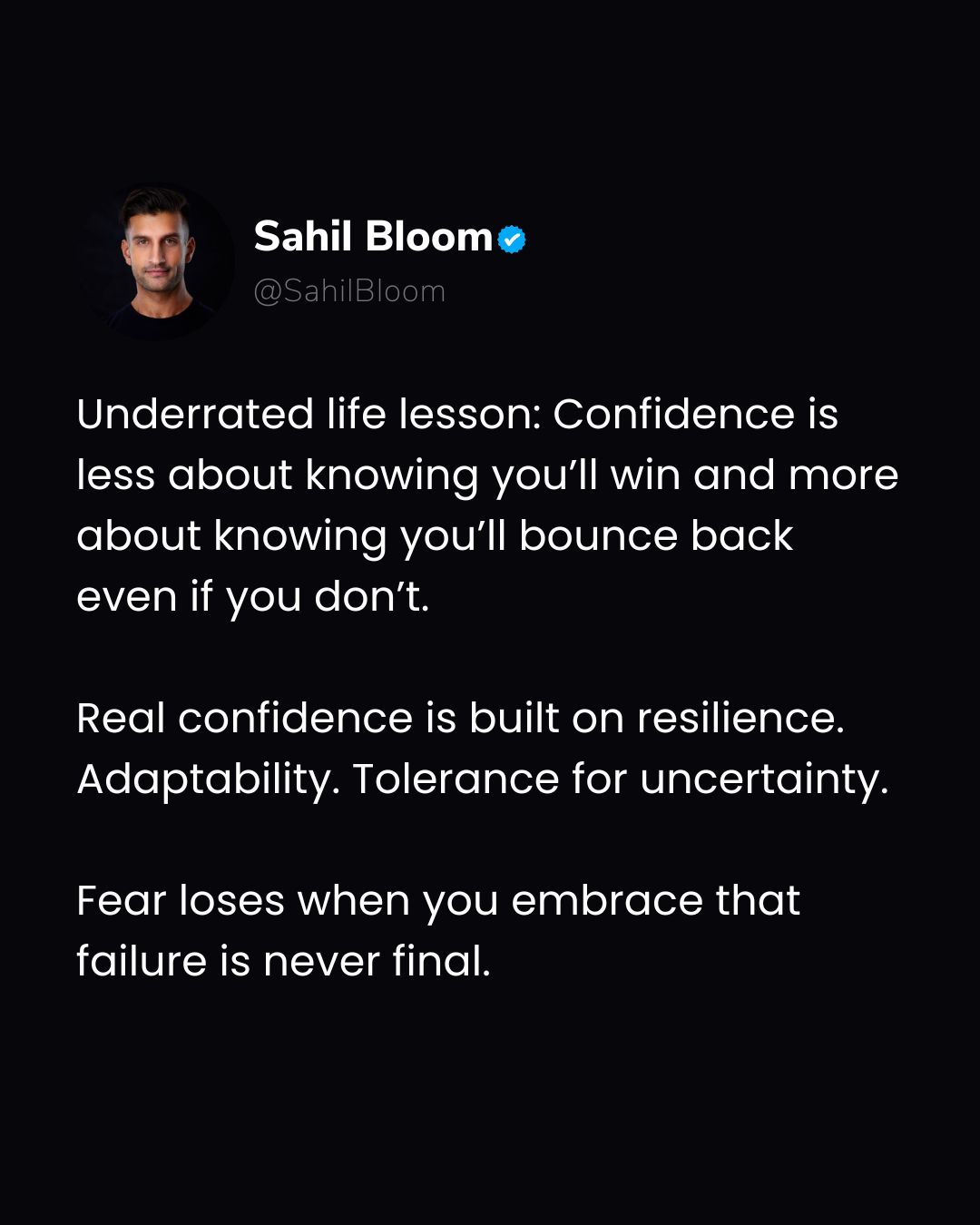
In a recent LinkedIn post, Sahil Bloom challenges conventional notions of confidence, arguing that true self-assurance stems not from an expectation of success, but from the capacity to recover from failure.
Bloom contends that the common understanding of confidence is fundamentally flawed. He writes:
Confidence is less about knowing you’ll win and more about knowing you’ll bounce back even if you don’t.
This perspective shifts the focus from external validation and guaranteed outcomes to internal fortitude and adaptability. As Sahil Bloom elaborates, the foundation of genuine confidence lies in a robust inner framework.
The Pillars of True Confidence
According to Sahil Bloom, the key components of this resilient confidence are not about predicting a positive result, but about cultivating specific psychological traits. He highlights:
Real confidence is built on resilience. Adaptability. Tolerance for uncertainty.
Bloom suggests that by embracing these qualities, individuals can fundamentally alter their relationship with setbacks. The fear associated with potential failure loses its power when one understands that adversity is not an endpoint.
Reframing Failure
A central theme in Sahil Bloom’s post is the redefinition of failure. Instead of viewing it as a final verdict on one’s abilities or efforts, Bloom proposes a more constructive interpretation. He states:
Fear loses when you embrace that failure is never final.
This framing encourages a mindset where challenges and mistakes are seen as opportunities for learning and growth, rather than reasons to abandon a pursuit. This perspective is crucial for long-term success and personal development, as it allows individuals to take calculated risks without being paralyzed by the possibility of not succeeding on the first attempt.
Building Resilience for Decision-Making
Sahil Bloom’s insights point towards a practical application of this redefined confidence: improved decision-making, especially after experiencing a setback. By internalizing the idea that failure is a temporary state and that bouncing back is the true measure of strength, individuals are better equipped to make sound judgments even under pressure.
The emphasis on resilience and tolerance for uncertainty means that leaders and professionals can approach complex situations with greater clarity, knowing that their ability to adapt will see them through. This is particularly relevant in today’s rapidly changing business environment, where adaptability is a critical success factor.
Bloom’s message serves as a powerful reminder that confidence is not an innate trait but a skill that can be developed through practice, perseverance, and a willingness to learn from every experience, win or lose.
📝 About This Content
This article is based on insights shared by Sahil Bloom on LinkedIn.
📅 Originally posted on December 18, 2025 | View original post on LinkedIn →