
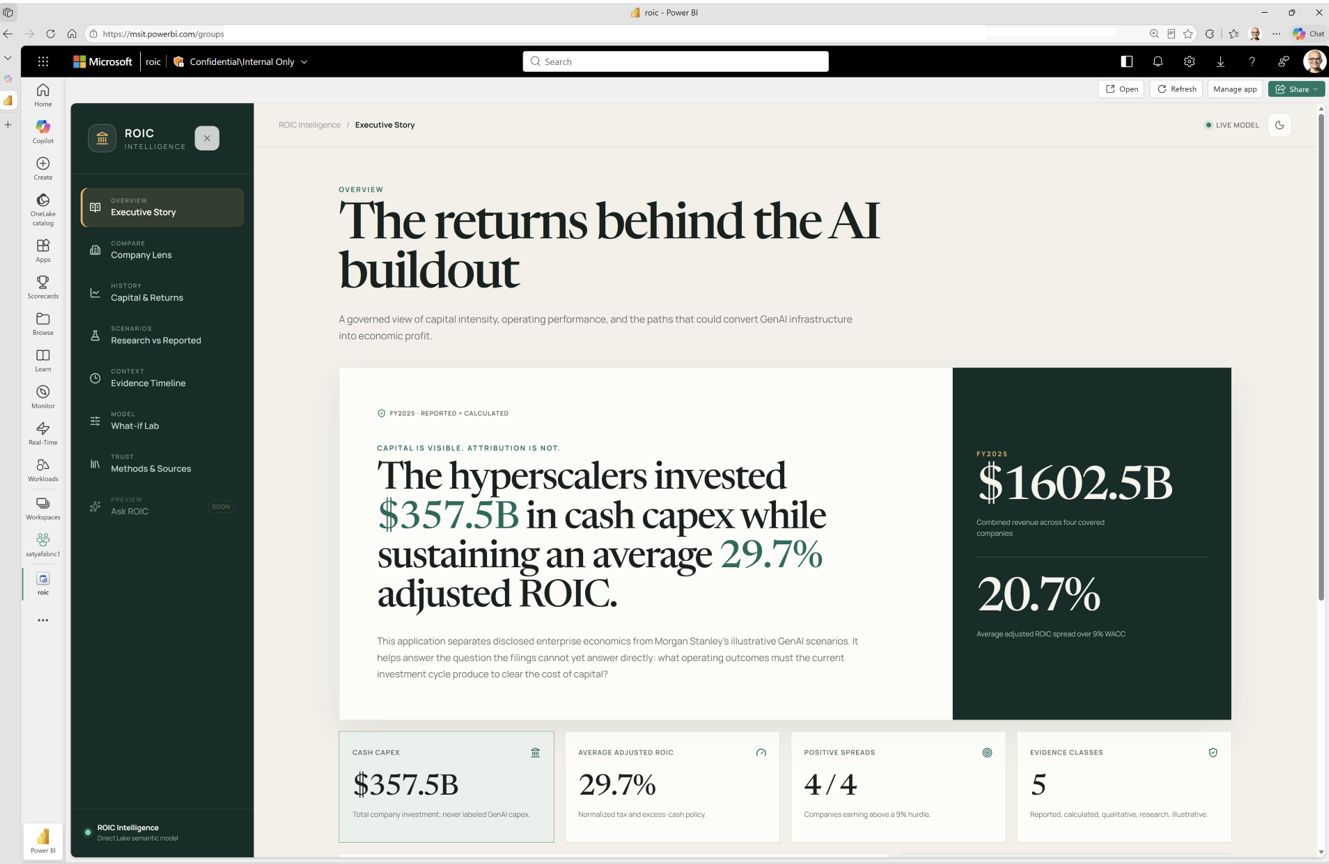
In a recent LinkedIn post, Microsoft CEO Satya Nadella shared details about a new application he built using Microsoft’s Copilot, highlighting its practical business applications and robust enterprise features. Nadella’s demonstration serves as a counterpoint to speculative discussions around AI development, emphasizing a focus on tangible value creation and governance.
Nadella detailed how he leveraged Copilot’s coding capabilities with a single prompt to create a plan for an application focused on Hyperscale Return on Invested Capital (ROIC), using a PDF report from Morgan Stanley analyst Brian Nowak as the source material. He then utilized Copilot’s autopilot feature to build the full application, complete with historical data, scenario planning, and what-if analysis tools.
Building Enterprise-Ready AI Applications
A key aspect of Nadella’s post was the emphasis on the seamless integration of the developed application within an enterprise environment. He pointed out that all the artifacts—the app itself, the code (on GitHub Enterprise), and the data pipelines (in Fabric)—resided within his organization’s controlled ecosystem.
As Satya Nadella notes:
“And the best part is that all the artifacts are in my enterprise environment. My app is in Copilot, my code is in GitHub Enterprise; all my data pipelines/lake/semantic models are in Fabric. And everything is under Agent 365 IT/Sec/FinOps control!”
This integration, according to Nadella, ensures that the development process is not merely about rapid, unmanaged coding but is deeply embedded with enterprise-grade security, IT oversight, and financial operational controls.
Distinguishing Value Creation from ‘Tokenmaxxing’
Nadella explicitly contrasted his approach with what he termed “Tokenmaxxing” or “vibe coding,” suggesting that the focus should be on engineering systems that consistently create long-term business value. He argued that each step in the development process, when properly governed, results in reusable assets that adhere to security and cost management protocols.
According to Satya Nadella:
“So this is not about Tokenmaxxing or vibe coding. Every step of the way the rails are engineered to create value, making everything a long-term reusable asset, with governance/security, and cost controls.”
This perspective positions Copilot and similar AI tools not just as novelties but as integral components of a structured business process designed for sustainable growth and operational efficiency. The emphasis on “rails engineered to create value” underscores a strategic vision for AI adoption that prioritizes control, security, and measurable business outcomes.
The Full System for Business Value
Nadella concluded by framing this integrated approach as the “full system to drive business value.” He clarified that the data used was publicly sourced and the demonstration was for illustrative purposes, not financial advice. The demonstration, including the architecture of the app, was shared to showcase the practical realization of AI’s potential within a governed enterprise framework.
In Satya Nadella’s view, the successful implementation of AI tools hinges on their ability to be:
- Integrated into existing enterprise environments.
- Governed by IT, security, and financial controls.
- Designed for long-term value creation and reusability.
- Secure and cost-controlled.
This approach, as demonstrated by Nadella, aims to move the conversation around AI from speculative potential to concrete, controlled, and valuable business applications.
📝 About This Content
This article is based on insights shared by Satya Nadella on LinkedIn.
📅 Originally posted on July 30, 2026 | View original post on LinkedIn →