
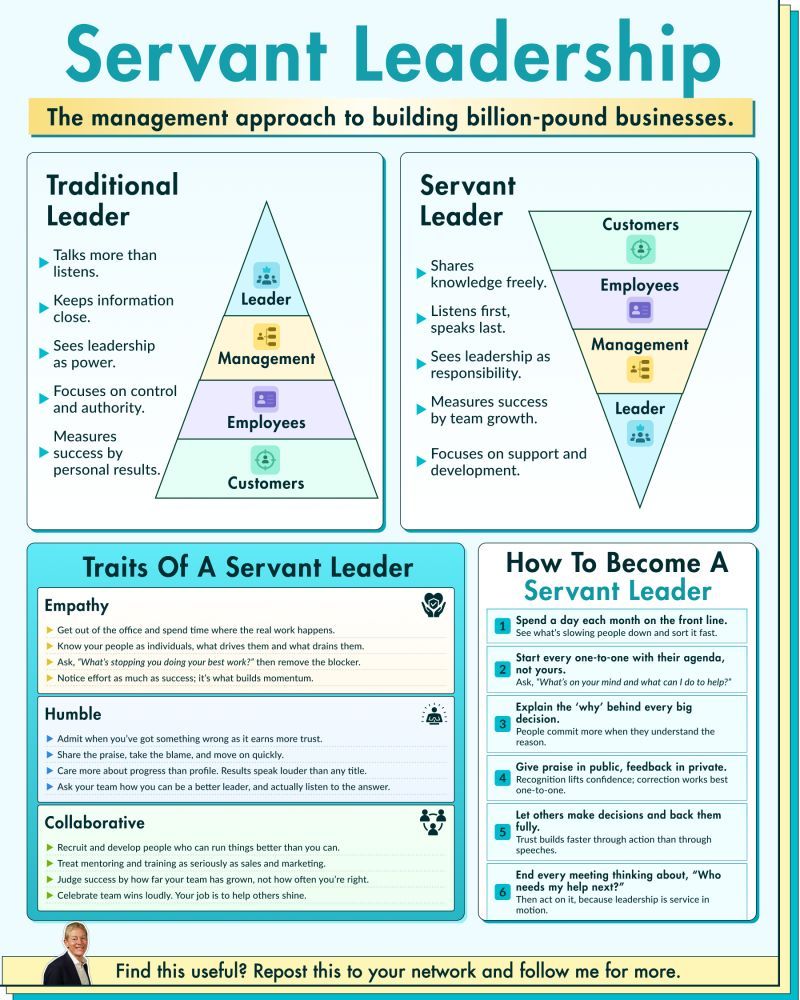
In a recent LinkedIn post, Lise Kuecker explores how the most effective founders prioritize their teams’ growth over personal power to achieve scalable business success. Kuecker emphasizes that true leadership lies not in control, but in fostering an environment where individuals can surpass their perceived limitations.
Kuecker contrasts traditional leadership styles with the principles of servant leadership, highlighting a fundamental shift in focus and responsibility. According to Kuecker, traditional leaders often tend to “talk more than they listen,” hoard information, and view leadership primarily as a form of power. In contrast, servant leaders are characterized by their willingness to listen first, ensure information is accessible, and see leadership as a profound responsibility.
“The best founders don’t scale by clinging to power. They scale by taking care of their team.”
The Core Tenets of Servant Leadership
Kuecker outlines key differences between traditional and servant leadership models. While traditional leaders measure success by personal achievements and focus on controlling others, servant leaders measure success by the growth and development of their team. This shift is crucial for sustainable scaling.
Key Differentiating Factors
- Communication: Traditional leaders talk more than listen; servant leaders are often the last to speak.
- Information Flow: Traditional leaders keep information close; servant leaders make it accessible.
- Leadership Philosophy: Traditional leaders see leadership as power; servant leaders view it as responsibility.
- Team Focus: Traditional leaders focus on controlling others; servant leaders focus on uplifting their team.
- Success Metrics: Traditional leaders measure by their own results; servant leaders measure by team growth.
As Lise Kuecker notes, this approach makes a significant difference when a business aims to scale. The focus shifts from the founder doing everything to serving the people who perform the essential work.
“You don’t need to be the smartest person in the room to be a great leader. You need to be the kind of person who lifts up your team no matter what.”
Essential Traits for Servant Leaders
Kuecker identifies three critical traits that indicate a leader is on the right track toward adopting a servant leadership model: empathy, humility, and a collaborative spirit. Cultivating these traits, Kuecker argues, is as important as focusing on core business functions like sales and marketing.
Cultivating Empathy, Humility, and Collaboration
- Empathy: Leaders must strive to understand the individuals on their team, recognizing what motivates and depletes them.
- Humility: This involves actively soliciting feedback from the team on how to improve as a leader and being receptive to that input.
- Collaborative Spirit: Treating mentoring and opportunities for team member growth with the same seriousness as sales and marketing efforts is essential.
According to Lise Kuecker, watching team members grow beyond their initial perceived capabilities is one of the most rewarding aspects of building and leading teams.
Practical Steps to Becoming a Servant Leader
To help founders and leaders implement these principles, Kuecker provides actionable steps:
- Engage directly on the frontlines periodically to remove obstacles.
- Prioritize the team member’s agenda at the start of one-to-one meetings.
- Clearly articulate the rationale behind significant business decisions.
- Offer public praise for achievements and private feedback for areas of improvement.
- Delegate decision-making authority and demonstrate trust in the team’s judgment.
- Conclude meetings with a focus on identifying and assisting the next team member in need.
“As a founder, it’s your job to see the spark in everyone and help them become the best they can be. That’s what servant leadership is about.”
Ultimately, Lise Kuecker concludes that building businesses that scale is achieved by serving the team, empowering them to do their best work, rather than attempting to manage every aspect personally. This approach fosters confidence and growth, leading to a more resilient and successful organization.
📝 About This Content
This article is based on insights shared by Lise Kuecker on LinkedIn.
📅 Originally posted on January 14, 2026 | View original post on LinkedIn →