
In a recent LinkedIn post, Alicia Teltz tackles a common pitfall for users on the platform: setting delusional goals that lead to burnout and quitting. Teltz, a recognized expert in LinkedIn strategy, argues that failure on the platform often stems not from a lack of content quality, but from unrealistic expectations and improper benchmarking.
Teltz highlights the tendency for users to compare their performance against creators with significantly larger audiences, leading to a cycle of comparison, frustration, and eventual disengagement. “You’re benchmarking yourself against creators with 5–10× your audience and expect the same results,” Teltz states, outlining the detrimental path: “You grind. Compare. Spiral. Burn out. Quit.”
Understanding Your True Benchmark
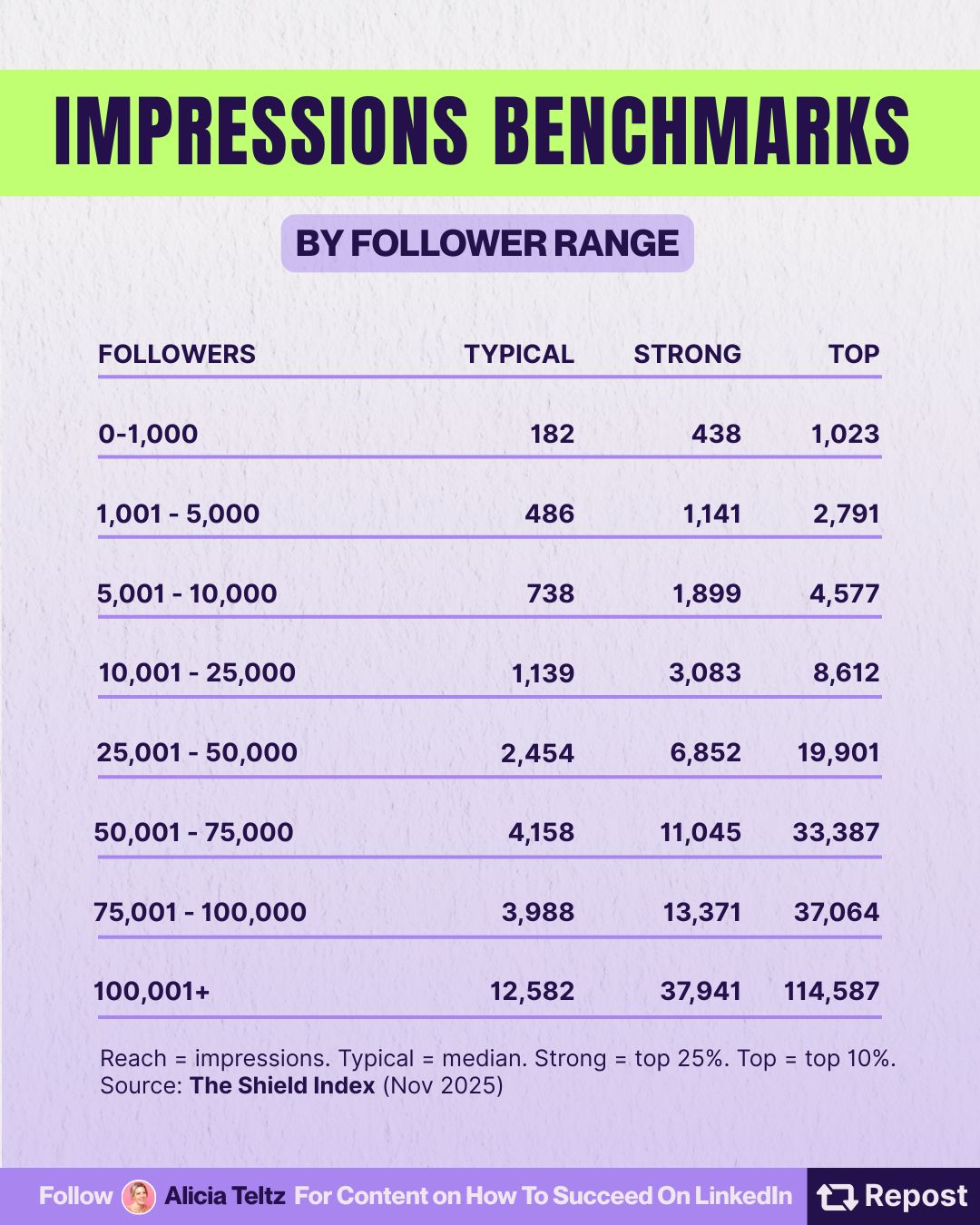
A core tenet of Teltz’s advice is the importance of understanding one’s own performance relative to their current audience size. She suggests categorizing weekly performance into “Typical,” “Strong,” and “Top.” According to Teltz, consistently hitting “Typical” indicates a healthy presence, while occasional “Strong” performance is a sign of doing very well. Expecting “Top” performance consistently, she warns, is a recipe for disappointment.
Teltz advocates for setting range-based goals rather than fixed targets. She contrasts a poor goal, such as “I want 10k impressions per post,” with a more effective approach: “I want 60–70% of my posts hit typical or strong for my follower range, with 1–2 outliers per month.” This method allows for natural fluctuations in performance while maintaining a clear objective.
Metrics That Actually Matter
Beyond vanity metrics like raw impressions, Teltz emphasizes tracking the key performance indicators (KPIs) that directly contribute to business objectives. She identifies several crucial metrics:
- Inbound DMs/Opportunities: Teltz calls this “The only metric that pays rent,” stressing its direct link to revenue and tangible business outcomes.
- Quality of Comments: Assessing whether the right people are engaging and adding value, rather than just superficial interaction.
- Profile Views: Particularly from ideal customers, this metric serves as a strong proxy for relevance and interest.
- Impressions: While still relevant, Teltz cautions against viewing impressions as the sole indicator of success. She notes that distribution does not equal success and that viral content can sometimes be for the wrong reasons. Impressions should be tracked alongside other metrics like DMs and relevant profile views.
Teltz also shares interesting data points regarding follower count and reach. She points out that follower count doesn’t always correlate with reach, citing data showing that accounts with 75k–100k followers can have lower typical reach than those with 50k–75k followers. This underscores her argument that simply growing a large following doesn’t guarantee better average post performance.
Optimizing for Consistency Over Dopamine
The post strongly advises against chasing fleeting viral trends or constantly altering strategies based on short-term results. Teltz champions a long-term approach focused on consistency, clear positioning, quality content, realistic benchmarks, and patience. “Don’t chase viral formats,” she urges, adding, “Don’t panic after one “bad” post.”
To illustrate her points, Teltz shares her own performance data: with 34,000 followers, her average impressions in November were 21,896. She expresses satisfaction with this result, stating, “I’m pleased, and I should be. LinkedIn is my full-time job. If I weren’t outperforming my peer group, I would run a questionable business.” This personal example serves to reinforce her message about setting appropriate benchmarks and understanding what constitutes success for one’s specific situation.
📝 About This Content
This article is based on insights shared by Alicia Teltz on LinkedIn.
📅 Originally posted on December 28, 2025 | View original post on LinkedIn →