
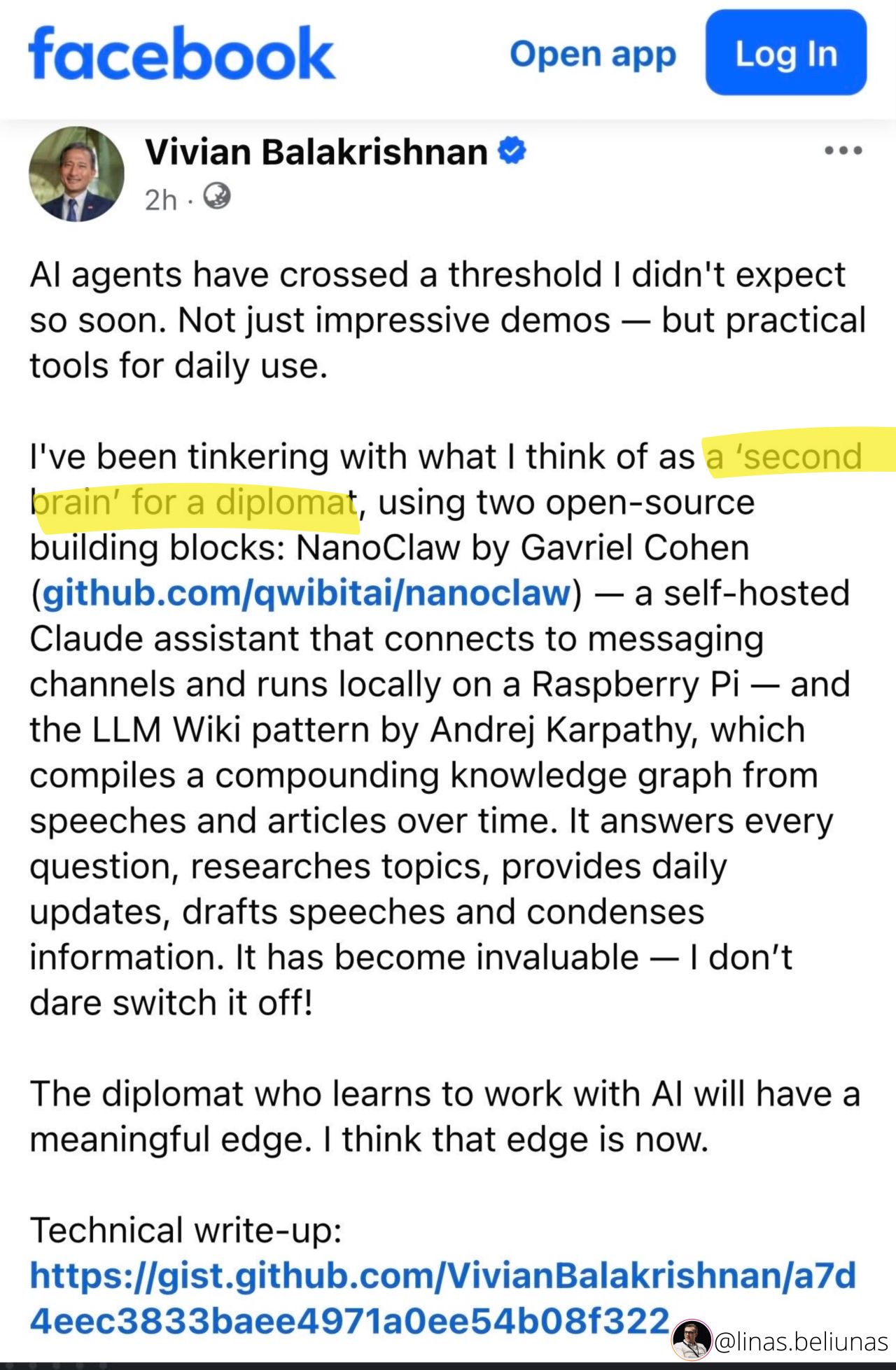
In a recent LinkedIn post, Linas Beliūnas highlights the innovative approach taken by Singapore’s Foreign Minister, Vivian Balakrishnan, in developing a personal AI architecture, suggesting it signals a new frontier for executive productivity.
Beliūnas contrasts the Minister’s sophisticated setup with the more superficial engagement many business leaders have with AI tools. He notes the contrast between Balakrishnan running his AI ‘second brain’ on a Raspberry Pi and the common practice of CEOs merely using tools like ChatGPT for basic tasks.
“Most people still use AI like a vending machine: Ask question. Get answer. Forget everything. Repeat tomorrow.”
According to Beliūnas, Balakrishnan’s setup, named NanoClaw, represents a fundamental shift in how AI can be utilized, moving beyond simple query-response interactions to become a persistent, contextual memory system.
From Vending Machines to Personal Infrastructure
Linas Beliūnas elaborates on this distinction, explaining that Balakrishnan is employing AI not as a disposable tool but as a foundational piece of personal infrastructure. This approach allows for a system that can remember, synthesize information, recall context, and compound knowledge over time.
Beliūnas breaks down the practical technology stack Balakrishnan is using, emphasizing its surprising accessibility:
- Raspberry Pi 5 for local hosting
- NanoClaw for agent orchestration
- Obsidian for human-readable knowledge
- SQLite knowledge graph for structured memory
- Local embeddings through Ollama
- Whisper for on-device voice transcription
- Docker containers for isolation
- Claude Code to assemble the system
A key point Beliūnas emphasizes is that Minister Balakrishnan did not need to become a full-time software engineer to achieve this. Instead, Beliūnas frames the achievement as a form of “tool assembly.”
“He described it as ‘tool assembly.’ And that may be the new executive skill.”
This concept of “tool assembly,” as highlighted by Beliūnas, suggests a new critical skill for executives: understanding not just how to code or outsource, but how to strategically combine existing tools, maintain data privacy, and continuously improve a personal knowledge system.
The Emerging Productivity Gap
Beliūnas posits that this shift from basic AI interaction to building owned personal infrastructure is where the future of AI at work lies. He outlines this evolution:
- From chatbots to second brains
- From prompts to workflows
- From software subscriptions to personal infrastructure
The core argument presented by Beliūnas is that the next significant productivity divide will emerge not between those who use AI and those who don’t, but between individuals leveraging “rented intelligence” versus those who are actively building “owned memory.”
“Because when everyone has access to the same models, the real moat is the context & the data only you control.”
As Linas Beliūnas concludes, in an era where advanced AI models are becoming widely accessible, the true competitive advantage will stem from the unique context and data that individuals and organizations can control and cultivate within their own systems. This personal infrastructure approach, exemplified by Minister Balakrishnan’s setup, represents a powerful strategy for sustained knowledge synthesis and productivity.
📝 About This Content
This article is based on insights shared by Linas Beliūnas on LinkedIn.
📅 Originally posted on April 26, 2026 | View original post on LinkedIn →