
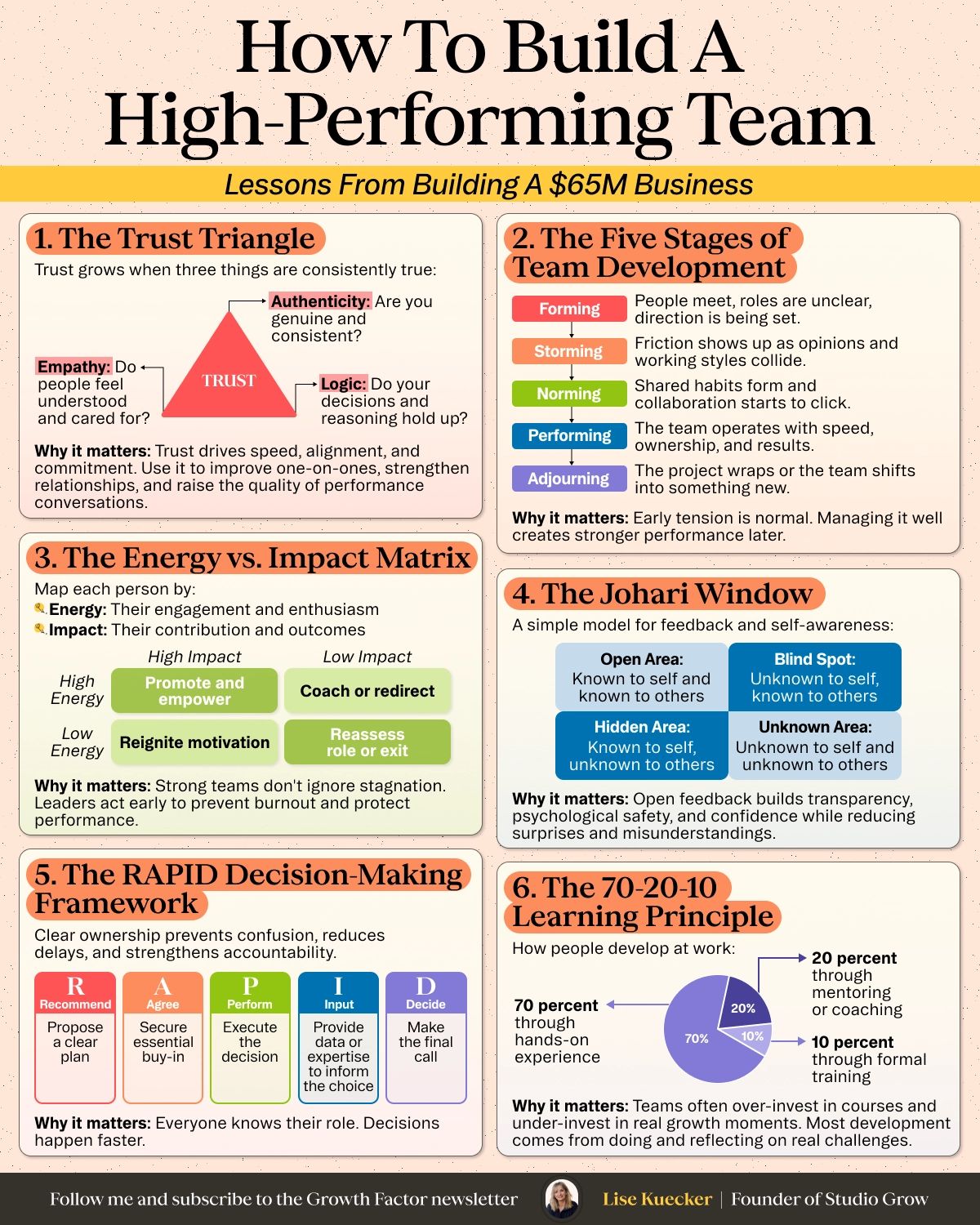
In a recent LinkedIn post, Lise Kuecker shares valuable frameworks for building and scaling high-performing teams, drawing from her experience scaling Studio Grow to $65 million. Kuecker emphasizes that this growth was not a solo effort but a result of building a strong team, which expanded from six to over 80 individuals.
She highlights the critical role of team members in maintaining the company’s unique identity during rapid expansion. Kuecker introduces six frameworks that have guided her in fostering team alignment and productivity.
“We’ve grown from 6 people to 80+, and I’m proud of every single person I work with. They’re the reason we’ve been able to scale without losing what makes Studio Grow special.”
According to Kuecker, establishing foundational frameworks early on is essential for protecting both the team and the business as it grows.
The Trust Triangle: Foundation of Teamwork
Kuecker begins by outlining The Trust Triangle, which she posits is formed by three key factors: Authenticity, Empathy, and Logic. Authenticity involves being genuine and consistent, while Empathy focuses on making team members feel understood and cared for. Logic pertains to the soundness of decisions and reasoning.
As Lise Kuecker notes, trust is a powerful driver:
“Trust drives speed, alignment, and commitment across your team.”
Navigating Team Development and Energy
The post also delves into The Five Stages of Team Development—Forming, Storming, Norming, Performing, and Adjourning. Kuecker suggests that managing early tensions is crucial for achieving stronger performance in later stages.
Furthermore, Kuecker introduces The Energy vs. Impact Matrix as a tool for identifying individual growth paths. This matrix categorizes individuals based on their energy levels and impact, guiding leaders on whether to promote, coach, redirect, or reassess roles. She advises,
“Act early to prevent burnout.”
Enhancing Decision-Making and Learning
To streamline operations, Kuecker presents the RAPID Decision-Making Framework, which involves Recommend, Agree, Perform, Input, and Decide. This structured approach, she argues, prevents confusion and enhances accountability by clarifying ownership.
Another framework shared is The Johari Window, which aims to improve transparency and reduce surprises within a team by clarifying what is known or unknown by individuals versus the group. Kuecker emphasizes that “Open feedback builds transparency and reduces surprises.”
Finally, Kuecker touches upon The 70-20-10 Learning Principle, suggesting that 70% of learning stems from hands-on experience, 20% from mentoring, and 10% from formal training. She observes that leaders often overemphasize formal training at the expense of practical growth opportunities.
Kuecker concludes by encouraging leaders to adopt these frameworks, stating that they don’t require a large team to implement and can significantly benefit businesses of all sizes.
📝 About This Content
This article is based on insights shared by Lise Kuecker on LinkedIn.
📅 Originally posted on March 29, 2026 | View original post on LinkedIn →