
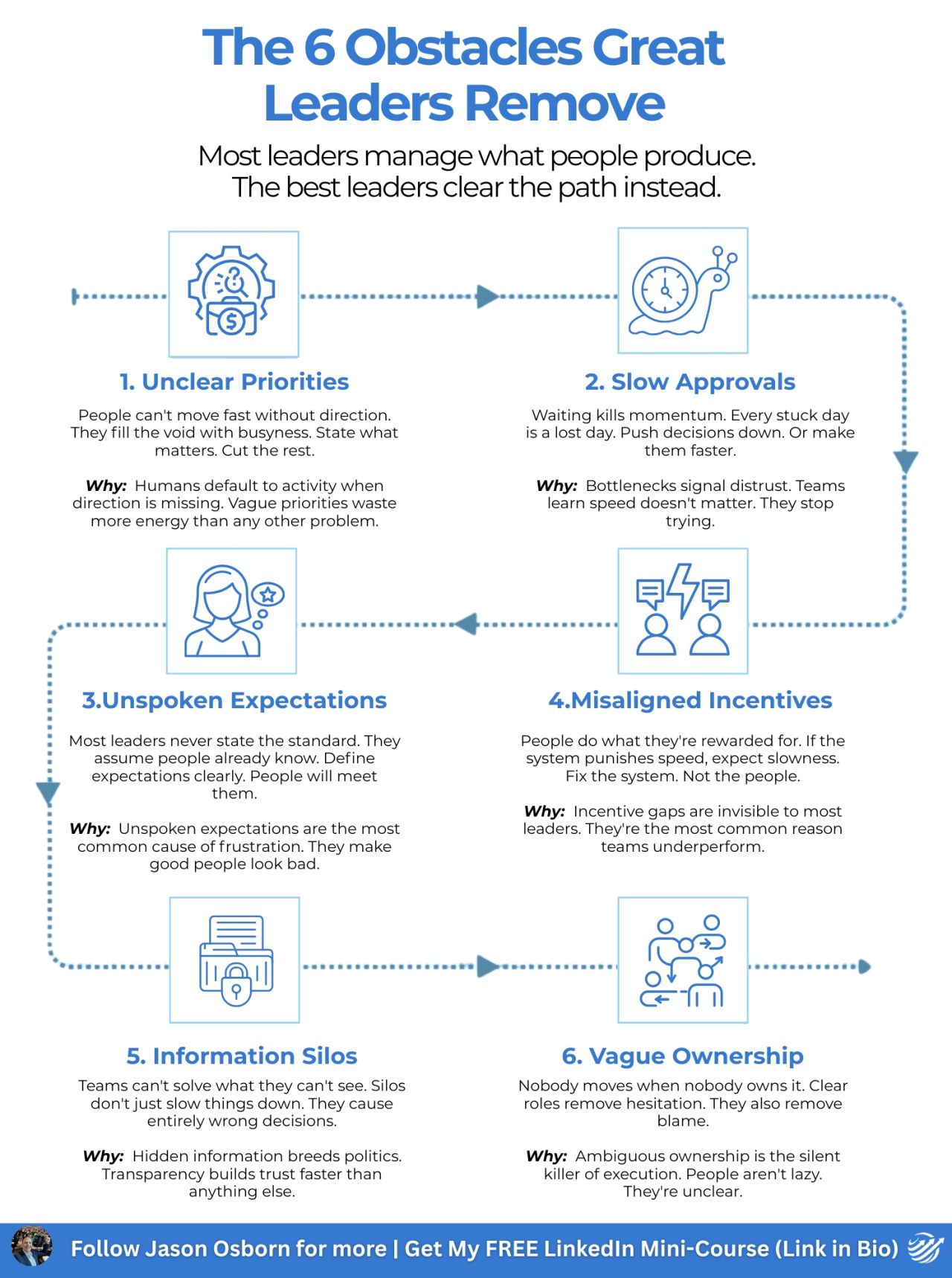
In a recent LinkedIn post, Jason Osborn explores common roadblocks that impede team efficiency and argues for a shift in leadership focus from managing output to actively removing obstacles. Osborn contends that the most effective leaders don’t simply push their teams harder; instead, they concentrate on clearing the path to allow for smoother progress.
Osborn highlights six specific obstacles that he believes are frequently overlooked or mishandled by leaders. He begins by contrasting the approach of typical managers with that of exceptional leaders.
“Most Leaders Manage What People Produce. The Best Leaders Clear the Path. Most leaders focus on getting more out of their team. The best leaders focus on removing what’s slowing them down.”
Unclear Priorities and Slow Approvals
One of the primary issues Osborn identifies is unclear priorities. He explains that without clear direction, employees often resort to ‘busyness’ to fill the void, wasting energy on tasks that may not be critical. “Vague priorities waste more energy than any other problem,” Osborn states, advocating for leaders to clearly define what matters and eliminate the rest.
Another significant impediment discussed is slow approvals. Osborn asserts that delays in decision-making can cripple momentum and represent lost opportunities. He suggests pushing decisions down to lower levels or streamlining the approval process. Bottlenecks, in his view, can be a sign of distrust and can condition teams to believe that speed is not valued, leading them to stop striving for it.
“Waiting kills momentum. Every stuck day is a lost day.”
Unspoken Expectations and Misaligned Incentives
Osborn also points to unspoken expectations as a common source of frustration. He argues that many leaders fail to articulate clear standards, assuming their teams inherently understand them. “Define expectations clearly. People will meet them,” he advises, emphasizing that this ambiguity can cause even good employees to underperform and appear ineffective.
Furthermore, the concept of misaligned incentives is presented as a critical factor. Osborn posits that employees naturally gravitate towards actions that are rewarded. If the existing system implicitly discourages speed, then slowness is an expected outcome. “Fix the system. Not the people,” he urges, noting that these incentive gaps are often invisible to leaders but are a frequent cause of underperformance.
“People do what they’re rewarded for. If the system punishes speed, expect slowness.”
Information Silos and Vague Ownership
The post further addresses the detrimental effects of information silos. Osborn explains that when teams lack visibility into crucial data or context, they cannot effectively solve problems, potentially leading to incorrect decisions. He suggests that silos not only slow down processes but also foster politics, whereas transparency builds trust.
Finally, vague ownership is identified as a silent killer of execution. Osborn contends that when roles and responsibilities are not clearly defined, hesitation sets in, and tasks may never be addressed. “Ambiguous ownership is the silent killer of execution,” he writes, concluding that people are often unclear rather than lazy. By clarifying roles, leaders can remove hesitation and blame.
Osborn concludes his analysis by reiterating that addressing these six obstacles allows teams to move faster without necessarily working harder. The key, in his perspective, is not to increase effort but to eliminate friction and clear the path for efficient execution. He invites readers to consider which of these obstacles might be currently affecting their own teams.
📝 About This Content
This article is based on insights shared by Jason Osborn on LinkedIn.
📅 Originally posted on February 7, 2026 | View original post on LinkedIn →