
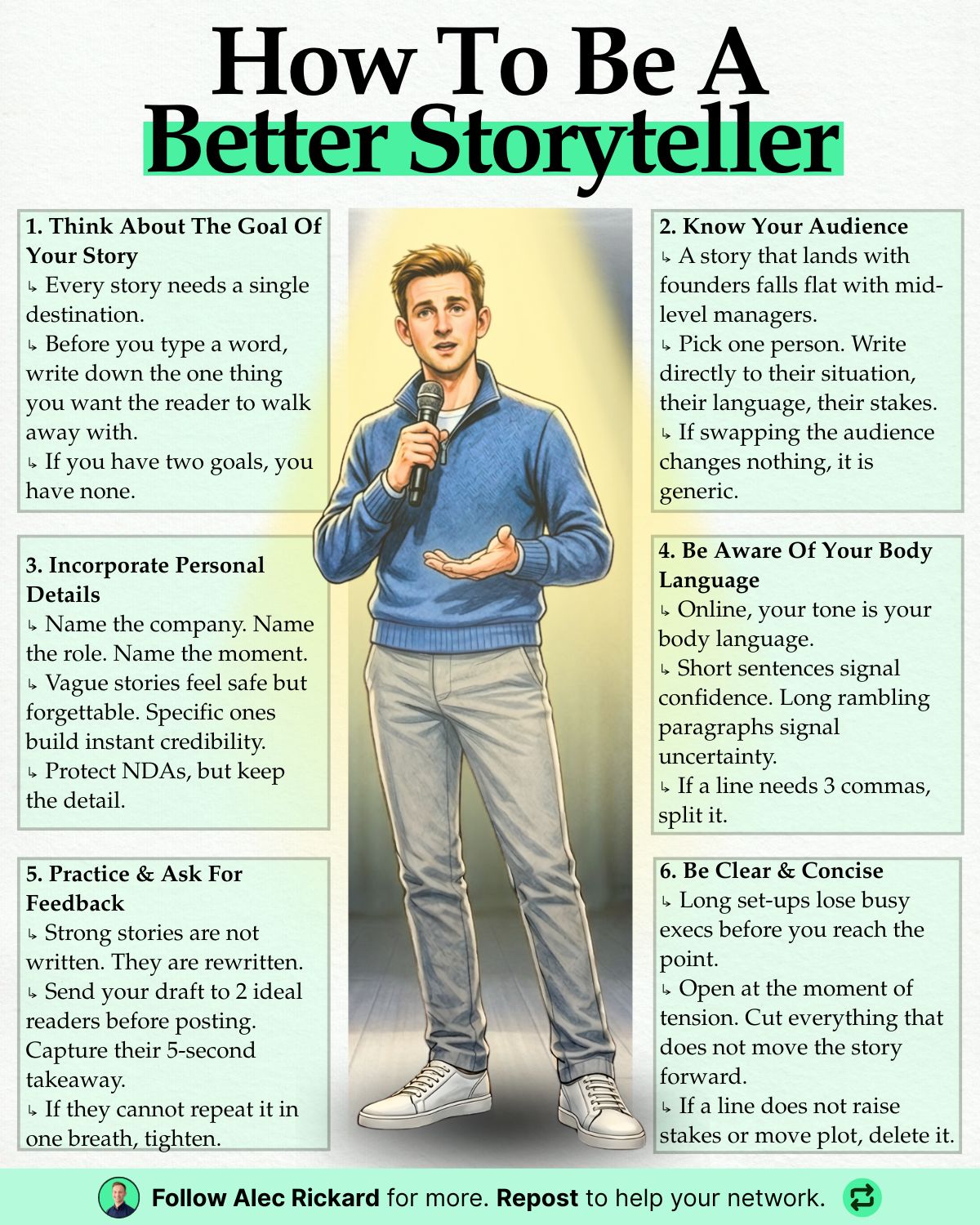
In a recent LinkedIn post, Alec Rickard discusses the critical importance of storytelling for business leaders and offers a framework for making those narratives resonate in a crowded digital space. Rickard emphasizes that a clear and compelling story is essential for a brand to stand out, particularly among an audience of executives where clarity and demonstrable proof capture attention.
Rickard opens by highlighting a common challenge: fuzzy stories lead to hidden brands. He uses the example of a Series B founder who successfully shared a vendor breakup that resulted in significant cost savings, illustrating how specific, impactful narratives can build credibility and capture interest.
“If your story is fuzzy, your brand stays hidden.”
The Foundation of Effective Business Storytelling
According to Rickard, the effectiveness of any story hinges on a clear understanding of its purpose and audience. He outlines a foundational rule emphasizing the need for a singular objective for each narrative.
Defining the Story’s Objective
Rickard argues that before any writing begins, the storyteller must identify the single, most crucial takeaway for the reader. He states:
“Every story needs a single destination. Before you type a word, write down the one thing you want the reader to walk away with. If you have two goals, you have none.”
This principle underscores the need for focus, suggesting that diluted objectives lead to ineffective communication.
Audience-Centric Narrative Construction
Further elaborating on the construction of impactful stories, Rickard stresses the importance of knowing the intended audience. He points out that a narrative tailored for one group may entirely miss the mark with another. Rickard advises picking a specific individual within the target audience and writing directly to their context, using their language and addressing their specific stakes. He notes that if the story remains unchanged when the audience is hypothetically swapped, it likely lacks the necessary specificity to be truly effective.
Crafting Stories That Stick
Beyond the foundational elements, Rickard provides practical advice on how to imbue stories with the detail and tone that make them memorable and credible.
The Power of Specificity and Personal Details
Rickard advocates for incorporating specific, personal details to build instant credibility. He encourages naming companies, roles, and pivotal moments, contrasting this with the perceived safety but ultimate forgettability of vague accounts. As Rickard puts it:
“Vague stories feel safe but forgettable. Specific ones build instant credibility. Protect NDAs, but keep the detail.”
Tone as Digital Body Language
In the online realm, Rickard highlights that tone functions as a form of body language. He suggests that short, confident sentences convey assurance, while long, rambling paragraphs can signal uncertainty. He offers a direct piece of advice: if a sentence requires three commas, it’s likely too long and should be broken down for better clarity and impact.
The Iterative Process of Storytelling
Rickard emphasizes that strong stories are not created in a single draft but are the result of revision and feedback. He recommends sharing a draft with two ideal readers to gauge their immediate takeaway. If they struggle to articulate the core message concisely, Rickard advises further tightening the narrative.
Conciseness and Clarity: The Final Polish
The final set of rules from Rickard focuses on achieving maximum impact through brevity and directness. He warns that lengthy introductions can cause busy executives to lose interest before the main point is even reached.
Opening at the Moment of Tension
Rickard’s advice is to open narratives at the most engaging point—the moment of tension—and to ruthlessly cut anything that doesn’t advance the story. According to Rickard, any line that doesn’t raise the stakes or move the plot forward should be removed.
In conclusion, Alec Rickard’s insights on LinkedIn provide a practical guide for business leaders aiming to enhance their brand presence through more effective storytelling. By focusing on clear goals, audience understanding, specific details, appropriate tone, iterative refinement, and concise delivery, leaders can ensure their stories not only get told but are also remembered.
📝 About This Content
This article is based on insights shared by Alec Rickard on LinkedIn.
📅 Originally posted on March 13, 2026 | View original post on LinkedIn →