
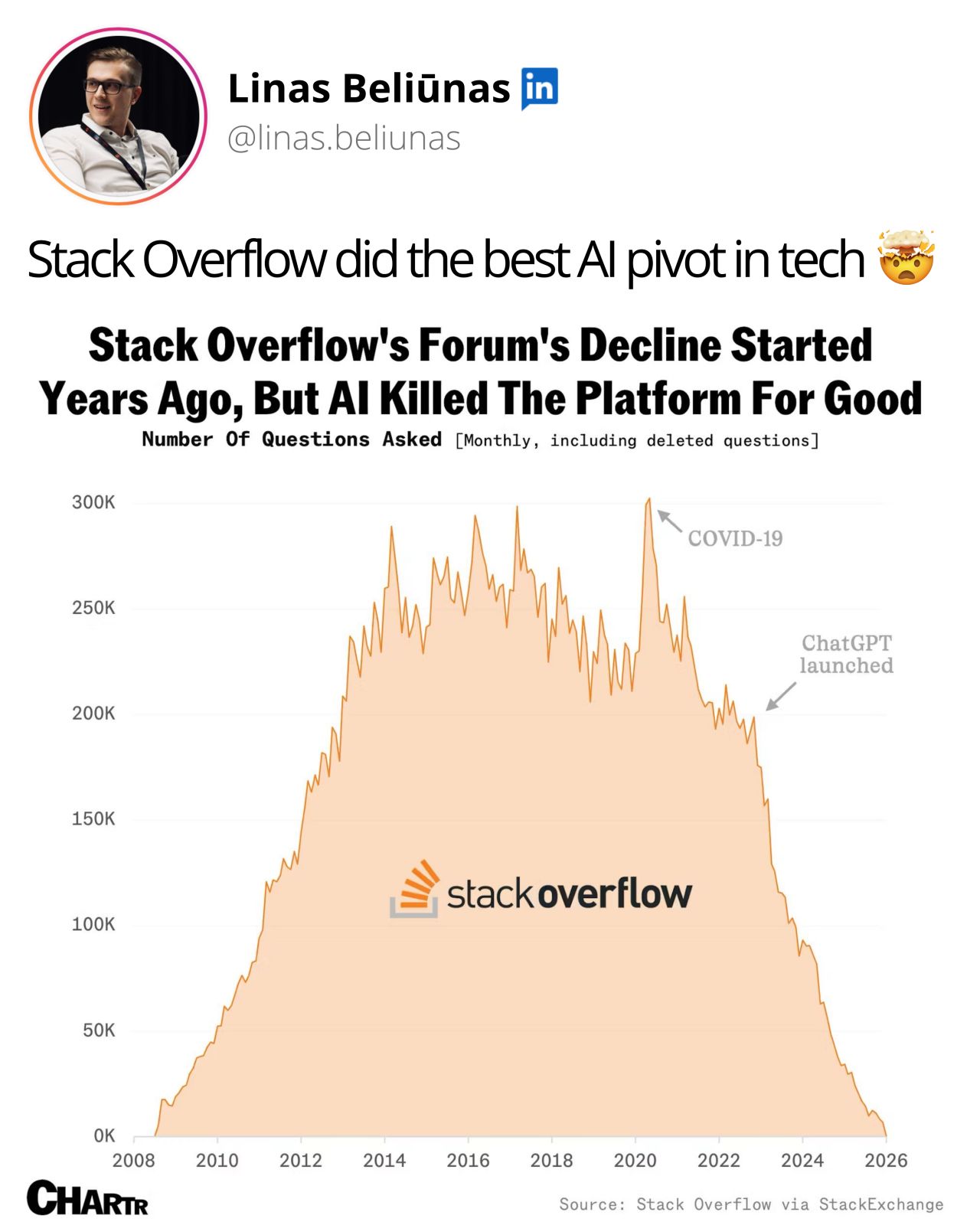
In a recent LinkedIn post, Linas Beliūnas discusses the surprising trajectory of Stack Overflow following the advent of AI tools like ChatGPT, highlighting the company’s strategic pivot from a public Q&A forum to an enterprise AI solution. Beliūnas points out the dramatic shift in user engagement on the platform.
As Linas Beliūnas notes:
“Stack Overflow went from 300,000 questions/month to almost 0 after ChatGPT launched, and yet its revenue is now up 2x to a whopping $115 million 😳”
Beliūnas explains that instead of viewing AI as a threat, Stack Overflow embraced it as an opportunity. The company leveraged its extensive, human-crafted dataset—comprising over 15 years of Q&A, millions of bugs, edge cases, and developer experiences—to forge new revenue streams. This vast repository of coding knowledge, Beliūnas argues, is the core asset that AI companies sought.
Monetizing a Decade of Developer Knowledge
Linas Beliūnas highlights Stack Overflow’s strategic decision to license its data to AI companies. This move capitalized on the immense value of its historical content, which represents a unique and high-quality dataset for training artificial intelligence models. The platform’s extensive archive, built over years by volunteer developers, became a valuable commodity in the burgeoning AI market.
“15+ years of human-crafted answers. 58M+ Q&A pairs. Millions of real bugs. Edge cases. War stories. The internet’s highest-quality coding dataset, so Stack Overflow licensed it.”
According to Beliūnas, this licensing strategy allowed Stack Overflow to generate revenue from its data without relying solely on its traditional public forum model, which was being disrupted by AI assistants. This approach effectively turned a potential existential threat into a significant financial opportunity.
Shifting Focus to Enterprise Solutions
Further detailing Stack Overflow’s transformation, Linas Beliūnas emphasizes the company’s move towards enterprise solutions with its “Stack Internal” product. This private GenAI tool is designed to be integrated directly into corporate workflows, offering a secure and private knowledge base for developers within organizations.
The Rise of Internal AI Brains
Beliūnas explains that by focusing on internal enterprise tools, Stack Overflow moved away from chasing public traffic. “Stack Internal” is presented not as a community forum, but as an internal AI brain for developers, trained on Stack Overflow’s proprietary knowledge. This private, secure solution addresses the growing need for AI tools that respect data privacy and integrate seamlessly into existing business operations.
“Launched “Stack Internal”, a private GenAI tool trained on Stack Overflow’s knowledge, plugged directly into enterprise workflows. Private. Secure. Inside companies.”
The adoption of “Stack Internal” by over 25,000 organizations, as cited by Beliūnas, underscores the market demand for such solutions. This pivot signifies a fundamental shift in how valuable knowledge platforms can operate and monetize their assets in the age of AI.
The Collapsing Open Knowledge Era
Linas Beliūnas posits that the success of Stack Overflow’s strategy reflects a broader trend: the potential collapse of the open knowledge era. He argues that while knowledge itself hasn’t vanished, its accessibility and monetization models are rapidly changing, with AI playing a central role in this privatization.
“The internet’s open knowledge era is collapsing. Not because knowledge vanished. But because it got privatized. Volunteers built it for free. AI monetizes it at scale.”
This dynamic, according to Beliūnas, presents a critical lesson for all platforms, founders, and creators. He concludes that owning high-quality data is now the ultimate competitive advantage, acting as a powerful moat in the current technological landscape. Those who possess such data have leverage, while those who do not risk becoming providers of raw material for others who do.
📝 About This Content
This article is based on insights shared by Linas Beliūnas on LinkedIn.
📅 Originally posted on March 27, 2026 | View original post on LinkedIn →