
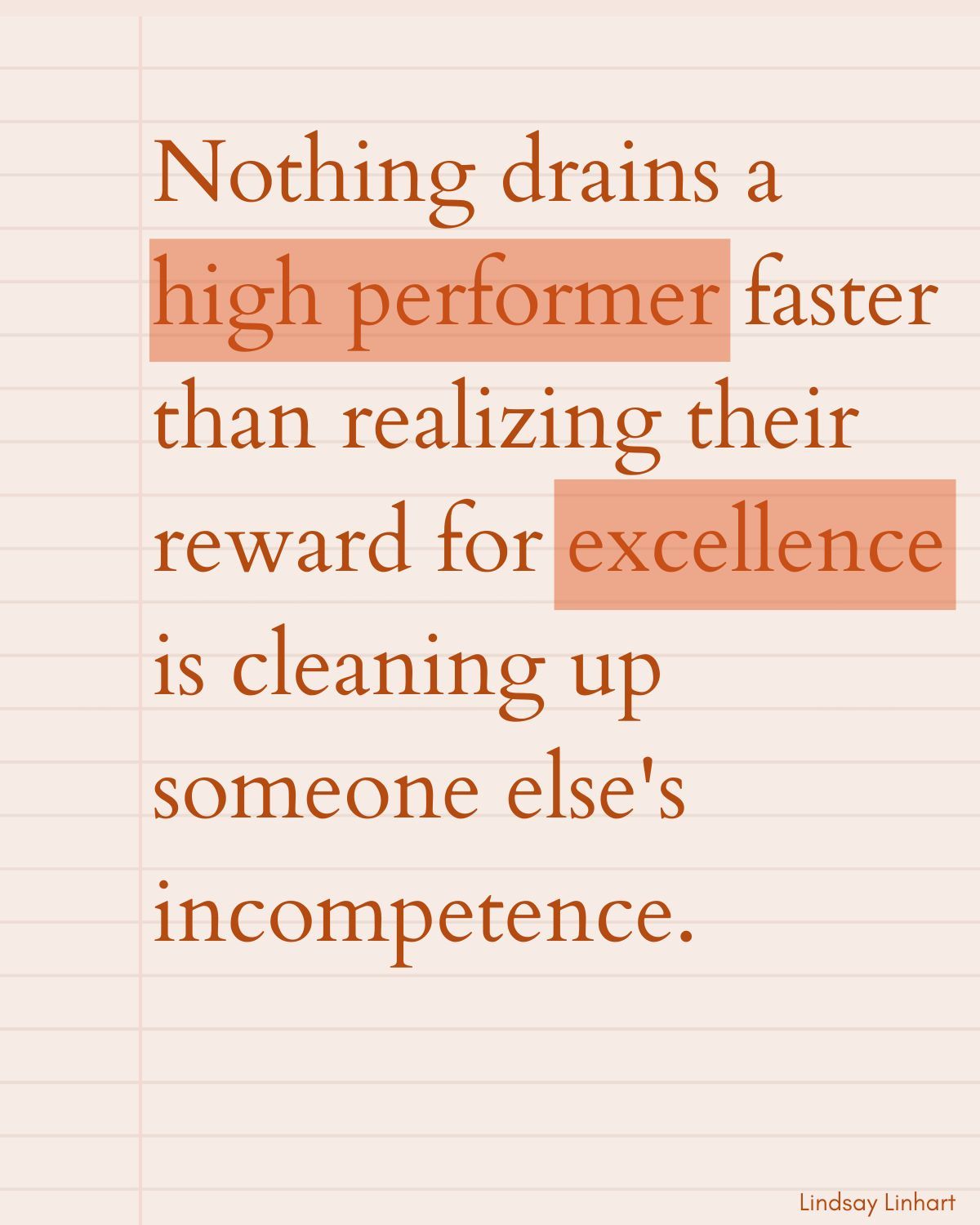
In a recent LinkedIn post, Lindsay Linhart discusses a common professional trap: being consistently tapped to fix others’ mistakes, often at the expense of one’s own core responsibilities and well-being. Linhart frames this not as an act of helpfulness, but as a dangerous precedent that can lead to burnout and enable lower standards within an organization.
Linhart begins by posing a relatable scenario for many high achievers:
“You weren’t hired to be the cleanup crew. So why does it feel like you are?”
The post details how this situation often escalates from innocent requests. As Linhart observes, it starts when someone delivers their work, is noticed for their competence, and then begins receiving side requests like, “Can you just take a look at this?” or “You’re so good at fixing things.” Linhart translates these seemingly innocuous comments into a stark reality: “Someone else dropped the ball and now it’s yours.”
The Predictable Cycle of Burnout
Linhart outlines a predictable cycle that high performers often fall into. It begins with excelling at one’s job, which then leads to being assigned the “broken pieces” left by others. Because they are highly capable and perhaps unable to resist, these individuals fix the issues, which in turn causes their own critical work to be delayed or neglected. The irony, Linhart points out, is that this reliability is often praised, creating a feedback loop that perpetuates the problem.
According to Linhart, this pattern is detrimental not only to the individual but also to the organization’s overall standards and accountability.
“Your excellence isn’t an invitation to inherit mediocrity. It’s a reminder to protect it.”
Linhart stresses that being capable does not equate to being perpetually available to fill others’ gaps, nor does reliability mean being the default problem-solver for every mishap.
Teaching Dangerous Lessons About Accountability
A core argument presented by Linhart is that by consistently stepping in to rescue projects or tasks that others have faltered on, individuals inadvertently teach the organization problematic lessons. Linhart argues that this behavior signals:
- That accountability is not strictly enforced if there’s someone willing to step in and fix the errors.
- That high performers are expected to compensate for lower standards or a lack of diligence from others.
This dynamic, as Linhart explains, can foster a culture where mediocrity is tolerated because it is implicitly understood that high performers will handle the fallout.
Protecting Excellence and Holding the Standard
The solution proposed by Linhart is not to lower one’s performance, but to actively protect one’s own excellence and energy. This involves setting boundaries and allowing others to face the natural consequences of their actions or inactions. Linhart advocates for a shift in perspective:
“The best way to help the organization isn’t to carry everyone’s weight. It’s to hold the standard high enough that they have to rise to meet it.”
By refusing to be the perpetual cleanup crew, high performers can, in Linhart’s view, ultimately contribute more effectively to the organization’s success by modeling and maintaining high standards, rather than enabling lower ones. This approach, Linhart suggests, protects individual energy and fosters a more accountable work environment.
📝 About This Content
This article is based on insights shared by Lindsay Linhart on LinkedIn.
📅 Originally posted on January 29, 2026 | View original post on LinkedIn →