
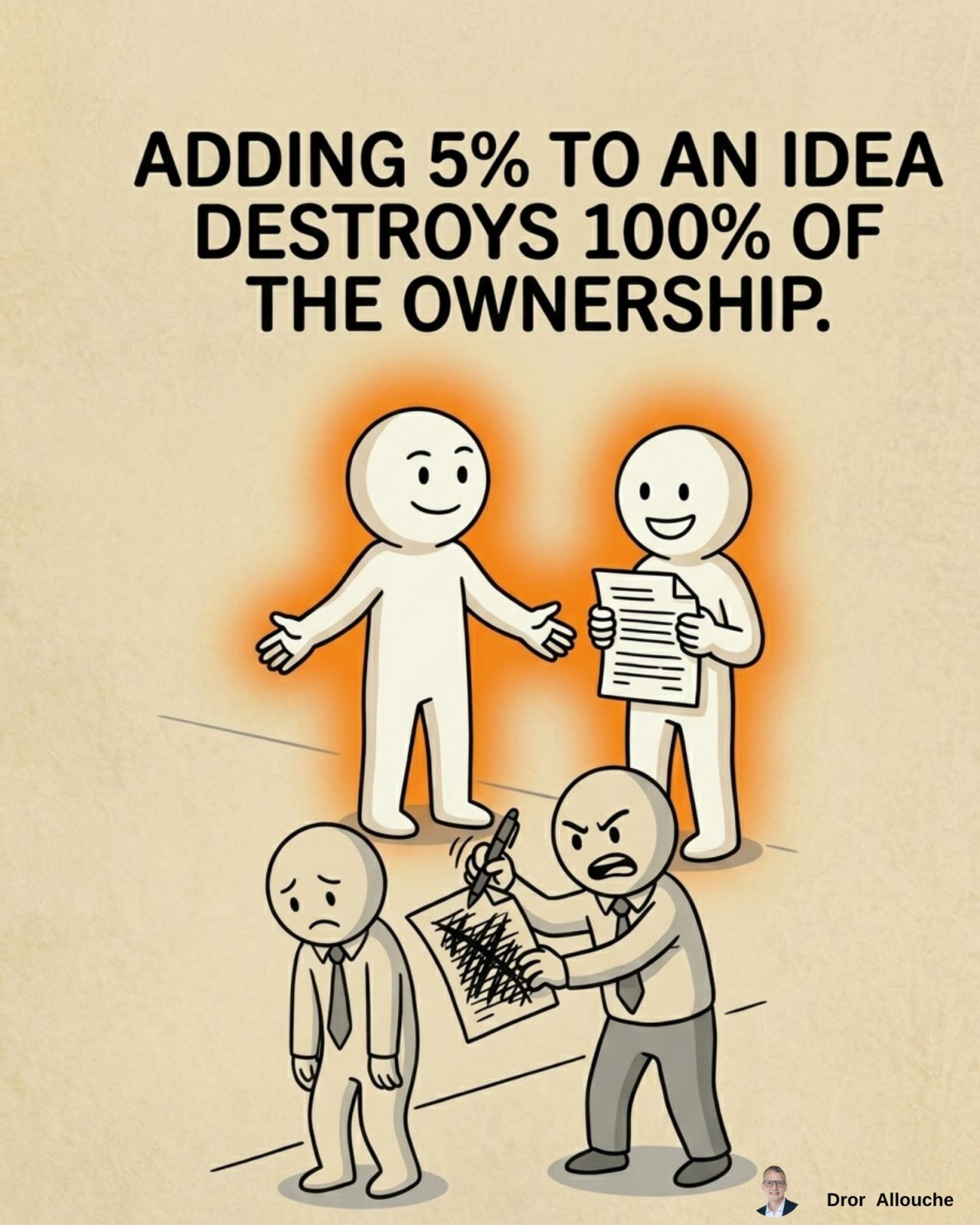
In a recent LinkedIn post, Drorallouche explores the unintended consequences of well-intentioned interventions in team projects, arguing that excessive ‘help’ can actually undermine an individual’s sense of ownership and commitment. Drorallouche frames this common workplace dynamic as a detrimental habit that, while often stemming from a desire to contribute, ultimately hinders the growth and development of team members.
The core of Drorallouche’s argument centers on the idea that true ownership is built through commitment and execution. When leaders or colleagues step in to make alterations, even with good intentions, they inadvertently diminish the creator’s stake in the outcome. As Drorallouche states:
“We possess an urge to contribute. A colleague presents a project. We love the ideas. But we can’t resist adding a little something extra. Not for their success, but to satisfy our ego. We think we are adding value. In reality, we are destroying their ownership.”
Drorallouche emphasizes that this is not a call to stop sharing ideas altogether, but rather to adopt a more strategic approach to how feedback and contributions are offered. The post outlines three key steps to help leaders foster ownership rather than erode it.
The Execution Equation: Protecting Commitment
Drorallouche introduces the concept of the “Execution Equation,” which posits that results are directly tied to commitment. Any alteration to a strategy, no matter how small, can reduce the creator’s dedication to their original vision. According to Drorallouche, the correct action for leaders is to approve plans that meet the required standard and to withhold personal additions, allowing the creator to execute their vision independently.
This principle is further distilled into a coaching question for leaders: “Where do you sacrifice team commitment to satisfy your urge to contribute?” This prompts reflection on how leaders’ actions might be inadvertently stifling their team’s full engagement.
The Intervention Threshold: Measuring Impact
To provide a more concrete guideline for intervention, Drorallouche proposes the “Intervention Threshold.” This concept suggests that interventions should only occur when the potential impact of one’s contribution significantly alters the outcome. Drorallouche sets a specific benchmark:
“Establish a 30% rule. Intervene only when your contribution alters the outcome by 30% or more.”
This threshold aims to differentiate between minor tweaks and substantial changes that genuinely require external input. Drorallouche also poses a critical question for self-assessment: “How do you measure the impact of your interventions?”
The Boardroom Application: Governance Over Execution
Finally, Drorallouche addresses the distinct roles of directors and operators, particularly in a boardroom setting. The post clarifies that directors should focus on governance and strategic oversight, while operators are responsible for execution.
“Directors advise. Operators execute.”
The recommended action for leaders in this context is to address perceived gaps through probing questions rather than direct directives. For instance, instead of dictating a solution, a leader might say, “I see a gap in the timeline. Walk me through your plan to close it.” This approach empowers the team member to identify and solve the problem themselves, thereby reinforcing their ownership. Drorallouche concludes by asking leaders to consider, “What mechanisms keep your focus on governance over execution?”
By following these principles, Drorallouche suggests that leaders can effectively build capacity within their teams and protect the valuable ownership that drives innovation and commitment.
📝 About This Content
This article is based on insights shared by Drorallouche on LinkedIn.
📅 Originally posted on May 27, 2026 | View original post on LinkedIn →