
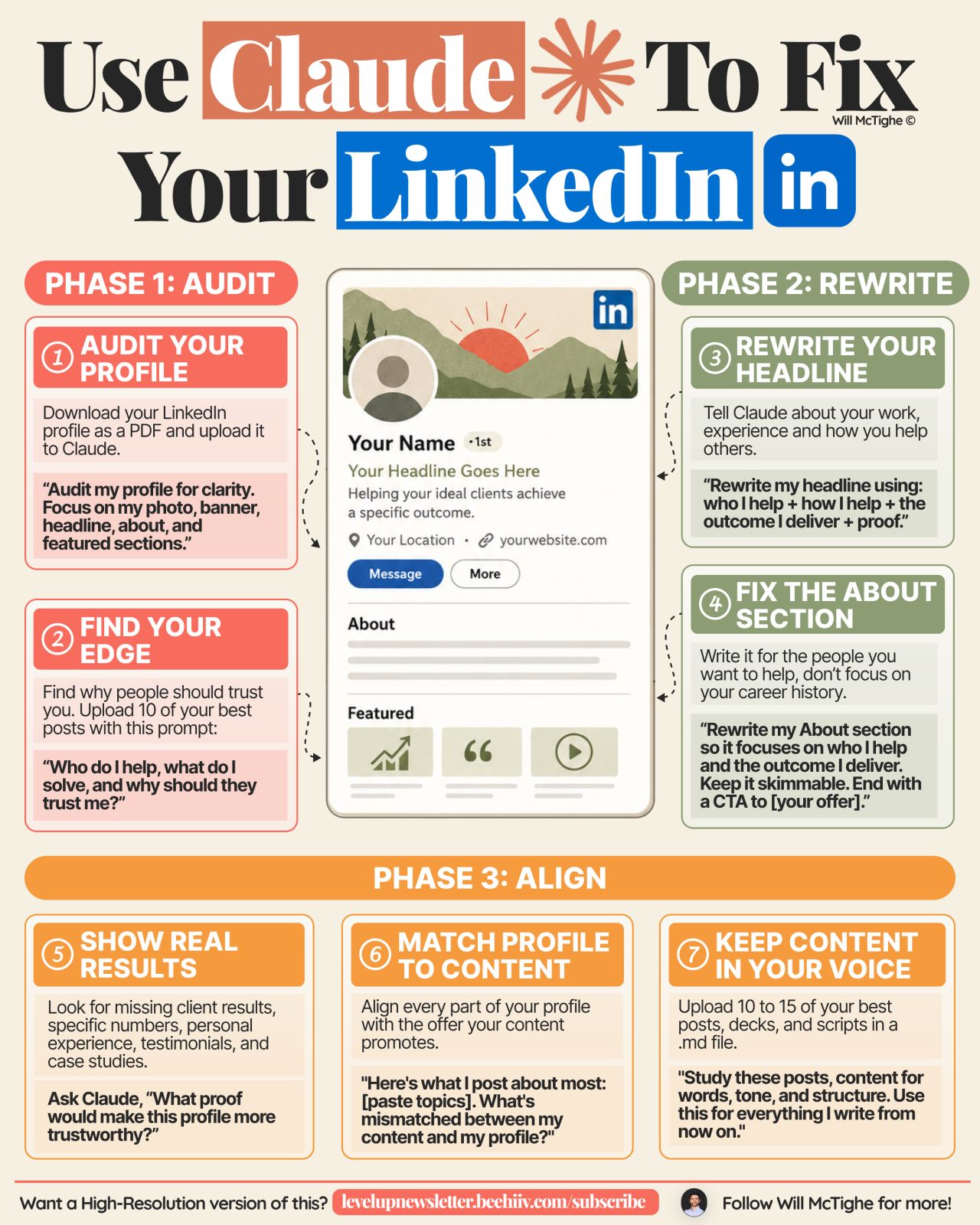
In a recent LinkedIn post, Will McTighe offers a practical guide to optimizing one’s LinkedIn profile for greater impact, emphasizing efficiency and strategic alignment. McTighe argues that many professionals dedicate excessive time to superficial profile elements while neglecting a more fundamental issue: the consistency of the message across their entire profile and content.
McTighe highlights the common problem of a disjointed online presence. “Your headline says one thing. Your About section says another. And your last 10 posts point somewhere else entirely,” he observes. This inconsistency, according to McTighe, can create doubt in the minds of potential connections or clients.
The Core Problem: Profile-Content Misalignment
McTighe’s central thesis is that a strong LinkedIn profile should not exist in isolation but should echo the narrative presented in a user’s content. He identifies this misalignment as the root cause of a less effective profile, leading to missed opportunities.
“A good LinkedIn profile should make the same argument as your content.”
To address this, McTighe proposes a structured approach, leveraging AI tools like Claude, to audit, refine, and align profile elements with ongoing content creation. This method, he suggests, can be completed in under 60 minutes.
A Phased Approach to Profile Optimization
McTighe breaks down the optimization process into three key phases: Audit, Rewrite, and Align.
Phase 1: Audit Your Presence
The initial step involves a comprehensive audit. McTighe recommends downloading your profile as a PDF and using an AI tool to review all major sections—photo, banner, headline, About section, and Featured section—for clarity. Crucially, he advises prompting the AI with “audit for clarity” rather than a generic “audit for improvement” to yield more specific insights.
Following the profile audit, McTighe suggests identifying your unique value proposition by analyzing your recent content. “Give Claude 10 of your strongest posts. Ask it to find the common thread: who you help, what problems you talk about, and what gives people a reason to trust you,” he advises. This analysis provides a clear direction before any rewriting begins.
Phase 2: Strategic Rewriting
With a clearer understanding of your core message, McTighe moves to the rewriting phase. He emphasizes that the headline, due to its limited space, must be highly effective. The recommendation is to instruct the AI to craft a headline that clearly articulates who you help, how you help them, the outcomes delivered, and the proof points supporting these claims.
Similarly, the About section should be rewritten to make it easy for the right audience to understand your value. McTighe notes that this process can significantly shorten the existing text, stating, “Mine got cut in half the first time I tried this.” The goal is to focus on the ‘who’ and the ‘outcome,’ concluding with a clear call to action.
Phase 3: Aligning Profile with Content
The final phase, Align, is critical for reinforcing credibility. McTighe stresses the importance of backing up profile claims with tangible evidence. “Look for real numbers, real client results, and real feedback you haven’t used yet,” he urges. Maintaining a running list of these proof points is recommended to avoid last-minute scrambling.
The most frequently overlooked step, according to McTighe, is ensuring that the profile directly matches the topics discussed in your content. He warns that inconsistencies can undermine trust. “If they’re arguing two different points, you lose the trust you just built with your last post,” he states.
Finally, McTighe advises on maintaining authenticity by training the AI on your existing content to ensure new profile text aligns with your personal voice and style. This reference, he suggests, should be updated regularly.
McTighe concludes by reinforcing the synergy between content and profile: “A good post makes someone curious. A strong profile gives them a reason to follow, trust and buy.” He reiterates that achieving this impactful profile can be done efficiently, in under an hour.
📝 About This Content
This article is based on insights shared by Will McTighe on LinkedIn.
📅 Originally posted on September 14, 2026 | View original post on LinkedIn →