
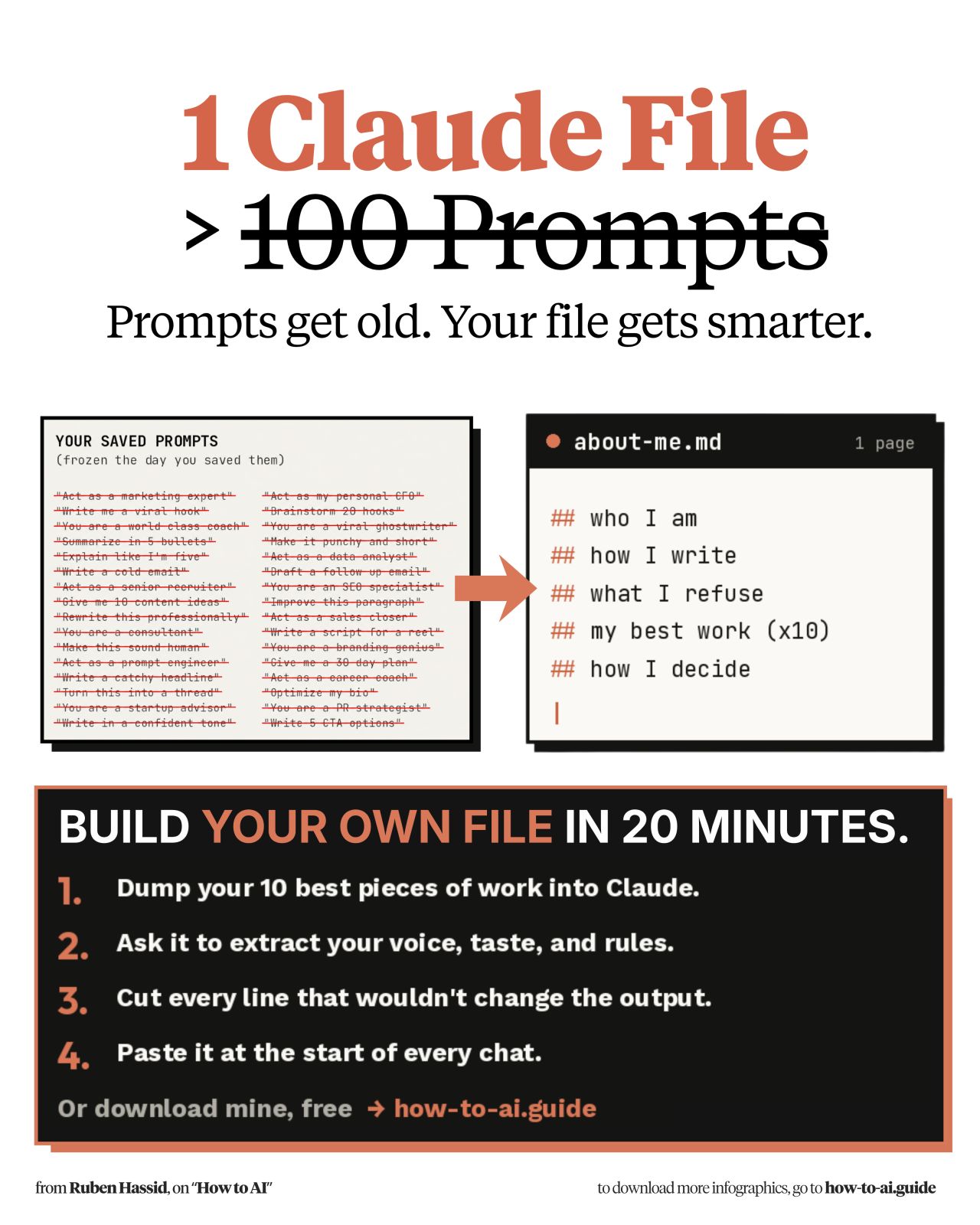
In a recent LinkedIn post, Ruben Hassid offers a radical approach to managing prompts for AI models like Claude, advocating for a significant reduction in saved prompts in favor of a more structured, file-based system. Hassid argues that the common practice of accumulating numerous, often redundant, prompts is inefficient and counterproductive.
Hassid’s core thesis is that effective AI interaction hinges on providing the AI with a deep understanding of the user’s identity, voice, and operational rules, rather than relying on a vast library of specific commands. He states:
“Delete almost every prompt you (ever) saved. You only need one text file. Here’s how to build it.”
This assertion sets the stage for a method that prioritizes contextual information over granular instructions. Hassid suggests that the AI, when properly informed, can derive the necessary actions from simpler, more direct prompts.
The ‘About Me’ File: An AI’s Essential Dossier
A cornerstone of Hassid’s strategy is the creation of a comprehensive ‘about-me’ file. He emphasizes that users often struggle to articulate their own voice and preferences, a task that AI can facilitate. Hassid outlines a process where the AI itself interviews the user to build this profile.
According to Hassid, the initial step involves:
“You are building my about-me .md file. Interview me using AskUserQuestion, 20 questions, one at a time. Push back on every vague answer. Compile it into an about-me .md under 2000 words.”
This interview process, Hassid explains, helps distill the user’s patterns and voice in a way that self-description often fails to capture. He notes the significant reduction in file size from an initial draft to a refined version, stating:
“My first file was 22,000 words. It re-read 22,000 before answering – token wasted. I cut it to under 2,000. Same voice, 10x less noise.”
The implication is that a concise, yet deeply informative, ‘about-me’ file leads to more efficient and accurate AI responses.
Expanding the Contextual Framework
Beyond the ‘about-me’ file, Hassid proposes two additional files to further refine the AI’s understanding and operational parameters:
- my-voice: This file details the user’s preferred tone, specific phrases to avoid, and includes real writing samples to exemplify the desired style.
- my-rules: This file establishes crucial operational guidelines, such as requiring the AI to ask for confirmation before executing actions, to present a plan, and to avoid deleting content without explicit approval.
Hassid argues that these three files collectively create a robust context for the AI, enabling much simpler and shorter prompts for everyday tasks. This contrasts sharply with the traditional approach of saving numerous, highly specific prompts.
Ensuring AI Adherence and Accessibility
To ensure the AI consistently utilizes these contextual files, Hassid recommends organizing them in a dedicated folder, such as “Claude Cowork,” and configuring the AI’s environment to read this folder before processing any task. He also suggests specific AI model settings (Opus 4.8 + Thinking + High Effort) for optimal performance.
Furthermore, Hassid provides a shortcut for users who may find the process daunting. He offers a free download of his own configured files via a subscription to his newsletter, making his streamlined system readily accessible.
In Ruben Hassid’s view, this methodical approach to AI prompting, centered on comprehensive user context rather than a multitude of saved commands, represents a significant leap in efficiency and effectiveness for interacting with advanced AI models.
📝 About This Content
This article is based on insights shared by Ruben Hassid on LinkedIn.
📅 Originally posted on June 16, 2026 | View original post on LinkedIn →