
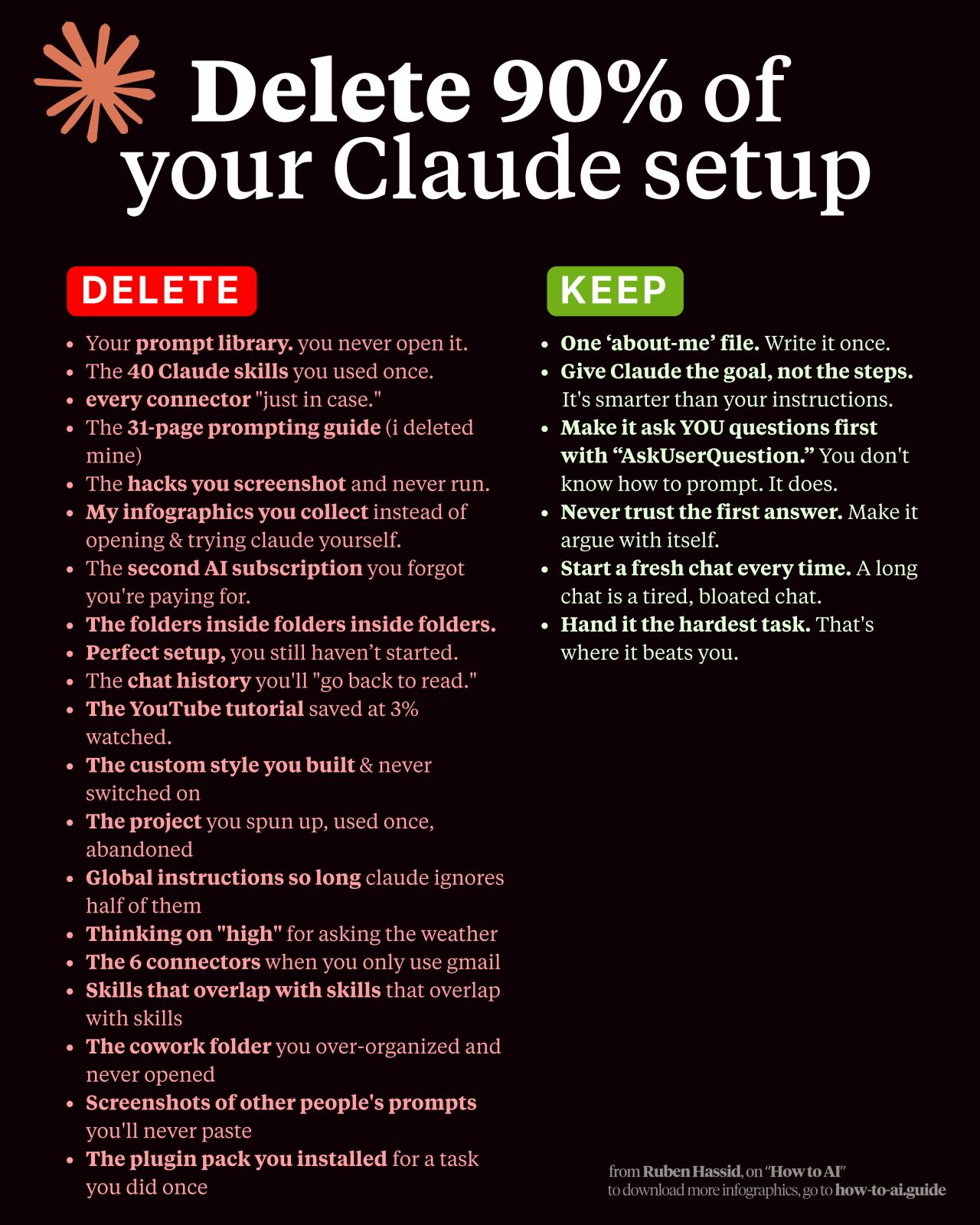
In a recent LinkedIn post, Ruben Hassid challenges conventional approaches to organizing and utilizing AI tools like Claude, arguing that excessive organization can significantly hinder productivity. Hassid suggests that many users overcomplicate their AI interactions, leading to slower workflows and less effective results.
The Pitfalls of Over-Organization
Ruben Hassid contends that the impulse to meticulously organize AI tools, such as creating extensive prompt libraries or saving numerous potentially useful but rarely used connectors, is often counterproductive. He points out that these curated collections can become digital graveyards of unused resources.
“Stop over organizing Claude. It slows you down.”
Hassid highlights common organizational habits that he believes should be eliminated. These include maintaining large prompt libraries that are never accessed, keeping skills or connectors added “just in case” they might be needed, and saving extensive guides or tutorials that remain unread. He also criticizes the creation of deeply nested folder structures and elaborate custom setups that are never fully implemented or utilized.
Deleting Digital Clutter
Ruben Hassid provides a list of 20 items users should consider deleting from their AI workflow. Among these are elements like extensive prompt libraries, skills used only once, connectors saved for hypothetical future use, and lengthy global instructions that AI models may ignore. Hassid argues that these items contribute to complexity without adding proportional value.
“Your prompt library. You never open it.”
Furthermore, Hassid points to the tendency to save screenshots of prompts or tutorials instead of actively using the AI, and the habit of keeping chat histories that are unlikely to be revisited. He suggests that such practices create a false sense of preparedness while detracting from actual task completion.
Hassid’s Six Core Habits for Effective AI Use
To counter the inefficiencies of over-organization, Ruben Hassid proposes six core habits that he believes are essential for maximizing the utility of AI models like Claude. These habits emphasize directness, clarity, and a willingness to let the AI perform its intended function.
1. The Single ‘About-Me’ File
Hassid advocates for a single, concise file that defines the user’s role, desired tone, and non-negotiables. He asserts that this file, when provided to Claude, is more effective at personalizing the AI’s responses than any saved prompt template.
2. Focus on Goals, Not Steps
According to Hassid, users should provide the AI with the desired outcome rather than dictating the exact steps to achieve it. He argues that overly prescriptive instructions limit the AI’s ability to problem-solve effectively.
“Give Claude the goal, not the steps.
‘Write the email in 4 short paragraphs, friendly, no bullet points’ = you doing its job. Say ‘reply to this so they say yes’ and let it think. The more you micromanage, the dumber the output.”
3. Prompt the AI to Ask Questions
Hassid suggests instructing the AI to ask clarifying questions before providing an answer. This approach, he explains, allows the AI to elicit necessary context from the user, acknowledging that users may not always know the best way to prompt.
4. Critically Evaluate and Refine
Ruben Hassid advises against accepting the first output from an AI without scrutiny. He recommends prompting the AI to identify and correct flaws in its own initial response, believing this iterative refinement process yields better results than the initial draft.
5. Start Fresh Chats for New Tasks
To maintain speed and relevance, Hassid recommends starting a new chat session for each distinct task. He explains that long, multi-message conversations can cause the AI to become slow, forgetful, and generic.
6. Assign the Most Challenging Tasks
Finally, Hassid encourages users to delegate their most difficult and time-consuming tasks to the AI. He posits that this is where AI offers the most significant time savings, rather than on simple, quick jobs.
Hassid concludes that this streamlined approach—one core file and six key habits—can dramatically improve efficiency when working with AI, eliminating the need for complex organizational systems.
📝 About This Content
This article is based on insights shared by Ruben Hassid on LinkedIn.
📅 Originally posted on June 21, 2026 | View original post on LinkedIn →