
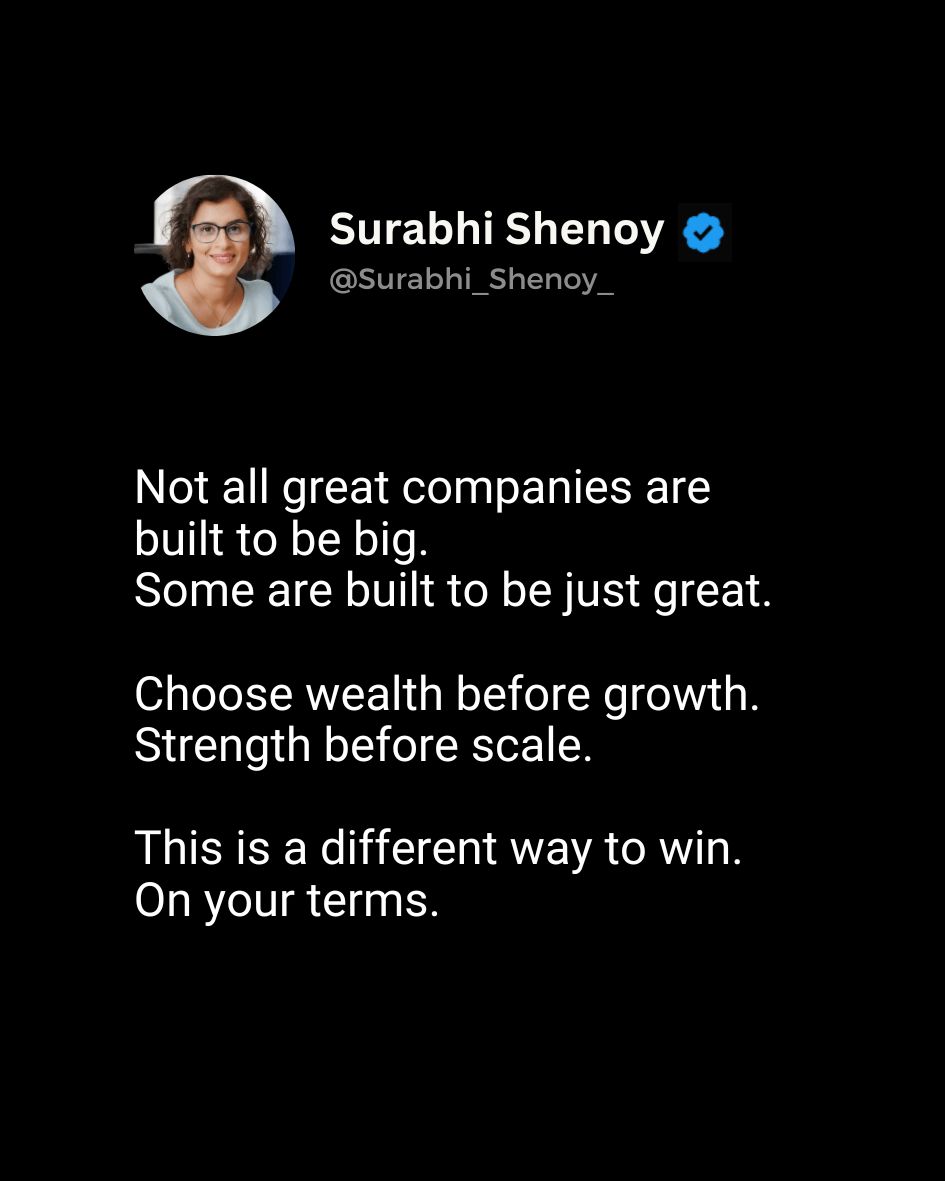
In a recent LinkedIn post, Surabhi Shenoy challenges conventional wisdom around long-term thinking for business founders, arguing that a focus on “pro-wealth” principles, rather than just growth momentum, is key to sustainable success. Shenoy, reflecting on her own entrepreneurial journey spanning over two decades, shares how she navigated periods of uncertainty and recession by prioritizing financial resilience and optionality.
Shenoy begins by acknowledging the common advice from figures like Jeff Bezos and Warren Buffett to think long-term. However, she admits that for much of her career, this felt out of reach when the immediate survival of her business was in question. She notes:
“When survival was always in question — when one client could disappear, when one big logo could change the roadmap — thinking ten years ahead felt almost stupid.”
Despite these challenges, Shenoy reveals that her business not only survived but scaled for over 20 years. This experience led her to a crucial realization: she wasn’t incapable of long-term thinking; rather, she was being discerning about growth.
Rethinking Growth: Beyond Momentum
Shenoy distinguishes her approach from simply chasing growth for its own sake. She explains that her focus was not on being anti-ambition or anti-progress, but rather on being deliberately selective about which growth opportunities to pursue. As Shenoy puts it,
“I was deliberately saying no to growth that existed only for momentum. I was aggressively 𝗽𝗿𝗼-𝘄𝗲𝗮𝗹𝘁𝗵.”
This “pro-wealth” mindset, she elaborates, meant prioritizing a business that was financially sound, predictable, resilient, and offered optionality. This became her guiding principle when making critical business decisions.
The “Pro-Wealth” Decision-Making Lens
Shenoy outlines a series of questions she used to filter opportunities, ensuring they aligned with her long-term vision and financial health. These questions helped her avoid decisions driven by short-term pressures that could undermine the business’s future.
According to Surabhi Shenoy, founders should ask:
- “Is this custom work driven by fear of losing a deal, or does it quietly change who we are?”
- “Am I taking this low-margin client for short-term cash, or lowering the bar we’ll struggle to raise later?”
- “Is this big logo shaping our future, or narrowing it?”
- “Am I pushing hard for a defined stretch, or teaching the team that exhaustion is normal?”
She emphasizes that while she sometimes said yes to such opportunities, she frequently said no. This selective approach, she argues, was her form of long-term thinking, even when she felt she didn’t know how to do it.
Protecting Optionality and Future Growth
Shenoy concludes that by refusing short-term decisions that could diminish the future, she was actively protecting her business’s optionality. This, in turn, allowed for genuine, sustainable growth to follow. She states:
“My long-term thinking didn’t look like Jeff Bezos’. But it served me well.”
Her insights offer a valuable perspective for founders, encouraging them to define their own version of long-term strategy, grounded in financial prudence and a clear vision for future resilience.
📝 About This Content
This article is based on insights shared by Surabhi Shenoy on LinkedIn.
📅 Originally posted on January 19, 2026 | View original post on LinkedIn →