
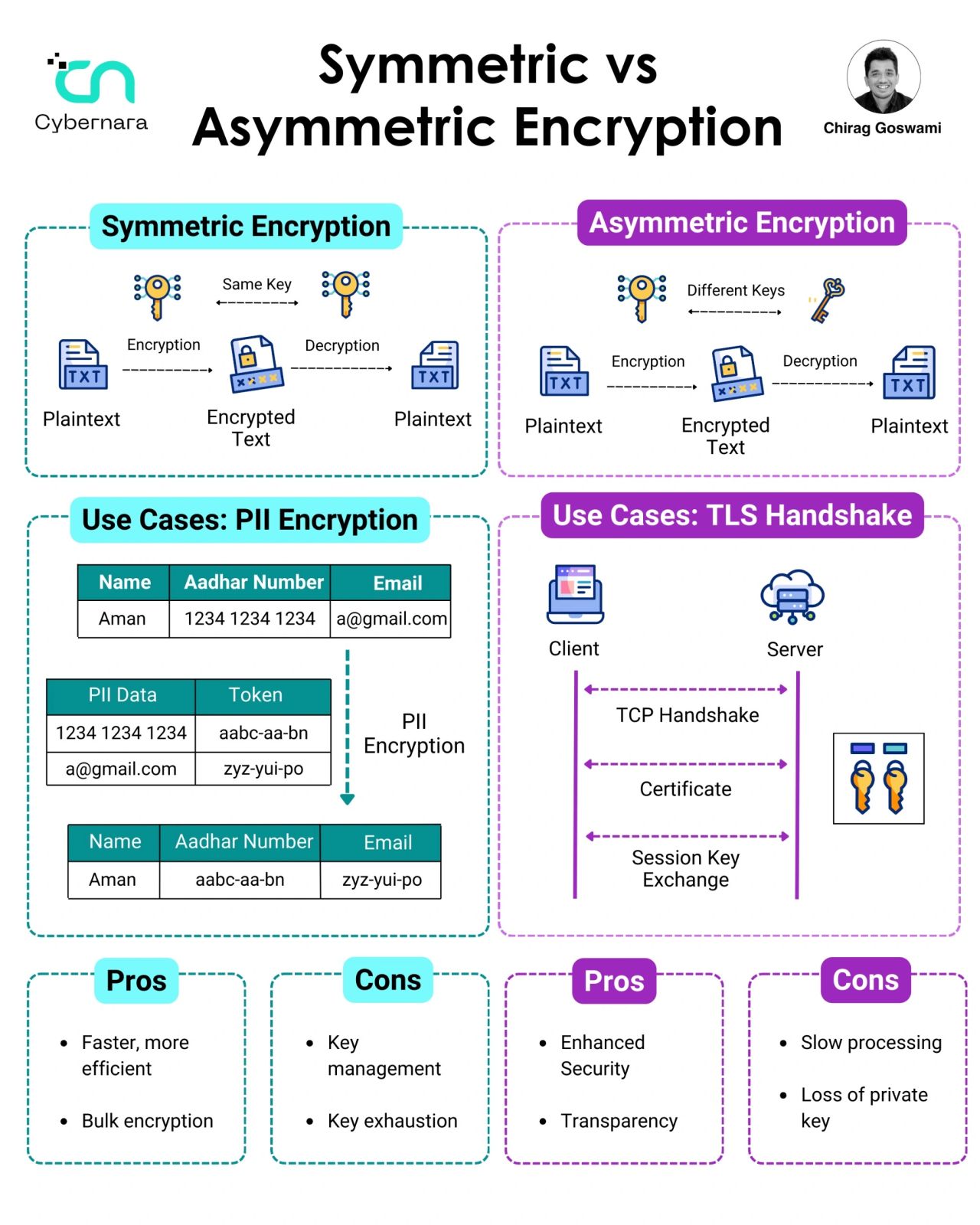
In a recent LinkedIn post, Chirag Goswami breaks down the fundamental differences between symmetric and asymmetric encryption, explaining their crucial roles in modern digital security. Goswami’s post aims to clarify these often complex concepts for a broader audience, highlighting how both methods work in tandem to protect sensitive information.
Goswami introduces symmetric encryption as a method where a single key is used for both locking and unlocking data. He emphasizes its efficiency and suitability for large-scale data protection.
“The same key is used to lock and unlock data. Fast, efficient, and perfect for protecting large amounts of sensitive data like PII, databases, and backups.”
According to Goswami, this makes symmetric encryption ideal for everyday data management tasks within systems.
The Role of Asymmetric Encryption in Secure Communication
Transitioning to asymmetric encryption, Chirag Goswami explains that this method utilizes a pair of keys: one public and one private. This dual-key system, he highlights, is the backbone of secure internet communication.
“Uses two keys, one public and one private. This is what makes secure communication on the internet possible.”
Goswami points out that asymmetric encryption is vital for establishing initial trust and secure connections. He provides a clear example of its application:
“Every HTTPS website uses it during the TLS handshake to safely exchange a session key before switching to fast symmetric encryption.”
This process, as detailed by Goswami, is fundamental to secure online transactions and browsing.
Why the Synergy Between Both Encryption Types is Essential
A key takeaway from Chirag Goswami’s analysis is the indispensable nature of combining both symmetric and asymmetric encryption. He argues that while asymmetric encryption establishes the initial secure channel and trust, symmetric encryption handles the bulk data transfer efficiently.
Goswami elaborates on this synergy:
“Asymmetric encryption builds trust between systems. Symmetric encryption protects the data at scale. Without this combination, secure logins, online payments, and cloud services would not exist.”
In his view, this complementary relationship is what underpins the security of numerous digital services we rely on daily, from online banking to cloud storage. Goswami’s post serves as a clear, accessible guide to understanding these critical cybersecurity mechanisms.
📝 About This Content
This article is based on insights shared by Chirag Goswami on LinkedIn.
📅 Originally posted on January 16, 2026 | View original post on LinkedIn →