
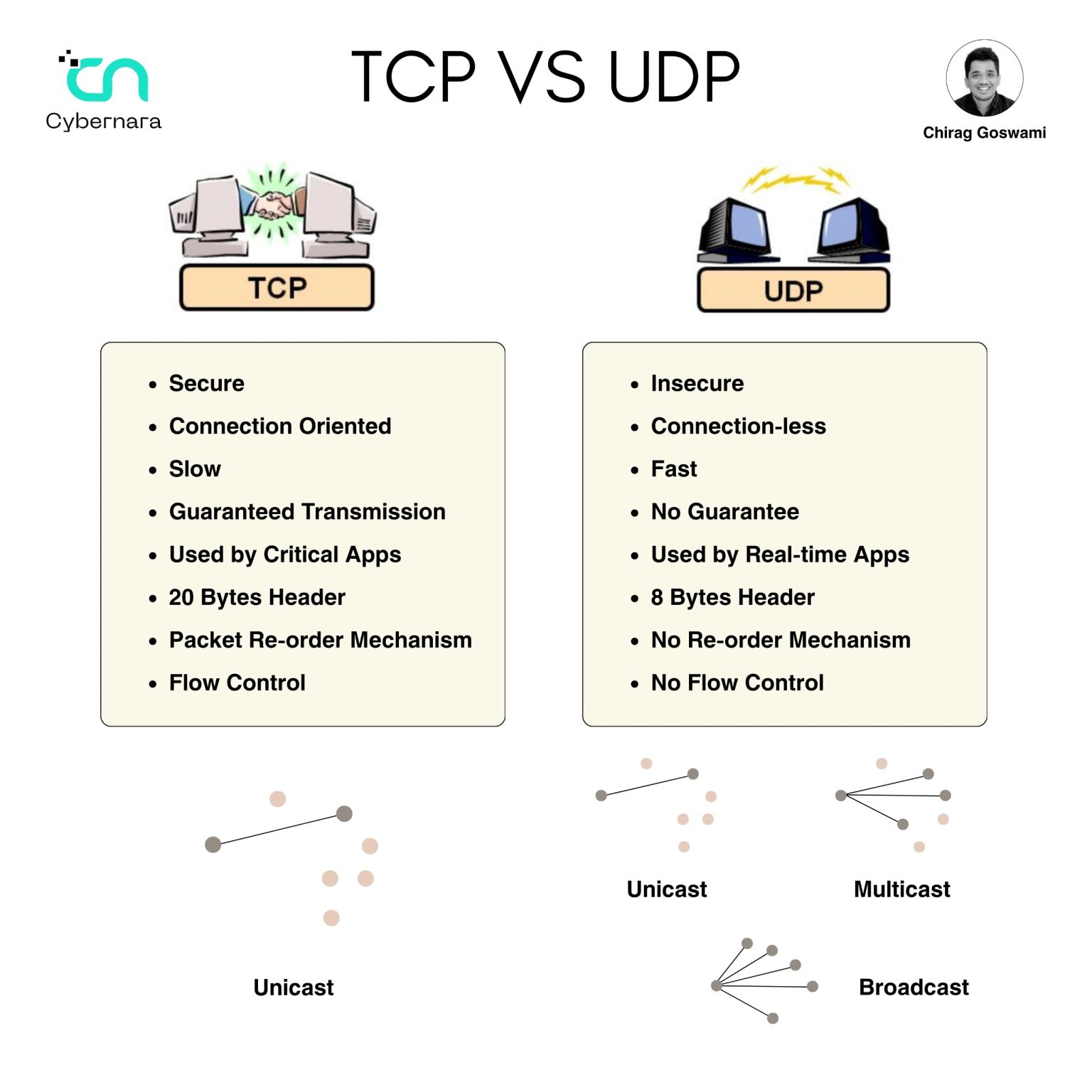
In a recent LinkedIn post, Chirag Goswami delves into the fundamental differences between TCP and UDP, two critical transport-layer protocols, and underscores their importance for building effective and high-performance systems.
Goswami highlights that while both protocols operate at the transport layer, they serve distinct purposes, making the choice between them crucial for optimizing network architecture.
⚙️ TCP and UDP are core transport-layer protocols, but they’re designed for very different purposes. Knowing when to use each one is key to building reliable and high-performance systems.
Understanding TCP: The Reliability Champion
Chirag Goswami explains that TCP (Transmission Control Protocol) is built with reliability as its primary goal. It is a connection-oriented protocol that guarantees data delivery in the correct order and without errors. This makes it the protocol of choice for applications where data integrity is paramount.
As Goswami notes, TCP is commonly used for activities such as:
- Web browsing
- File transfers
The inherent reliability of TCP comes with a trade-off, which Goswami points out:
• Larger header size • Guaranteed delivery and packet order • Flow control and retransmissions included
Exploring UDP: The Speed-Focused Alternative
In contrast, Chirag Goswami describes UDP (User Datagram Protocol) as a protocol designed for speed and minimal latency. Unlike TCP, UDP is connectionless and does not establish a dedicated connection before sending data. It achieves its speed by forgoing error checking, retransmissions, and ordering guarantees.
This makes UDP ideal for real-time applications where slight data loss or out-of-order packets are less critical than maintaining a smooth, uninterrupted experience. Goswami lists these use cases for UDP:
- Video streaming
- Voice calls
- Online gaming
The advantages of UDP, as outlined by Goswami, include its efficiency:
• Smaller, lightweight header • No delivery or ordering guarantees • Faster transmission with lower overhead
Delivery Modes and Strategic Importance
Beyond the core differences, Goswami also touches upon delivery modes, explaining that both TCP and UDP support unicast (one-to-one) communication. However, UDP is more commonly associated with multicast and broadcast (one-to-many) communication, which are essential for efficient distribution of data to multiple recipients simultaneously.
The central thesis of Goswami’s post revolves around the practical implications of choosing the right protocol. He argues that selecting the incorrect protocol can have significant negative consequences.
📌 Why This Matters Choosing the wrong protocol can impact performance, reliability, and user experience.
Goswami emphasizes that a well-designed network architecture must carefully balance speed, security, and resilience. He concludes by positioning his company, Cybernara, as a resource for businesses seeking to optimize their networks.
“Connect with us to optimize your network the right way,” Chirag Goswami concludes, offering his expertise in navigating these complex networking decisions.
📝 About This Content
This article is based on insights shared by Chirag Goswami on LinkedIn.
📅 Originally posted on January 24, 2026 | View original post on LinkedIn →