
In a recent LinkedIn post, Melissa Perri, a prominent voice in product management, highlights a significant disconnect between executive-level AI strategies and their practical application by product managers. Perri’s analysis, stemming from the State of AI in Product survey conducted by Product Institute and Product Circle, points to a communication and translation gap as the primary obstacle, rather than a lack of technological understanding or ambition.
The Executive-Product Manager AI Strategy Divide
Melissa Perri identifies a striking disparity in how AI strategy is perceived within organizations. According to the survey data she shared, a substantial 62% of product managers cited the lack of a clear AI strategy from leadership as a major challenge. In stark contrast, only 19% of C-level leaders reported the same issue. This 43% gap underscores a critical breakdown in how strategic intent is communicated and operationalized.
“That gap turned out to be the single biggest one in our entire State of AI in Product survey… Bigger than any difference by tool, industry, geography, or company size. And it has nothing to do with technology.”
Perri argues that this discrepancy doesn’t necessarily mean executives lack an AI strategy altogether. Instead, she posits that the high-level conversations happening among CEOs, CPOs, and the board are not being effectively translated into actionable guidance for product managers on the ground.
Bridging the Strategy Translation Gap
From Boardroom to Monday Morning Decisions
The core of Melissa Perri’s argument is that AI strategies, while perhaps existing at the investment or board level, are failing to permeate the day-to-day realities of product development. This lack of translation means that product managers are often left without clear rules or frameworks to guide their decisions regarding AI implementation.
As Perri points out, this breakdown affects crucial aspects of product management:
- What AI applications should be prioritized?
- What AI applications should be avoided?
- Who is responsible for checking AI outputs?
She emphasizes that without clarity on these points, a strategy remains theoretical rather than practical. Perri states:
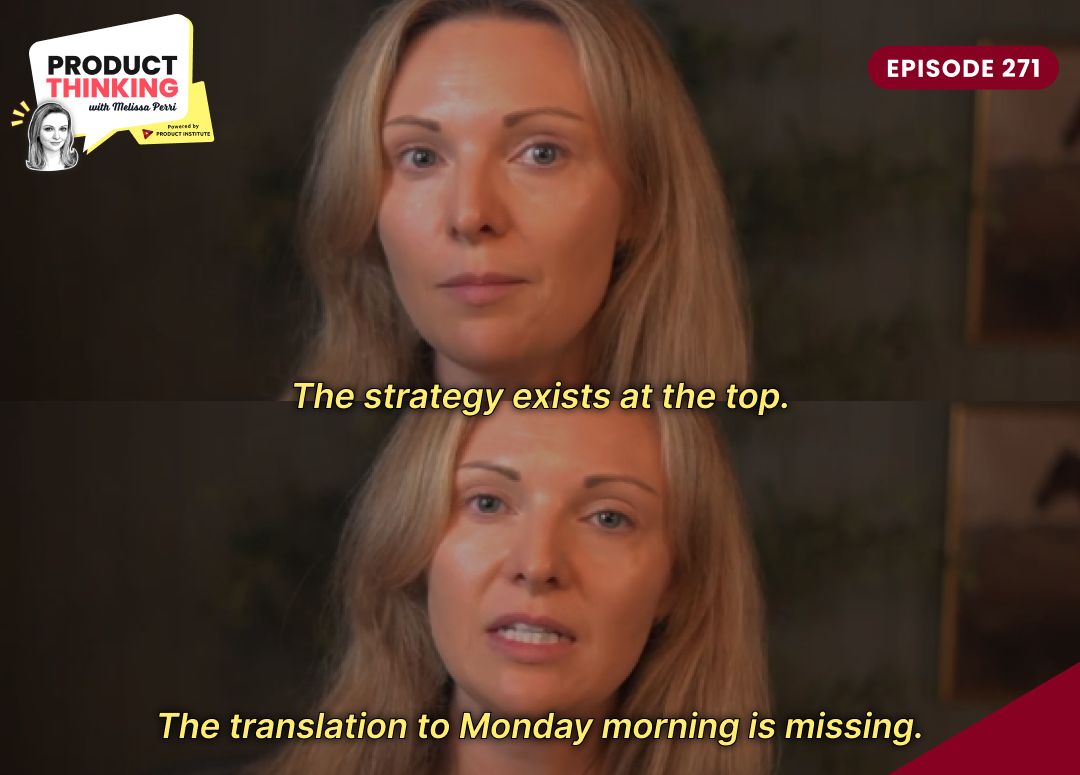
“It never reaches their priorities. Their decision rights. Their review rituals. What to use AI for, what to leave alone, who checks the output. The strategy exists at the top. The translation is missing.”
Making Strategy Actionable
Melissa Perri’s key takeaway for leadership is the imperative to make organizational strategies explicit and accessible. The goal, as she outlines, should be to formulate a strategy that can be understood and acted upon by individuals several levels down from the executive suite.
Perri challenges leaders to consider the practical impact of their vision:
“If you lead, the move is to make your strategy explicit enough that someone three levels down can act on it. A strategy nobody can apply is not actually a strategy yet.”
She further prompts reflection by asking leaders when they last observed someone two or more levels below them effectively applying the company’s AI strategy in a real-world decision. This question underscores the need for strategies to be not just documented, but deeply understood and integrated into the fabric of product decision-making. Perri also noted that she breaks down these findings further in her Product Thinking Podcast.
📝 About This Content
This article is based on insights shared by Melissa Perri on LinkedIn.
📅 Originally posted on July 2, 2026 | View original post on LinkedIn →