
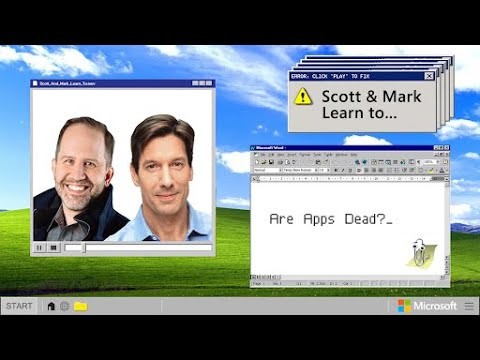
In a recent LinkedIn post, Mark Russinovich tackles the increasingly heated debate surrounding the future of applications, specifically questioning the notion that “apps are dead.” He argues that while agentic AI is powerful for certain tasks, it’s not a universal replacement for traditional software, especially for deterministic processes.
Russinovich begins by setting the stage for the discussion, acknowledging the rise of AI and concepts like “vibe coding” that suggest a future where users interact primarily with AI agents rather than structured applications. However, he expresses strong reservations about this trajectory.
“While AI is incredible for handling ambiguity and reasoning, throwing ‘world-burning’ compute at a deterministic problem—like an expense report or booking travel—often just means you’re using AI to paper over a bad UI.”
The Limits of AI for Deterministic Tasks
Russinovich contends that the drive towards AI-driven interactions for everyday, predictable tasks misunderstands the fundamental nature of software. He points out that for activities requiring high levels of reliability, security, and repeatability, codified, deterministic workflows remain essential. Using AI to solve these problems, in his view, is often an inefficient workaround for poor user interface design.
As Russinovich elaborates, the allure of AI might be overshadowing the enduring need for robust, predictable systems. He highlights that not all problems benefit from the ambiguity-handling capabilities of AI.
The Enduring Relevance of SaaS and TUIs
The discussion, which originates from a “Scott & Mark Learn To…” episode featuring Scott Hanselman, also touches upon the continued viability of Software as a Service (SaaS) and even the resurgence of Terminal User Interfaces (TUIs). Russinovich suggests that the idea of AI agents completely supplanting all existing applications is a premature conclusion.
“Reliability, security, and repeatability still demand deterministic, codified workflows.”
Russinovich argues that the complexity of systems like SAP or Dynamics, which are not amenable to simple “vibe coding,” further underscores the need for structured software. He implies that while AI can augment user experiences, it cannot entirely replace the underlying architecture of these critical business applications.
Addressing the ‘Vibe Coding’ Myth
A key point Russinovich makes is the skepticism surrounding “vibe coding” for complex systems. This term, often associated with a more intuitive, less structured approach to development or interaction, is presented as a potentially misleading concept when applied to enterprise-level software. According to Russinovich, these systems require precision and predictability that “vibe coding” cannot reliably deliver.
“In this episode, we discuss: … The myth of ‘vibe coding’ complex systems like SAP or Dynamics … Why SaaS isn’t going anywhere”
He further emphasizes that SaaS models are not facing obsolescence, as some might predict in a purely AI-driven future. This indicates his belief in a hybrid approach where AI complements, rather than replaces, existing software paradigms.
In conclusion, Mark Russinovich’s insights, shared via LinkedIn, advocate for a nuanced view of AI’s impact on applications. He champions the continued importance of deterministic workflows, robust UIs, and established software models like SaaS, cautioning against an oversimplified vision of AI agents taking over all software interactions.
📝 About This Content
This article is based on insights shared by Mark Russinovich on LinkedIn.
📅 Originally posted on February 7, 2026 | View original post on LinkedIn →