
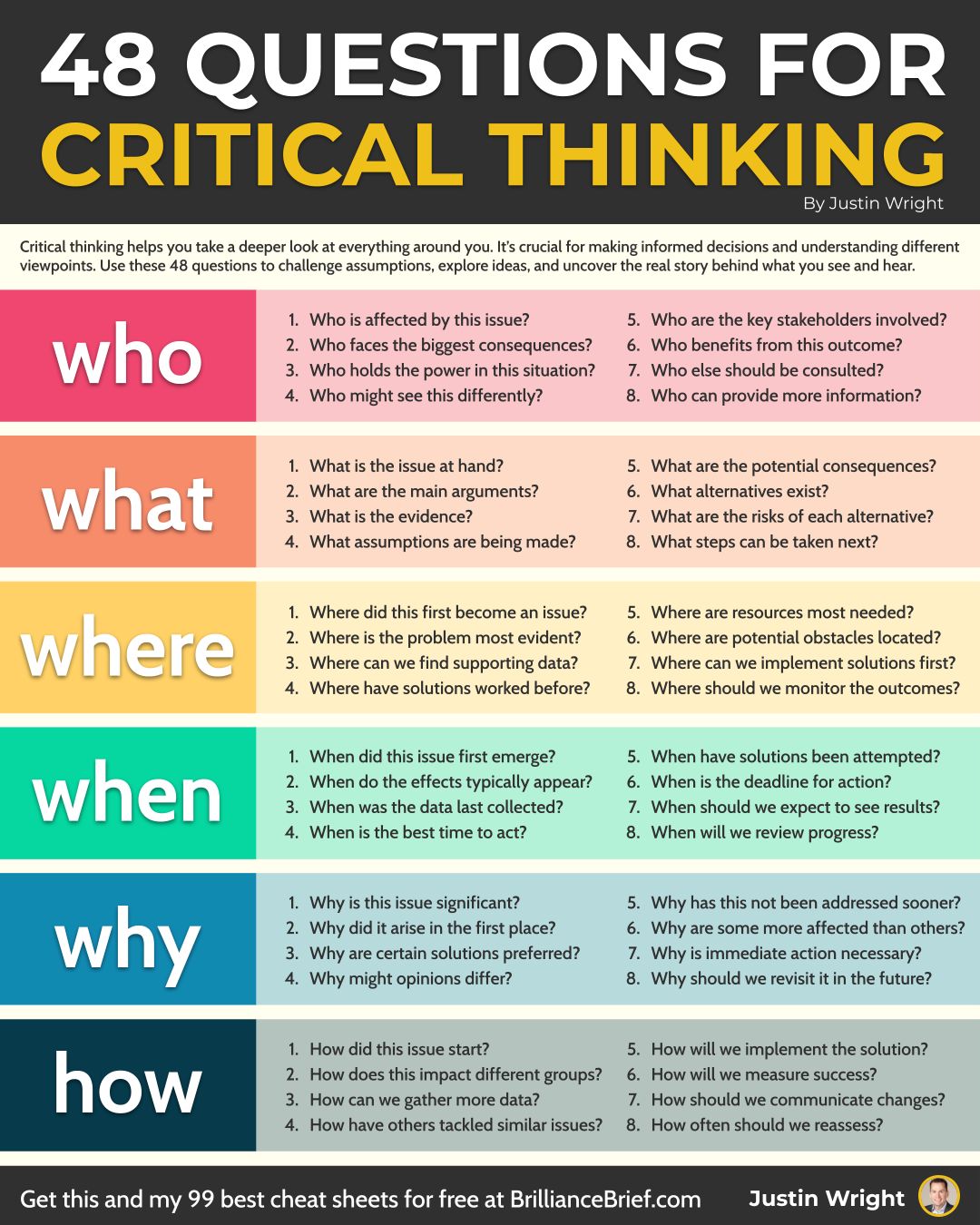
In a recent LinkedIn post, Justin Wright delves into the crucial skill of critical thinking, asserting that while many believe they possess it, the reality is far more selective. Wright frames critical thinking not as mere skepticism, but as an active process of inquiry and deep analysis essential for navigating an increasingly complex information landscape.
Wright begins by challenging common perceptions, stating:
“90% of people think they’re critical thinkers. (Only 10% actually are.)”
This stark assertion sets the stage for his exploration of what critical thinking truly entails and why it’s indispensable in modern life.
Defining the Core of Critical Thinking
According to Justin Wright, critical thinking transcends simply accepting information at face value. He defines it as a rigorous process involving asking pertinent questions and pursuing deeper understanding. As Wright puts it:
“It’s not taking things at face value. It’s asking tough questions. It’s digging deeper.”
This emphasis on active questioning and investigation is central to his argument, positioning critical thinking as a proactive intellectual stance rather than a passive reception of data.
The Indispensable Value of Critical Thinking
Wright highlights several key benefits that critical thinking offers individuals. He argues that developing this skill empowers people to think independently, make more informed decisions, and effectively resolve challenging problems. Furthermore, he points out its role in fostering empathy and understanding diverse perspectives, contributing to the development of emotional intelligence.
Protection Against Manipulation
A significant aspect of critical thinking, as outlined by Wright, is its function as a shield against manipulation. In an era saturated with information, discerning truth from falsehood is paramount. Wright suggests that the ability to question, analyze evidence, and consider multiple viewpoints is vital for protecting oneself from misinformation and persuasive tactics that may not serve one’s best interests.
“In a world full of noise, it helps you find the truth.”
This sentiment underscores the practical, real-world implications of honing one’s critical thinking abilities.
Cultivating a Critical Mindset
To foster critical thinking, Justin Wright proposes a practical, five-step approach. He encourages individuals to embrace a mindset of questioning, even challenging their own deeply held beliefs. The process involves actively seeking evidence to support claims, rather than relying solely on opinions, and making a conscious effort to understand and consider viewpoints that differ from one’s own.
Wright also stresses the importance of intellectual humility, advocating for the willingness to admit when one is wrong as a catalyst for growth. Finally, he emphasizes continuous learning as essential, given the ever-evolving nature of the world and the information it presents.
Curiosity Over Negativity
Dispelling a common misconception, Wright clarifies that critical thinking is not synonymous with being negative or cynical. Instead, he characterizes it as an expression of curiosity. This distinction is crucial, reframing critical thinking as a constructive and open-minded pursuit of understanding.
Concluding his post, Wright offers a powerful reminder of the direct correlation between the quality of one’s thinking and the quality of their life. He urges readers to move beyond passive acceptance and engage actively with information:
“The next time you hear something… Don’t just nod. Question. Explore. Think.”
Wright’s insights provide a valuable framework for anyone seeking to improve their analytical skills and navigate the modern information landscape with greater clarity and confidence.
📝 About This Content
This article is based on insights shared by Justin Wright on LinkedIn.
📅 Originally posted on April 16, 2026 | View original post on LinkedIn →