
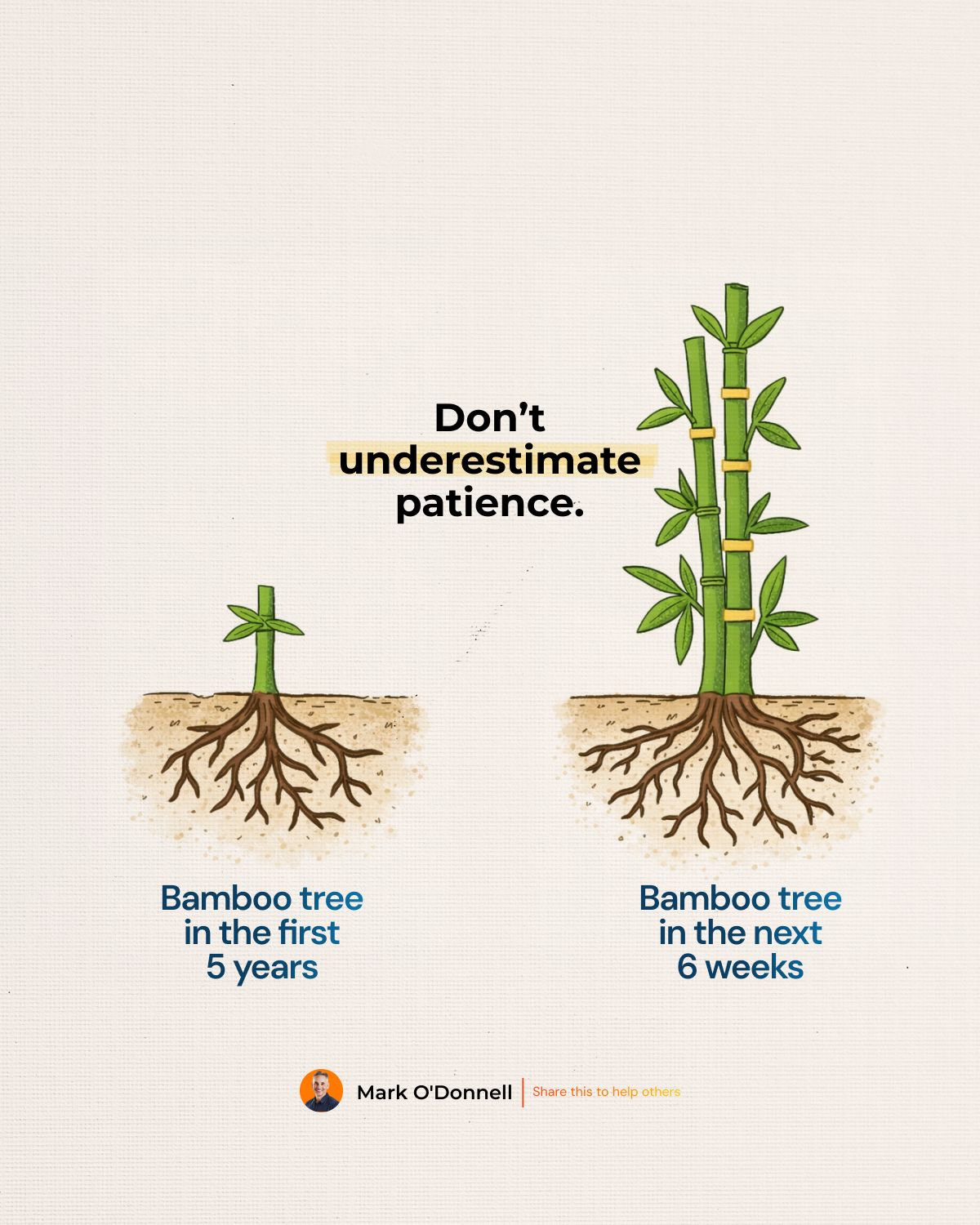
In a recent LinkedIn post, Mark O’Donnell discusses the critical distinction between a long-term business-building mindset and the short-term expectations often held by new entrepreneurs. O’Donnell, who advises clients on business growth, addresses the common frustration experienced by founders after their first year, who may question their progress and consider scaling back.
O’Donnell uses the analogy of bamboo growth to illustrate his point about patience and foundational development. He notes:
“Bamboo spends five years doing almost nothing above ground. There’s no visible growth at all. And then in six weeks, it shoots up taller than most trees. That’s a business building roots.”
This metaphor, O’Donnell argues, highlights how significant progress in business, much like with bamboo, often occurs beneath the surface, unseen during initial stages. He draws a parallel to the S&P 500’s steady, long-term performance, which often outperforms more aggressive, short-term investment strategies over time. However, he observes that many entrepreneurs struggle with this slower pace, craving immediate, visible results.
The Pitfalls of Seeking Immediate Returns
The core issue, as O’Donnell sees it, is that entrepreneurs often abandon their strategies just before a period of exponential growth. He states:
“The problem is they abandon the position right before the curve goes parabolic.”
This tendency to give up prematurely can be detrimental to sustainable success. O’Donnell emphasizes that consistent, incremental improvements made week after week accumulate to significant long-term benefits, even if they aren’t readily apparent in short-term reviews.
Visible Results and Strategic Execution
According to O’Donnell, the true impact of this patient, consistent execution becomes palpable approximately two years down the line. He outlines key indicators of this mature growth phase:
- Teams transition from constant ‘firefighting’ to proactive problem-solving.
- Business metrics become clearer and more predictable.
- The founder is no longer the primary bottleneck limiting progress.
This foundational strength, O’Donnell asserts, is the result of consistent effort and strategic implementation. He points to frameworks like EOS (Entrepreneurial Operating System) as tools designed to foster this type of sustained development. O’Donnell highlights specific components:
- Rocks: These are 90-day objectives designed to maintain focus.
- Level 10 Meetings: Weekly meetings aimed at ensuring team alignment.
- Scorecards: Tools to track progress and identify issues before they become critical.
He acknowledges that these methods are not inherently exciting on a day-to-day basis, but argues that this is precisely their strength. The focus is on building the underlying structure—the roots—rather than chasing immediate, superficial gains.
The Long Game in Entrepreneurship
O’Donnell concludes by posing a crucial question to founders: the results are coming, but will you still be executing when they arrive? He suggests that the ‘underground years’ of business development often surface underlying problems, which need to be addressed effectively. In his view:
“The question isn’t whether the results are coming. It’s whether you’ll still be executing when they do.”
This perspective underscores the importance of resilience, strategic patience, and consistent execution in achieving lasting business success, moving beyond the allure of short-term wins to embrace the power of long-term value creation.
O’Donnell also mentions his new book, “Issues,” which focuses on solving business problems, and encourages readers to subscribe to his newsletter for leadership insights.
📝 About This Content
This article is based on insights shared by Mark O'Donnell on LinkedIn.
📅 Originally posted on March 30, 2026 | View original post on LinkedIn →