
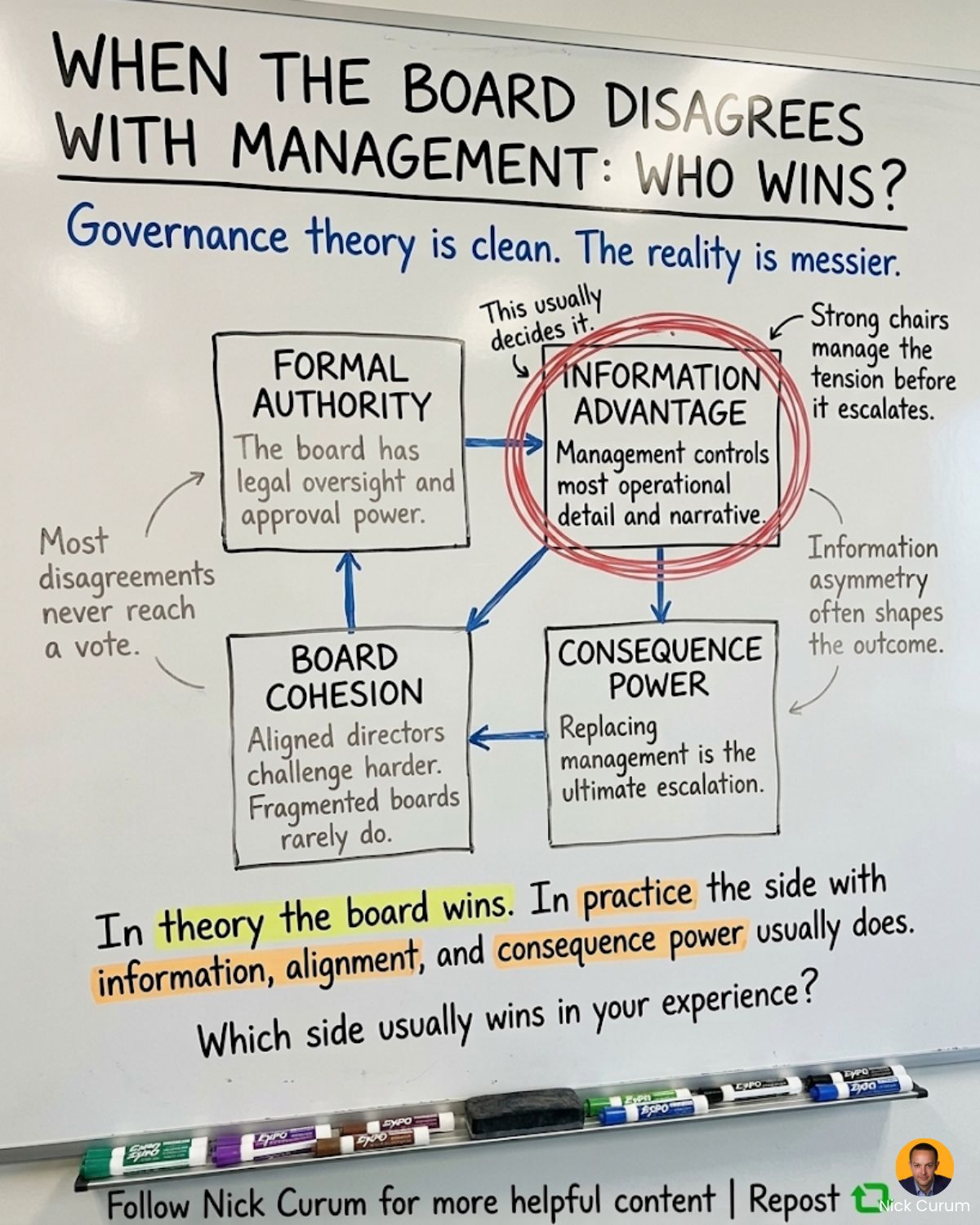
In a recent LinkedIn post, Nick Curum explores the often-unseen dynamics that determine how boardroom decisions are truly made, challenging the conventional view of formal board authority. Curum highlights a fundamental tension between the board’s ultimate oversight and management’s control over information flow, suggesting the latter frequently holds more sway.
Curum begins by posing a critical question about power in the boardroom: “The board has formal authority. Management has the information. Guess which one usually shapes the outcome.” This sets the stage for an analysis that moves beyond theoretical governance structures to the practical realities of board-management interactions.
Challenging the Hierarchical Governance Model
The traditional model of corporate governance, as Curum points out, often assumes a clear, top-down hierarchy. This model typically dictates that the board oversees and approves, while management executes. However, Curum argues that this is an oversimplification of complex real-world scenarios.
“Most governance frameworks assume a clean hierarchy,” Curum writes. “The board oversees. The board approves. Management executes. That’s the theory. The reality is messier.” This assertion underscores the central theme of his post: the practical influence wielded by those who control the information presented to the decision-makers.
Key Dynamics in Board-Management Disagreements
Curum identifies four key dynamics that typically resolve disagreements between a board and management, moving beyond the board’s formal authority. These dynamics reveal where the true power often lies:
1. Formal Authority vs. Information Advantage
While the board possesses legal oversight and approval power, Curum emphasizes that this is often less impactful than management’s control over operational details and the narrative presented. “Management controls the operational detail, the narrative, and the timing of what surfaces,” Curum states. This information advantage allows management to frame issues in a way that can pre-emptively shape the board’s perspective and decision.
2. The Role of Board Cohesion
The effectiveness of a board’s formal authority is significantly influenced by its internal unity. Curum notes that “Aligned directors challenge harder. Fragmented boards rarely do. Unity determines whether formal authority actually gets used.” A cohesive board is more likely to leverage its oversight powers effectively, whereas a divided board may struggle to assert its will, regardless of its formal mandate.
3. Consequence Power and its Credibility
The ultimate power the board holds is the ability to replace management. However, Curum points out that this is a drastic measure, “Used rarely. But the credibility of that option matters constantly.” The mere existence of this power, and the board’s willingness to consider its use, can influence management’s approach and the issues brought forward.
The Practicality of Information Flow
Curum’s analysis suggests that most significant disagreements are not resolved through formal votes but much earlier in the process. “Most disagreements never reach a vote. They resolve earlier — in how the issue is framed, what data is presented, and which questions get answered,” he explains. This observation highlights why experienced directors often prioritize understanding the information pipeline.
As Curum concludes, the focus for effective board members extends beyond the final decision to the very mechanisms by which information is prepared and presented. “Who prepared the pack. What surfaced early. What arrived two days before the meeting,” he lists, illustrating the granular details that influence boardroom outcomes. Ultimately, Curum’s post serves as a compelling reminder that in the practical application of governance, control over information can be as, if not more, powerful than formal authority.
📝 About This Content
This article is based on insights shared by Nick Curum on LinkedIn.
📅 Originally posted on March 10, 2026 | View original post on LinkedIn →