
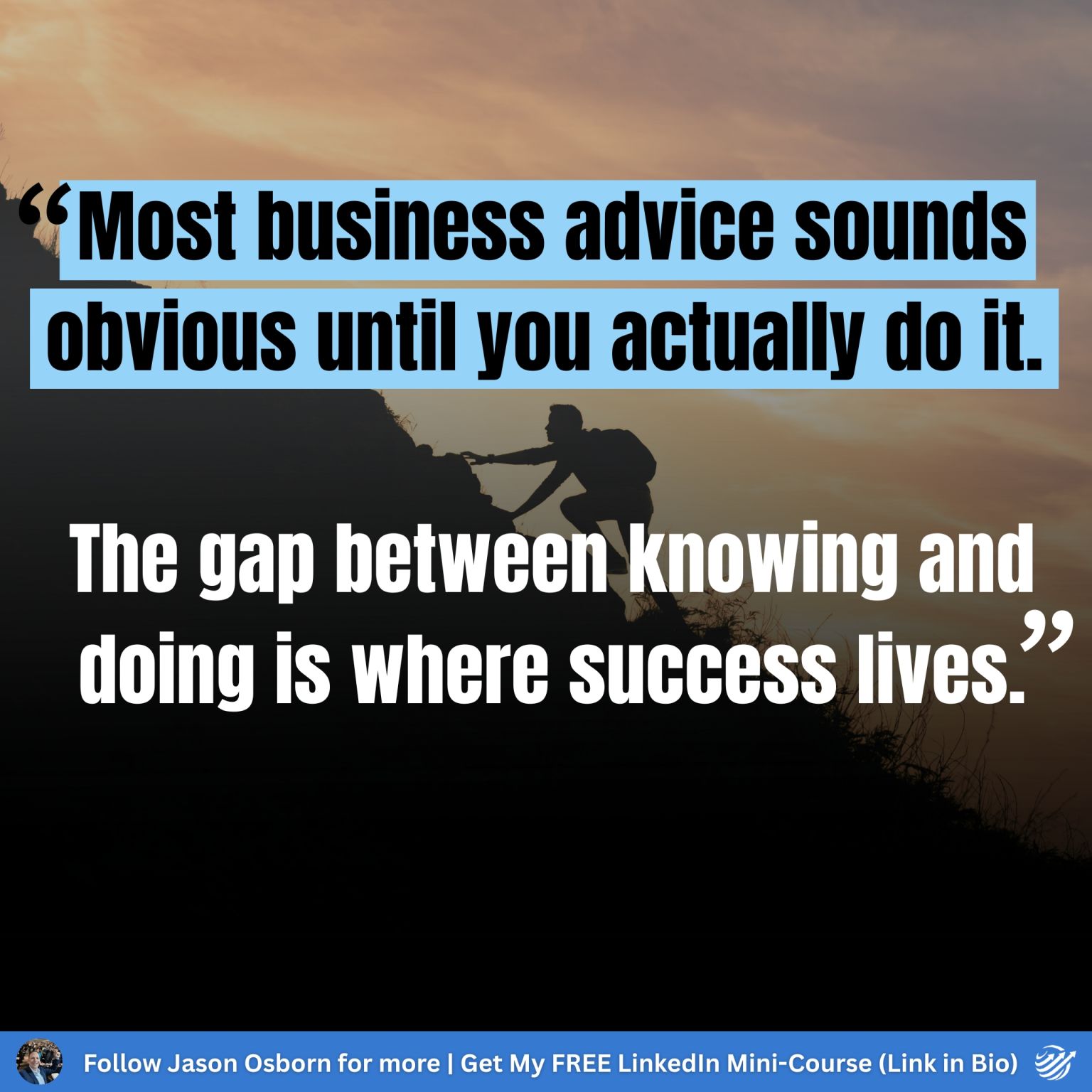
In a recent LinkedIn post, Jason Osborn delves into a common yet often overlooked challenge faced by business leaders: the significant gap between knowing what needs to be done and actually doing it. Osborn argues that while many entrepreneurs are inundated with advice, the real differentiator for success lies not in accumulating knowledge, but in consistent execution.
Osborn opens by highlighting the universal nature of this problem, stating:
Most Business Advice Sounds Obvious Until You Actually Do It. The Gap Between Knowing and Doing Is Where Success Lives.
He elaborates on how this disconnect manifests, pointing out that the advice itself is rarely the issue. Business owners are often well-versed in what they ‘should’ be doing—whether it’s niching down, delegating, automating, or raising prices. Yet, their actions frequently diverge from this knowledge.
The ‘Knowing Problem’ vs. The ‘Execution Problem’
Jason Osborn identifies a primary hurdle as ‘advice overload.’ Business leaders consume books, podcasts, and courses, amassing a wealth of information about the ‘right’ way to operate. However, Osborn posits that this accumulation of knowledge doesn’t automatically translate into action. He categorizes this as the ‘Knowing Problem,’ where understanding is comfortable and requires no risk.
In contrast, Osborn emphasizes that the true engine of business growth is the ‘Execution Problem’—the challenge of translating knowledge into tangible actions. This is where the real work, and the real risk, lies.
Knowing is comfortable. Doing is hard.
He explains that the reluctance to act stems from the inherent risks associated with doing. Raising prices, firing an underperforming employee, or fundamentally changing a business model all involve potential discomfort and uncertainty. ‘Knowing feels productive. Doing feels scary,’ Osborn writes, underscoring why many remain ‘stuck in knowing because it feels safer.’
Where True Business Success Resides
According to Osborn, success is not found in the strategies one understands, but in those consistently put into practice. He illustrates this with several examples:
- Knowing you should follow up with leads is ‘worthless,’ but actually following up generates ‘revenue.’
- Knowing you should document processes is ‘worthless,’ but doing so leads to ‘scalability.’
- Knowing you should focus on fewer things is ‘worthless,’ but actively doing so builds ‘momentum.’
Osborn’s core message is that while the advice is readily available and often obvious, the consistent application of that advice is rare. This rarity, he argues, is precisely why many businesses remain stagnant.
The advice is obvious. The doing is rare. That’s why most businesses stay stuck.
Closing the Gap: From Learning to Doing
To bridge this critical gap, Jason Osborn advises a shift in focus from consuming more information to taking decisive action. He frames the central question not as ‘what should I do?’ but rather, ‘why am I not doing what I already know I should?’ He encourages readers to identify the root cause of their inaction—be it fear, a perceived lack of time, or uncertainty—and address it directly.
Osborn advocates for a step-by-step approach, suggesting that the gap is closed ‘one action at a time.’ He proposes starting with just one actionable item—a single piece of advice that is known to be correct but has not yet been implemented. This could be a delayed pricing change, a postponed hiring decision, or an unaddressed prospect.
The gap between knowing and doing closes one action at a time. Not through more learning. Through more doing.
The emphasis is on completion, not perfection. Osborn concludes by reiterating that tangible results stem from action, not just knowledge. ‘Success doesn’t come from knowing more. It comes from doing what you already know,’ he asserts.
📝 About This Content
This article is based on insights shared by Jason Osborn on LinkedIn.
📅 Originally posted on January 16, 2026 | View original post on LinkedIn →