
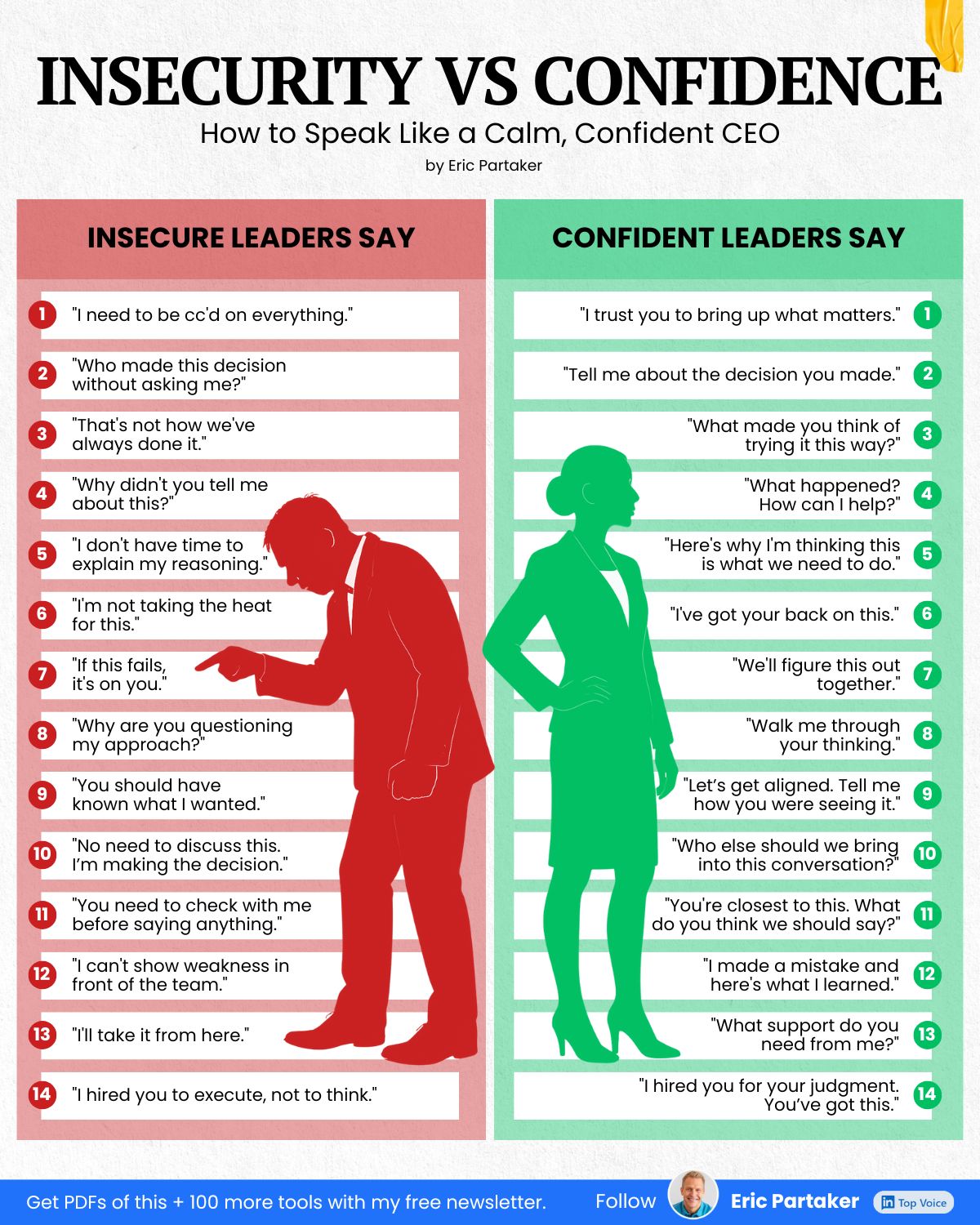
In a recent LinkedIn post, Eric Partaker discusses a fundamental aspect of effective leadership: the impact of a leader’s confidence on team dynamics and performance. Partaker, who has coached over 650 CEOs, argues that a leader’s internal state—whether driven by insecurity or confidence—is immediately felt by their team and significantly shapes the organizational culture.
The Distinction Between Insecure and Confident Leadership
Partaker draws a stark contrast between leadership styles rooted in insecurity and those stemming from genuine confidence. He posits that insecure leaders tend to foster an environment of fear, where team members are hesitant to speak up or take risks. Conversely, confident leaders cultivate momentum by creating a space where truth and open communication can flourish. As Partaker states:
Insecure leaders shut down the truth. Confident leaders seek it out.
This difference, according to Partaker, is not subtle but is instantly perceived by the team. He elaborates on the consequences:
One creates fear. The other creates momentum.
The core message is that a leader’s internal posture is transparent to their employees. Partaker emphasizes that teams are acutely aware of whether their leader operates from a place of strength or insecurity, influencing their willingness to engage, innovate, and perform.
How Confidence Unlocks Team Potential
Partaker outlines several key benefits that arise when leaders operate from a confident stance. He suggests that confidence enables leaders to create an environment of psychological safety, which is crucial for unlocking team potential. According to Partaker, when confidence sets the tone:
- People speak up because they trust they will be heard.
- Problems surface more quickly, allowing for faster decision-making and action.
- Ideas are refined through constructive challenge, fostering innovation.
- Accountability increases as team members feel safe to take ownership.
- Leaders emerge, as the environment encourages growth and development rather than mere compliance.
This leads to a powerful paradox of leadership, as Partaker points out:
The more confident you are, the less you need control.
He advocates for leading from a place of calm, clarity, and groundedness. In Partaker’s view, this approach not only ensures that a team executes tasks effectively but also inspires them to elevate their performance, innovate, and ultimately outperform expectations.
The Impact on Organizational Momentum
The insights shared by Partaker highlight how a leader’s confidence acts as a catalyst for positive organizational change. By fostering an environment where honesty is valued and constructive feedback is welcomed, leaders can accelerate problem-solving and idea generation. This contrasts sharply with cultures driven by insecurity, where fear of reprisal can stifle creativity and lead to ‘safe’ but uninspired solutions. Partaker’s analysis suggests that confident leadership is not just about personal assurance but is a strategic imperative for building resilient, high-performing teams capable of navigating complex business challenges and driving sustained growth.
📝 About This Content
This article is based on insights shared by Eric Partaker on LinkedIn.
📅 Originally posted on July 4, 2026 | View original post on LinkedIn →