
In a recent LinkedIn post, Mark O’Donnell addresses a common paradox faced by many successful entrepreneurs and solo practitioners: the ability to excel at their work while simultaneously feeling unfulfilled by the daily grind.
O’Donnell highlights this internal conflict, stating:
“You’re good at this. You just don’t enjoy most of your week. Those two things can be true at once.”
He elaborates that this situation often traps successful operators, particularly coaches and consultants, who find their businesses thriving financially but their weeks consumed by tasks that demand their constant personal involvement.
Deconstructing the “EOS Life” Framework
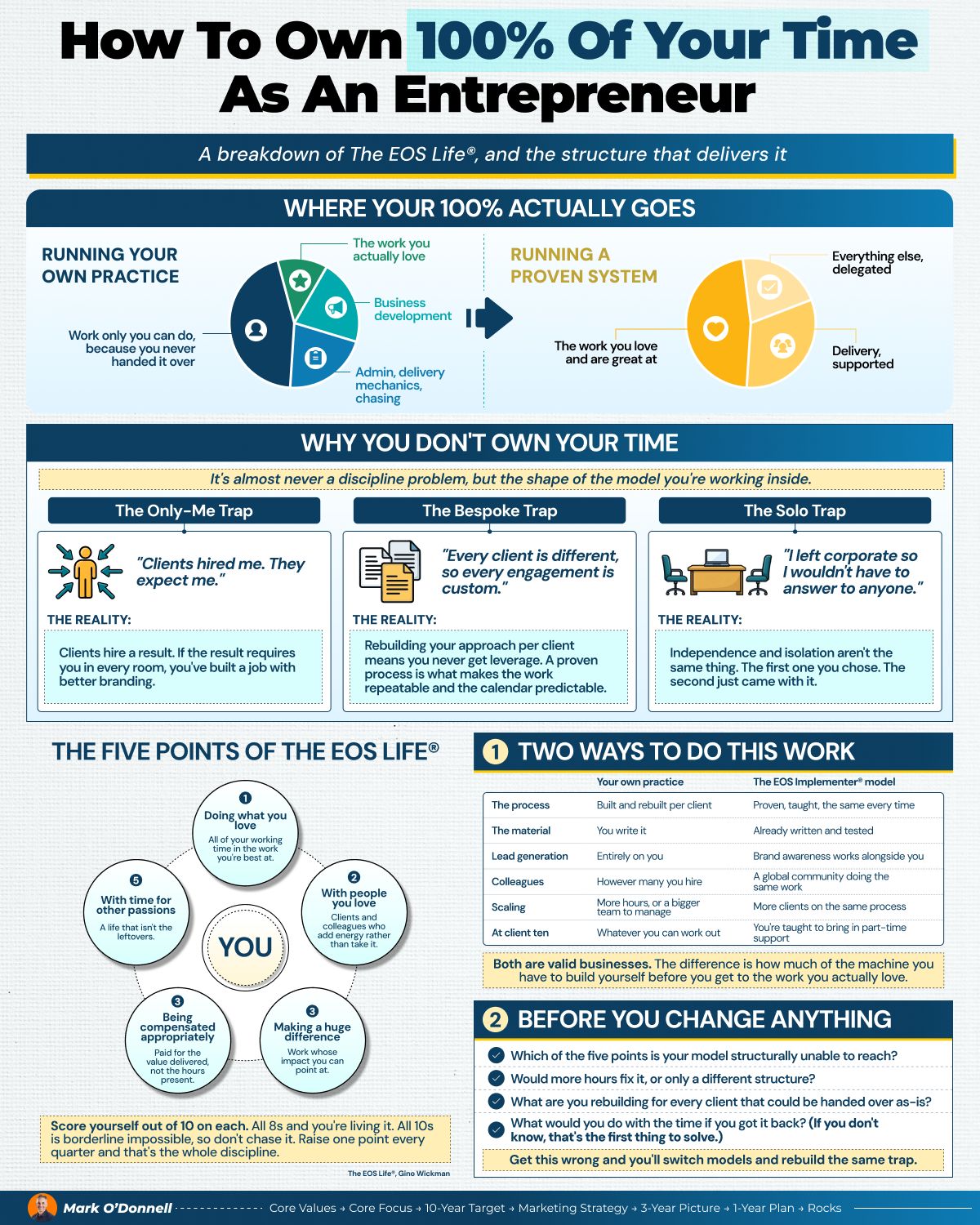
The core of O’Donnell’s discussion revolves around the principles outlined in “The EOS Life,” a framework designed to help entrepreneurs achieve a more balanced and fulfilling professional existence. According to O’Donnell, the book breaks down an entrepreneur’s ideal life into five distinct components, emphasizing the importance of achieving all of them, not just a select few.
As Mark O’Donnell explains, these five essential parts are:
- Doing what you love: Ensuring that working hours are dedicated to the tasks one is genuinely great at.
- With people you love: Surrounding oneself with clients and colleagues who are positive influences.
- Making a huge difference: Clearly seeing the impact and positive changes resulting from one’s work.
- Being compensated appropriately: Earning compensation that reflects the true worth of the work, rather than simply the time spent.
- With time for other passions: Having sufficient time and energy for life outside of work.
O’Donnell suggests a self-assessment method where individuals rate themselves out of ten for each component. He notes that achieving scores of ‘8’ indicates one is living “The EOS Life,” while acknowledging that perfect ’10s’ are largely unattainable and not the primary goal.
The Challenge of Solopreneurship and the Importance of Model
For solo practitioners, O’Donnell anticipates that self-assessments often reveal high scores in work and compensation, but low scores in available time, and potentially in the quality of people. He dismisses the idea that this imbalance is solely a matter of willpower or boundary-setting.
Mark O’Donnell argues that the fundamental issue lies in the business model itself:
“When you sell your own hours one client at a time, you’re sitting in a seat you can’t get out of. The money shows up when you’re in the room, so more money means more rooms.”
This structure, he posits, means that increased income directly correlates with more time spent in client sessions, creating a difficult cycle to break. The math of this model, as O’Donnell points out, makes it challenging to scale personal time while increasing revenue.
EOS Implementation as a Solution
O’Donnell presents becoming an EOS Implementer as a viable pathway to overcome these inherent limitations. He explains that this model provides a pre-established structure and process, removing the need to constantly reinvent the wheel for each new client.
According to Mark O’Donnell:
“There’s brand awareness pulling the same direction you are, and hundreds of people doing this same work you can call up on a Tuesday. You just add clients instead of rebuilding the whole thing every time someone signs.”
He further details a practical rule within the EOS framework: upon reaching ten clients, hiring a part-time assistant to handle administrative tasks, thereby preserving the core session work for the implementer.
O’Donnell concludes by suggesting that for entrepreneurs envisioning a more balanced and fulfilling practice, exploring the EOS Implementer path might be a worthwhile consideration. He also promotes an upcoming live session hosted by Kelly Knight for those interested in learning more about the EOS system.
📝 About This Content
This article is based on insights shared by Mark O'Donnell on LinkedIn.
📅 Originally posted on September 12, 2026 | View original post on LinkedIn →