
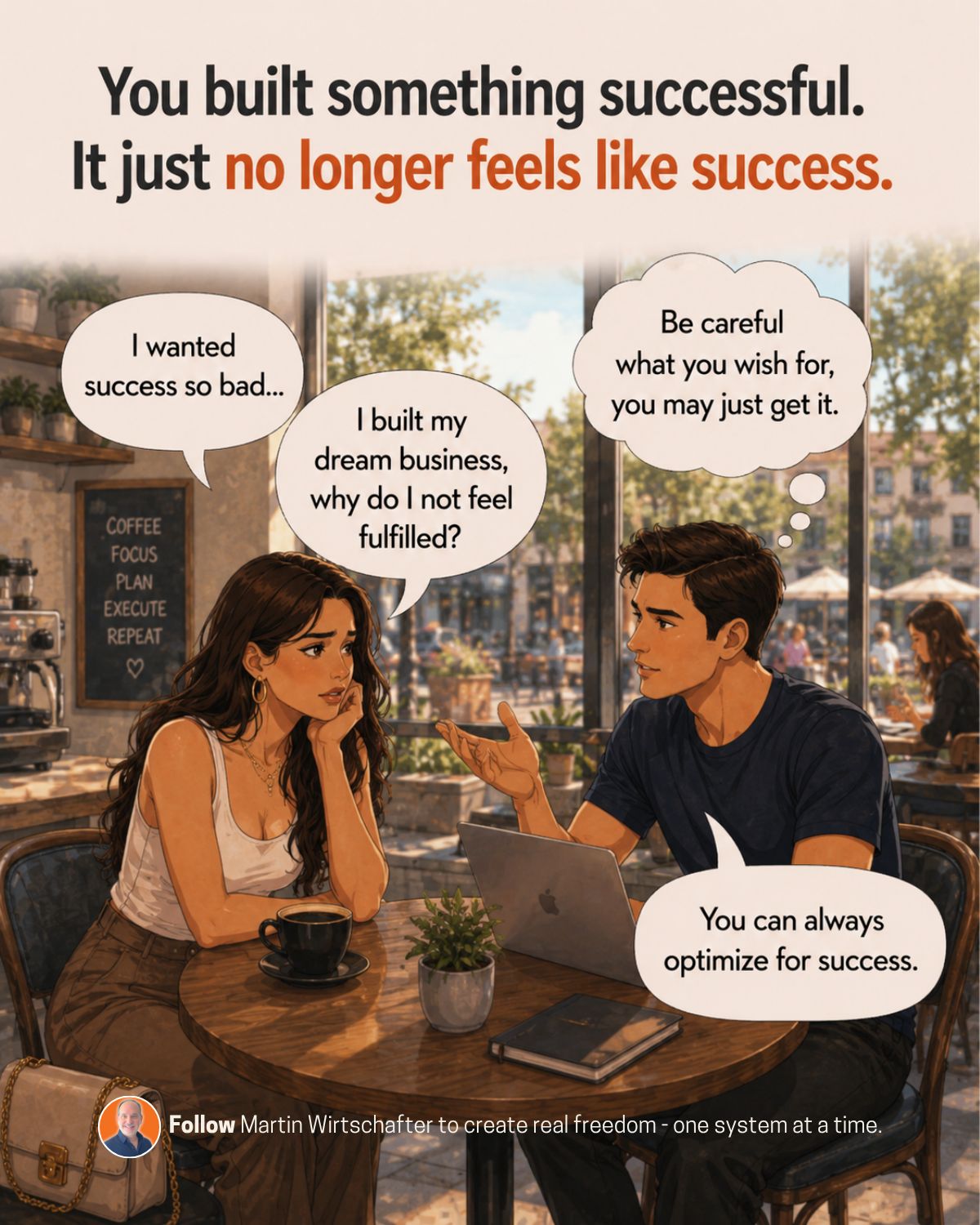
In a recent LinkedIn post, Martin Wirtschafter shares a personal realization about the potential disconnect between building a dream business and the personal life that accompanies it. He details his journey of achieving significant entrepreneurial success, only to find himself feeling unfulfilled and essential to the point of being indispensable, which ultimately hindered his own freedom and the company’s scalability.
Wirtschafter describes the outward appearance of his success: a company operating across three continents, with remote teams established long before the trend, and advanced technology. However, beneath this facade of achievement, he felt a diminishing excitement and a sense of predictability in his work. “The work that once energized me had become predictable,” he writes. “I could feel myself giving the business less than it deserved.” This realization led him to understand that while he had built his dream business, the life that came with it was not what he truly desired.
The Challenge of Indispensability
A significant hurdle Wirtschafter faced was his own indispensability. The business had become so reliant on his direct involvement that his absence would cause operations to slow down. “Too much still ran through me,” he explains. “If I stepped away, decisions slowed and work started waiting.” This situation, common among many founders, highlighted a critical flaw: the business’s value and its founder’s personal freedom were inversely related. As the business grew more valuable, it demanded more of the founder’s time and attention, paradoxically reducing their freedom.
“A founder can feel essential and still be holding the company back.”
Implementing ‘Freedom by Design’
To break this cycle, Wirtschafter implemented a deliberate strategy he calls “freedom by design.” He instituted a personal rule: every Wednesday, he would “fire” himself from one responsibility. This initially started as a lighthearted experiment but evolved into a structured process of delegation and documentation. He began codifying processes that had only existed in his head and empowered team members to make decisions autonomously.
The Process of Gradual Release
Over eight months, this consistent practice of relinquishing control allowed the business to evolve. Wirtschafter observed that the company began to run more efficiently, and the team developed a greater sense of ownership. “Week by week, the business stopped waiting for my input,” he notes. This process not only improved the company’s operational independence but also significantly increased its market value when it came time to sell. A buyer could see a business that was robust and capable of continuing to perform without the founder’s constant oversight.
“The real work is building something that keeps moving when you step away.”
Wirtschafter argues that the true measure of a successful business is its ability to operate and grow independently of its founder. “The more valuable the company becomes, the less it should depend on you,” he states. This principle is key to achieving what he terms “freedom by design” – being present in life while having the option to be less critical at work.
Key Takeaways for Founders
Wirtschafter’s insights offer a crucial perspective for entrepreneurs. He encourages founders to actively work towards reducing their own centrality within their businesses. His post serves as a powerful reminder that building a sustainable and valuable company requires not just innovation and growth, but also the strategic delegation and empowerment of the team. He concludes with a direct call to action:
“Your business should need a little less of you each week. Start this week by handing off one responsibility that no longer needs to sit with you.”
His message is clear: true entrepreneurial success lies in building a business that thrives independently, granting the founder the freedom they sought when they first embarked on their entrepreneurial journey.
📝 About This Content
This article is based on insights shared by Martin Wirtschafter on LinkedIn.
📅 Originally posted on July 30, 2026 | View original post on LinkedIn →