
In a recent LinkedIn post, Mark O’Donnell delves into a subtle yet pervasive issue within organizations: the phenomenon of employees being in the ‘wrong seat,’ even when performing their jobs competently. O’Donnell, a consultant who has worked with numerous leadership teams, argues that this situation is often overlooked because it doesn’t always present as outright failure.
He highlights that loyalty, habit, or a reluctance to admit a mistake can keep individuals in roles that aren’t the right fit. This leads to a state of functional mediocrity, where work is done ‘well enough’ but without genuine engagement or fulfillment.
“The wrong seat doesn’t always look like failure. Sometimes it’s someone doing their job well and feeling nothing.”
O’Donnell emphasizes that being in the wrong role is not a reflection of an individual’s inherent value, but rather a fundamental mismatch between the demands of the position and the person’s core capabilities and inclinations. This misalignment, he warns, carries significant costs for the individual, their colleagues, and the business as a whole.
Identifying the Subtle Signs of a Mismatch
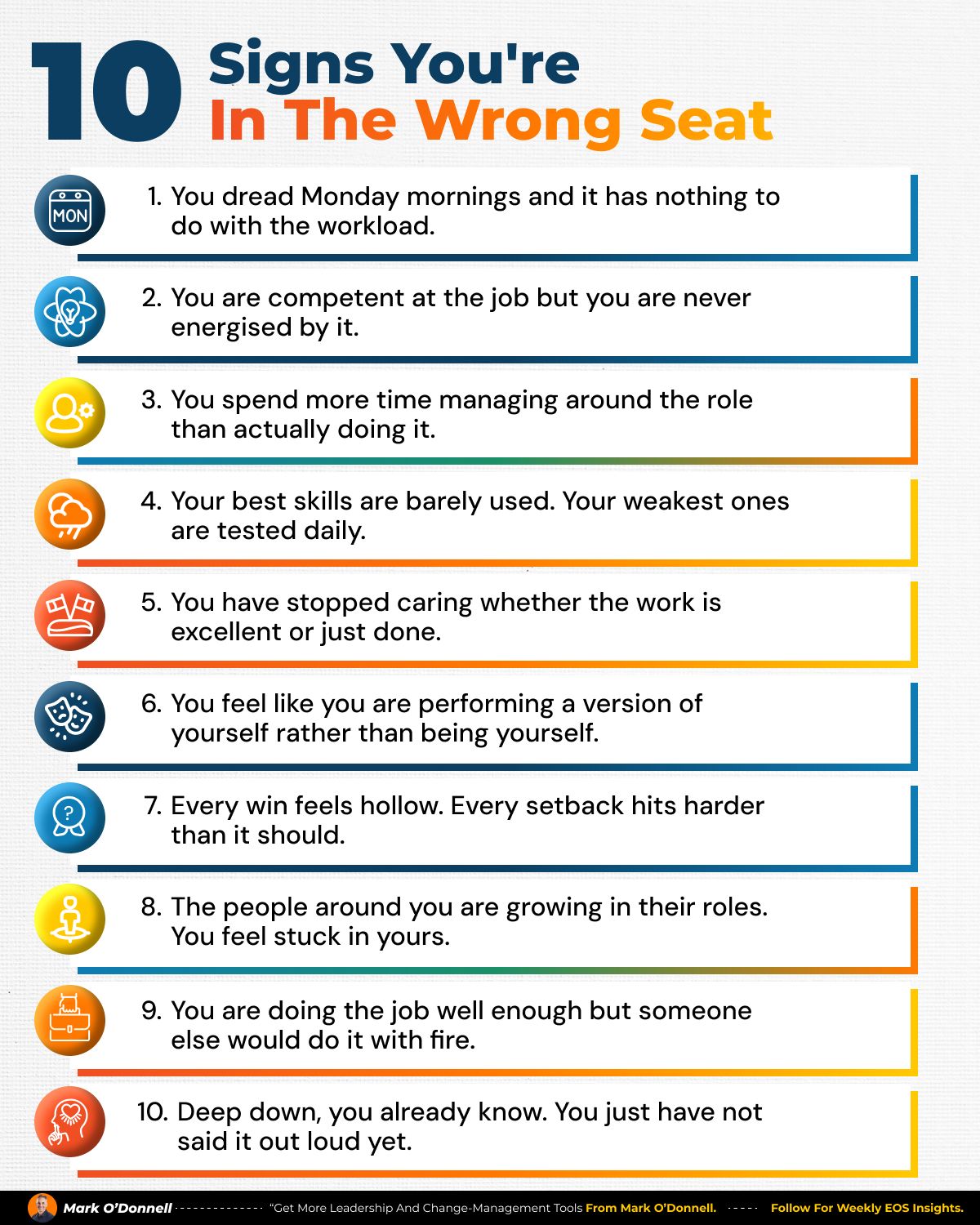
According to O’Donnell, the indicators of being in the wrong seat are often clear in hindsight but easily rationalized away in the moment. He provides a list of common signs that leaders and individuals should watch for:
- A disproportionate dread of Sunday evenings.
- Performing a job capably without deriving any energy from it.
- Spending more time navigating the role’s limitations than executing its core functions.
- Rarely utilizing strong skills while constantly being tested on weaker ones.
- A decline in the desire for excellence, with ‘done’ being sufficient.
- Feeling like one is playing a role rather than being authentic at work.
- Wins feeling hollow and setbacks feeling deeply personal.
- Observing colleagues grow while feeling stagnant.
- Recognizing that someone else could bring more passion and effectiveness to the role.
- An internal acknowledgment of the mismatch that has yet to be voiced.
Reframing the ‘Wrong Seat’ as Informational Data
A key aspect of O’Donnell’s message is his proposed reframe for leadership teams. He suggests viewing the ‘wrong seat’ not as a negative judgment on an employee’s worth, but as valuable information.
“The reframe I give every leadership team I work with: The wrong seat isn’t a verdict on someone’s value. It’s information.”
As O’Donnell points out, acting on this information promptly benefits everyone involved. He states that the presence of the right person in the wrong seat is a common and expensive problem in business, but one that is highly solvable once acknowledged with honesty.
“The right person in the wrong seat is one of the most common and most costly problems I see in business. It’s also one of the most fixable, once you’re honest about it.”
O’Donnell’s insights underscore the importance of organizational alignment and the potential pitfalls of overlooking subtle indicators of employee dissatisfaction or disengagement. By recognizing these signs and reframing the issue as actionable data, businesses can foster environments where individuals are not only productive but also genuinely fulfilled, leading to better outcomes for all stakeholders.
📝 About This Content
This article is based on insights shared by Mark O'Donnell on LinkedIn.
📅 Originally posted on March 22, 2026 | View original post on LinkedIn →