
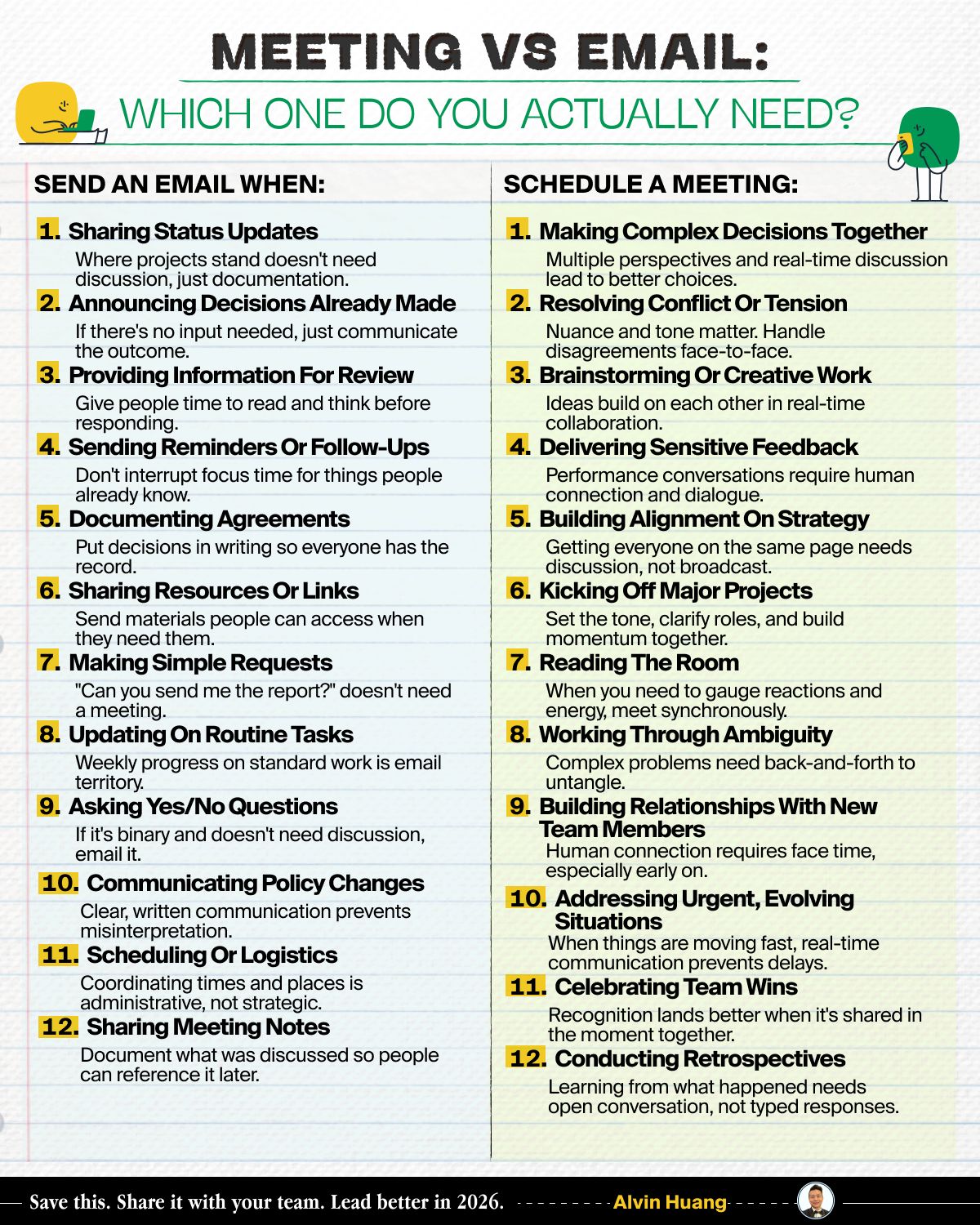
In a recent LinkedIn post, Alvin Huang discusses a pervasive drain on workplace productivity: excessive meetings. Huang argues that the decision of when to call a meeting versus when to send an email is a critical, yet often overlooked, leadership skill. He observes that many professionals default to scheduling calls because it feels productive, but this practice can actually signal a lack of thoughtful communication strategy.
The True Cost of “Unnecessary” Meetings
Huang emphasizes the significant toll unnecessary meetings take on a company’s resources. He illustrates this point with a stark calculation: “A 30-minute meeting with 6 people isn’t 30 minutes, it’s 3 hours of company time.” This figure doesn’t even account for the additional costs associated with context switching, where employees lose focus and efficiency by jumping between different tasks and discussions.
“Every unnecessary meeting burns collective hours.”
According to Huang, meetings should be reserved for specific, high-value activities such as collaboration, decision-making, and alignment. He contends that if information can be effectively conveyed and understood independently, a meeting is likely superfluous.
Email vs. Meeting: A Framework for Effective Communication
To help professionals make more informed choices, Alvin Huang outlines clear criteria for when to utilize email versus scheduling a meeting. He suggests sending an email when:
- Sharing project updates that require no discussion.
- Providing materials for review.
- Announcing a decision that has already been finalized.
- Making simple requests.
- Following up or sending reminders.
- Documenting agreements.
- Sharing links or resources.
Conversely, Huang identifies scenarios where a meeting is more appropriate:
- Kicking off major projects.
- Delivering sensitive feedback.
- Building strategic alignment.
- Addressing urgent, fast-moving situations.
- Onboarding new team members.
- When gauging reactions or reading the room is essential.
- Navigating ambiguity that requires interactive discussion.
“The test is simple: if people could fully understand and act on this information on their own time, skip the meeting.”
Huang asserts that opting for email when appropriate is not a sign of laziness but rather a demonstration of respect for colleagues’ time and focus, which he views as a hallmark of true leadership.
A Call to Action: Auditing Your Calendar
Concluding his post, Alvin Huang issues a direct challenge to his audience: audit your calendar for the upcoming week and identify at least three meetings that could be effectively replaced with an email. He encourages readers to observe the impact of this change.
“Sending an email when it makes sense isn’t lazy. It shows you respect people’s time and focus. And that’s true leadership.”
By providing this practical framework and encouraging self-reflection, Huang aims to help professionals reclaim valuable time and enhance overall productivity within their organizations. He prompts further discussion by asking what types of unnecessary meetings are most frustrating to others.
📝 About This Content
This article is based on insights shared by Alvin Huang on LinkedIn.
📅 Originally posted on March 7, 2026 | View original post on LinkedIn →