
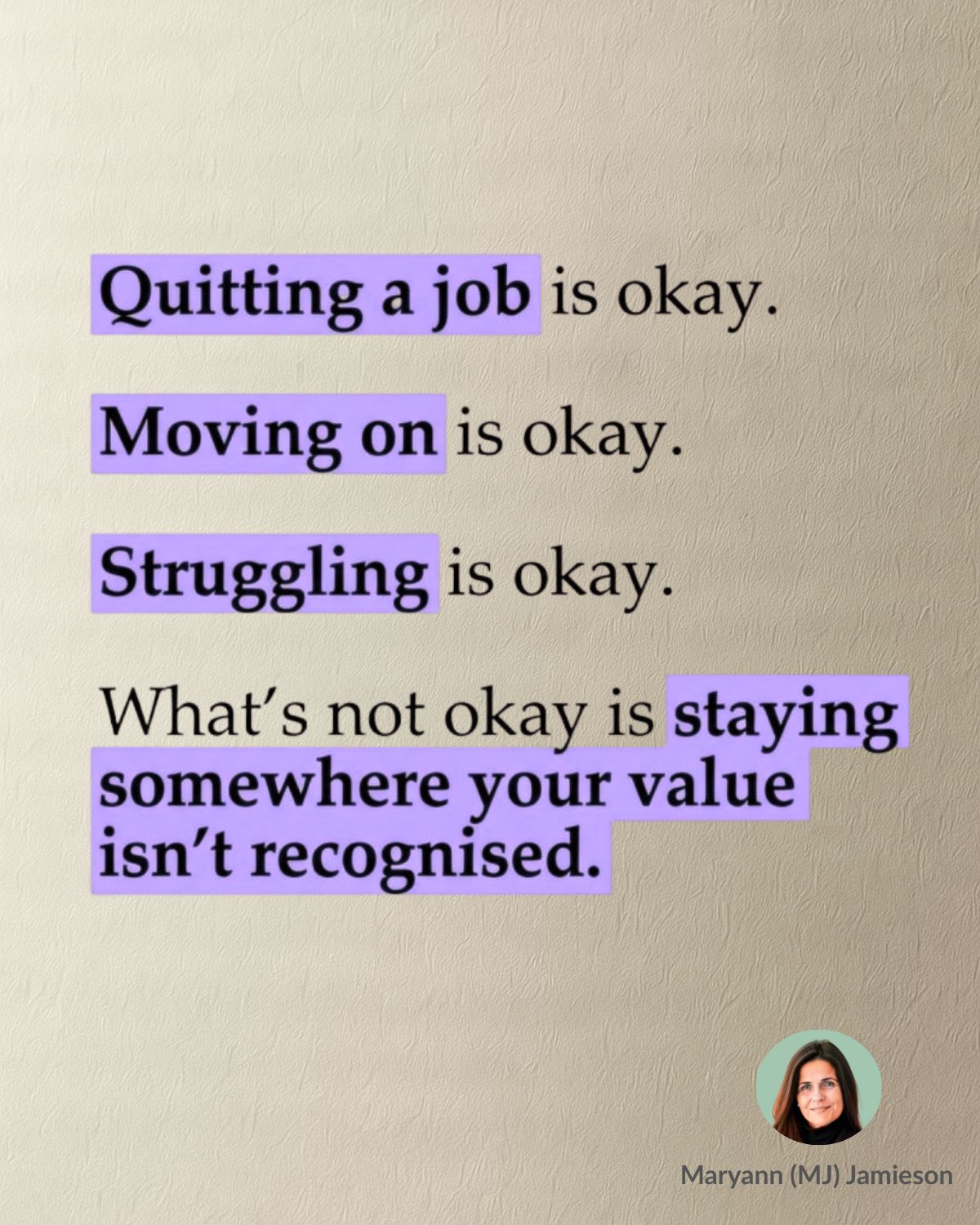
In a recent LinkedIn post, Maryann (MJ) Jamieson addresses a common yet often unacknowledged struggle faced by high-achieving professionals: the tendency to remain in roles where their contributions are undervalued, even when it’s detrimental to their career growth. Jamieson highlights the internal conflict between societal expectations of loyalty and the personal need for recognition.
Jamieson’s post begins by normalizing the difficult decisions professionals face, stating:
“Quitting a job is okay. Moving on is okay. Struggling is okay. What’s not okay is telling yourself you should be grateful while your value goes unseen.”
This powerful opening sets the stage for Jamieson’s exploration of why many high performers fall into this trap. According to Jamieson, deeply ingrained beliefs about loyalty, the promise of future improvement through patience, and the conditioning of self-worth based on external validation contribute to this phenomenon.
The Roots of Undervalued Loyalty
Jamieson argues that professional environments often foster a culture where loyalty is perceived as a paramount virtue. This can lead individuals to believe that staying put, regardless of the circumstances, is the right thing to do. Furthermore, Jamieson points out that past advice, such as being patient and trusting that situations would eventually improve, can keep professionals tethered to unfulfilling roles.
The post elaborates on how this can manifest in practice:
“You learned to make your self‑worth conditional on finally winning approval. So you worked harder. Volunteered more. Made yourself impossible to ignore.”
However, Jamieson critically observes that even these efforts may not yield the desired recognition from management, suggesting that a lack of recognition is often not about an individual’s effort but about the manager’s underlying priorities.
Identifying Unseen Value
A significant portion of Jamieson’s post is dedicated to helping individuals recognize when their value is genuinely not being seen or acted upon. Jamieson outlines three key indicators:
1. Exclusion from Succession Planning
Jamieson notes that a clear sign of being overlooked is when one is unaware of future leadership discussions or plans. As Jamieson puts it:
“Your name disappears from succession conversations. ↳ You find out about “future leaders” after the slide deck’s already been shared.”
2. Role Reduction to Execution
Another sign, according to Jamieson, is when a professional’s involvement is limited to executing decisions rather than influencing them. This shift, Jamieson explains, means their role has become about implementation, not strategic input.
3. Ideas Gaining Airtime Without Credit
Jamieson also highlights the subtle, yet damaging, experience of having one’s ideas adopted and presented by others without proper attribution. This lack of credit, Jamieson argues, signifies that while the ideas may be valued, the source is not prioritized.
The Empowerment of Moving On
Jamieson concludes with a message of empowerment, asserting that leaving a role or a manager who fails to recognize one’s contributions is not a failure but a strategic choice. The core message is that professionals are allowed to outgrow their positions and seek environments where their talents are acknowledged and leveraged.
In Jamieson’s view, staying in a situation where one is perceived as replaceable is a drain on potential. The act of leaving, therefore, becomes an act of self-preservation and career advancement. As Jamieson emphasizes, it’s about choosing to invest one’s best work in a place that values it. The post encourages professionals to recognize their worth and seek opportunities that align with their capabilities and aspirations.
📝 About This Content
This article is based on insights shared by Maryann (MJ) Jamieson on LinkedIn.
📅 Originally posted on February 23, 2026 | View original post on LinkedIn →