
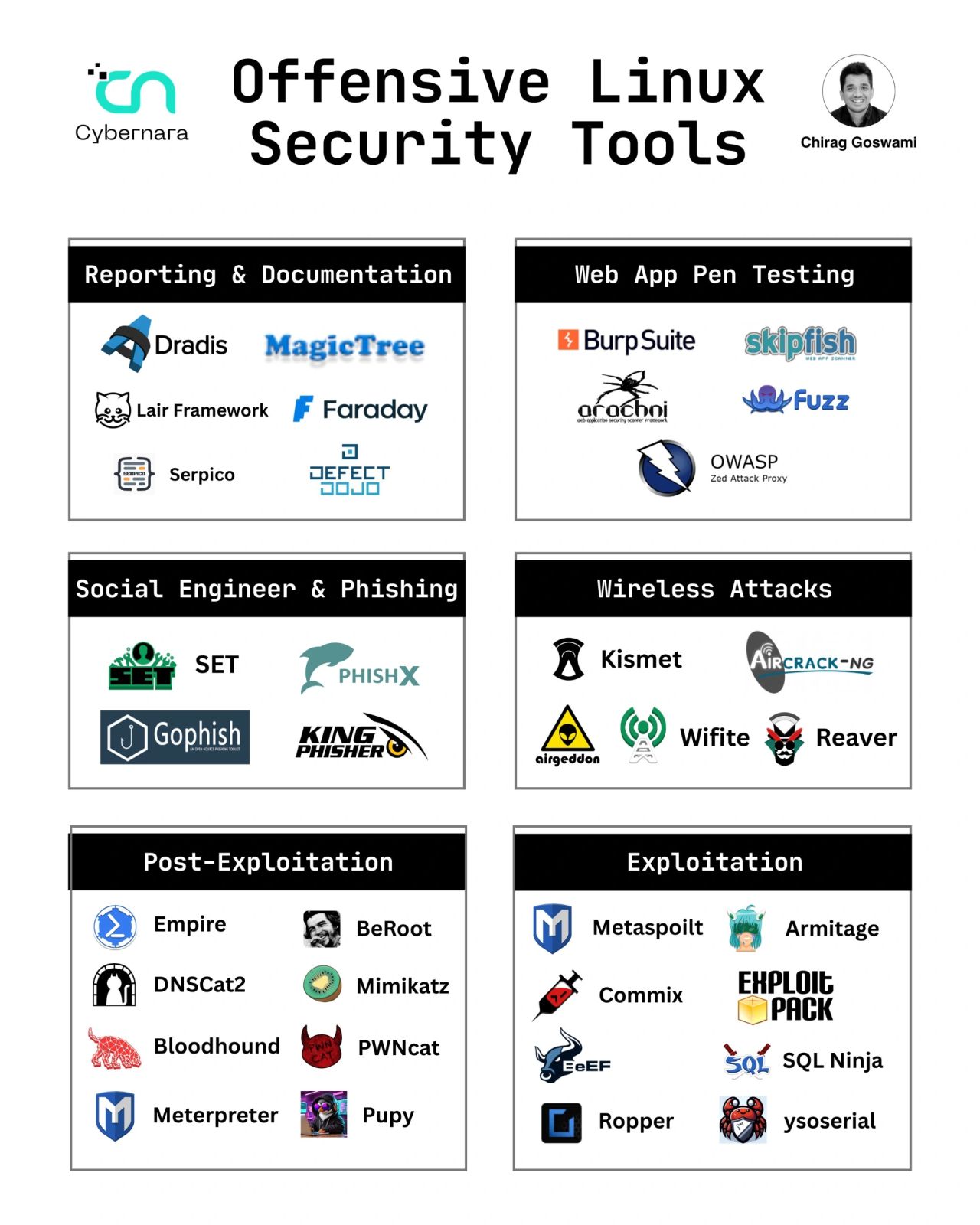
In a recent LinkedIn post, Chirag Goswami emphasizes that the true power in cybersecurity and ethical hacking lies not in the tools themselves, but in the skill and knowledge of the individual wielding them. Goswami, a prominent voice in the cybersecurity community, shared a detailed breakdown of various hacking tools across different domains, making a clear distinction between possessing the software and mastering its application.
Tools Are Just Enablers, Not Solutions
Goswami’s post highlights a common misconception in the field: that acquiring advanced tools automatically equates to advanced capabilities. He directly challenges this notion, stating:
Tools don’t hack systems. People do. 🧠 These are just what they use 👇
This fundamental point underscores Goswami’s argument that the human factor is paramount. The ability to strategize, adapt, and execute is what differentiates a skilled cybersecurity professional from someone merely operating software. As he elaborates:
Tools are easy to download
Knowing when and how to use themThat’s the real skill
This distinction is crucial for anyone looking to build a career in ethical hacking, penetration testing, or red teaming. Goswami’s perspective suggests that continuous learning and practical experience are far more valuable than simply accumulating a list of software.
Categorizing the Cybersecurity Arsenal
To illustrate his point, Goswami meticulously categorized common tools used in various cybersecurity disciplines. This breakdown serves not only to showcase the breadth of available resources but also to reinforce his central thesis about human expertise being the key differentiator.
Reporting and Reconnaissance
Goswami lists tools like Dradis, Faraday, and Serpico for reporting and data consolidation, emphasizing that these tools help organize findings, but the analysis and interpretation are human-driven.
Web Application Testing
In the realm of web app testing, he mentions industry staples such as Burp Suite, OWASP ZAP, and Arachni. These powerful tools are essential for identifying vulnerabilities, but their effective use requires a deep understanding of web technologies and attack vectors.
Phishing and Social Engineering
For phishing simulations, Goswami points to SET (Social-Engineer Toolkit), Gophish, and King Phisher. He implies that the success of a phishing campaign, even a simulated one, depends heavily on the attacker’s ability to craft convincing lures and social engineering tactics, not just the tool’s features.
Network and Wireless Security
Tools like Aircrack-ng, Kismet, and Reaver are highlighted for wireless security testing. Similarly, in exploitation, Metasploit, Commix, and SQL Ninja are mentioned. Goswami’s underlying message is consistent: these are instruments, and their effectiveness is directly proportional to the user’s proficiency.
Post-Exploitation Techniques
The post-exploitation phase, often considered the most critical, includes tools like Mimikatz, Empire, and BloodHound. Goswami implicitly argues that navigating this complex stage, gathering critical data, and maintaining persistence requires sophisticated human intelligence and planning.
The Path Forward: Skill Over Software
Chirag Goswami’s LinkedIn post serves as a valuable reminder for aspiring and established cybersecurity professionals alike. By focusing on the critical role of human skill, he encourages a more thoughtful approach to tool acquisition and development. The emphasis is clearly on continuous learning, practical application, and understanding the ‘why’ and ‘how’ behind each action in the cybersecurity landscape.
Goswami concludes by inviting engagement, asking:
Which area are you exploring right now?
This question encourages a community dialogue, further reinforcing the idea that shared knowledge and experience are vital components of mastering the complex field of cybersecurity. For organizations looking to assess their security posture, Goswami also subtly points towards solutions like 3C ITS Cybernara for safe attack simulations, further contextualizing the practical application of these skills.
📝 About This Content
This article is based on insights shared by Chirag Goswami on LinkedIn.
📅 Originally posted on April 13, 2026 | View original post on LinkedIn →