
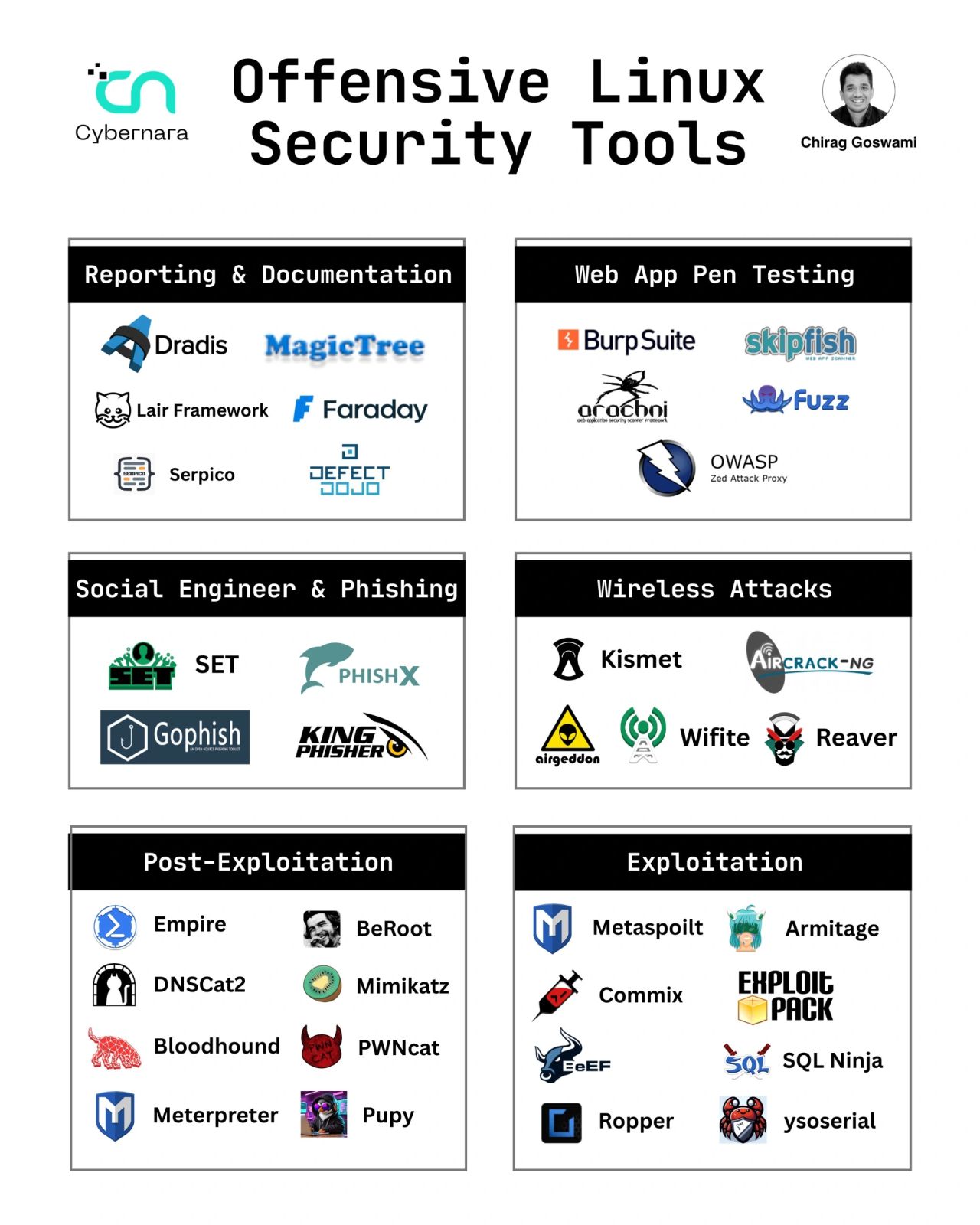
In a recent LinkedIn post, Chirag Goswami highlights a crucial distinction in the realm of cybersecurity: the difference between possessing tools and wielding them effectively. The post, which has garnered attention from industry professionals, emphasizes that true expertise in areas like ethical hacking and penetration testing lies not in the availability of software, but in the knowledge and skill of the individual using it.
Goswami directly addresses a common misconception, stating:
Tools don’t hack systems. People do. 🧠 These are just what they use 👇
This opening immediately sets the stage for Goswami’s argument that the human factor is paramount in cybersecurity operations. He proceeds to categorize various tools used in different domains of cyber warfare, from reporting and web application testing to phishing and exploitation.
Understanding the Tools of the Trade
Chirag Goswami meticulously lists a range of tools under distinct categories, offering a snapshot of the modern cybersecurity toolkit. These categories include:
- Reporting: Dradis, Faraday, Serpico
- Web App Testing: Burp Suite, OWASP ZAP, Arachni
- Phishing: SET, Gophish, King Phisher
- Wireless: Aircrack-ng, Kismet, Reaver
- Exploitation: Metasploit, Commix, SQL Ninja
- Post-Exploitation: Mimikatz, Empire, BloodHound
While the enumeration of these tools provides a valuable reference for those in the field, Goswami’s core message transcends mere listing. He stresses that accessibility to these powerful instruments is not the barrier to entry in cybersecurity.
The Real Skill: Application and Intent
The crux of Chirag Goswami’s message lies in the application of these tools. He argues that the true challenge and differentiator for cybersecurity professionals is not acquiring the software, but understanding its strategic deployment. Goswami articulates this point clearly:
Tools are easy to download. Knowing when and how to use them. That’s the real skill.
According to Goswami, this nuanced understanding encompasses recognizing vulnerabilities, planning attack vectors, interpreting results, and adapting methodologies based on the specific target environment. It requires critical thinking, problem-solving abilities, and a deep comprehension of system architecture and human behavior—elements that software alone cannot replicate.
The Human Element in Red Teaming and Ethical Hacking
Goswami’s insights are particularly relevant to the practices of red teaming and ethical hacking. These disciplines require professionals to think like adversaries, identifying weaknesses before malicious actors can exploit them. As Chirag Goswami points out, this necessitates a continuous learning process, staying abreast of evolving threats and techniques, and mastering the art of tool utilization rather than simply collecting them.
The post concludes with an interactive question, inviting engagement from his network: “Which area are you exploring right now?” This prompts reflection on individual skill development and areas of focus within the vast cybersecurity landscape. Goswami also subtly promotes his own company, 3C ITS Cybernara, as a resource for safe system testing, reinforcing the practical application of cybersecurity principles.
In essence, Chirag Goswami’s LinkedIn post serves as a timely reminder that in the ever-evolving world of cybersecurity, sophisticated tools are merely extensions of human ingenuity and expertise. The true measure of a professional’s capability lies in their knowledge, strategic thinking, and the skillful application of the resources at their disposal.
📝 About This Content
This article is based on insights shared by Chirag Goswami on LinkedIn.
📅 Originally posted on April 13, 2026 | View original post on LinkedIn →