
In a recent LinkedIn post, cybersecurity professional Chirag Goswami highlights a crucial distinction often overlooked in the realm of digital security: the primary role of human skill over the tools themselves. Goswami emphasizes that while various sophisticated tools exist for different facets of cybersecurity, it is the practitioner’s knowledge and application of these tools that truly determine their effectiveness.
Goswami leads with a strong, declarative statement that cuts through the common focus on software and hardware:
Tools don’t hack systems. People do. 🧠
This assertion sets the stage for his argument that the human element is the critical factor in both offensive and defensive cybersecurity operations. He clarifies that the tools, while essential, are merely the instruments used by skilled individuals.
The Spectrum of Cybersecurity Tools
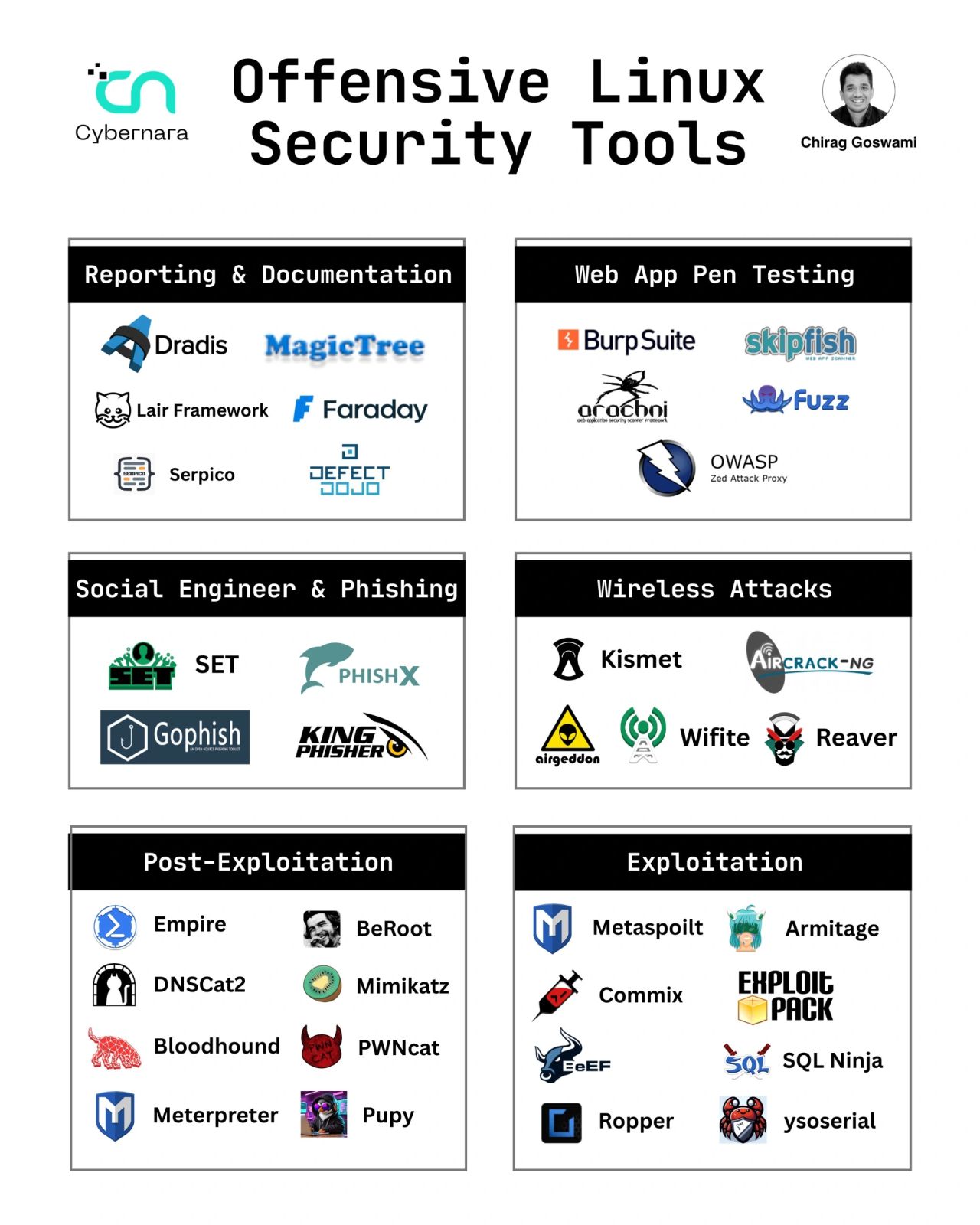
Goswami then proceeds to categorize and list a wide array of tools used across different cybersecurity domains, illustrating the breadth of the field. This detailed breakdown underscores the variety of technical resources available to professionals.
Reporting and Web Application Testing
For reporting and system analysis, Goswami lists tools such as Dradis, Faraday, and Serpico. In the domain of web application testing, he names industry standards like Burp Suite, OWASP ZAP, and Arachni. As Goswami points out:
Web App Testing
Burp Suite • OWASP ZAP • Arachni
Phishing, Wireless, and Exploitation
The post continues to detail tools for specific attack vectors. In phishing simulations, Goswami mentions SET, Gophish, and King Phisher. For wireless network security, tools like Aircrack-ng, Kismet, and Reaver are cited. When it comes to exploitation, a critical phase in penetration testing, Goswami includes Metasploit, Commix, and SQL Ninja.
Post-Exploitation Capabilities
Further elaborating on the attacker’s toolkit, Goswami touches upon post-exploitation, the phase after initial system compromise. Here, he lists potent tools such as Mimikatz, Empire, and BloodHound, which are used to maintain access, escalate privileges, and map out compromised environments.
Skill: The Differentiating Factor
Despite the extensive list of tools, Goswami reiterates his core message. The ease with which these tools can be obtained is contrasted with the difficulty of mastering their application. According to Goswami:
Tools are easy to download
Knowing when and how to use them
That’s the real skill
This statement encapsulates his belief that true expertise in cybersecurity lies not in possessing the latest software, but in understanding the strategic and tactical nuances of its deployment. He argues that a deep understanding of systems, vulnerabilities, and attacker methodologies is what empowers a professional to leverage these tools effectively for ethical hacking, penetration testing, or red teaming.
The Human-Centric Approach to Cybersecurity
Goswami concludes by inviting engagement, asking his audience which area they are currently exploring. He also subtly promotes his organization, 3C ITS Cybernara, as a resource for simulating real-world attacks safely. Through this post, Chirag Goswami effectively shifts the focus from technology to the technologist, underscoring that in the complex world of cybersecurity, human intelligence and skill remain the most formidable assets.
📝 About This Content
This article is based on insights shared by Chirag Goswami on LinkedIn.
📅 Originally posted on April 13, 2026 | View original post on LinkedIn →