
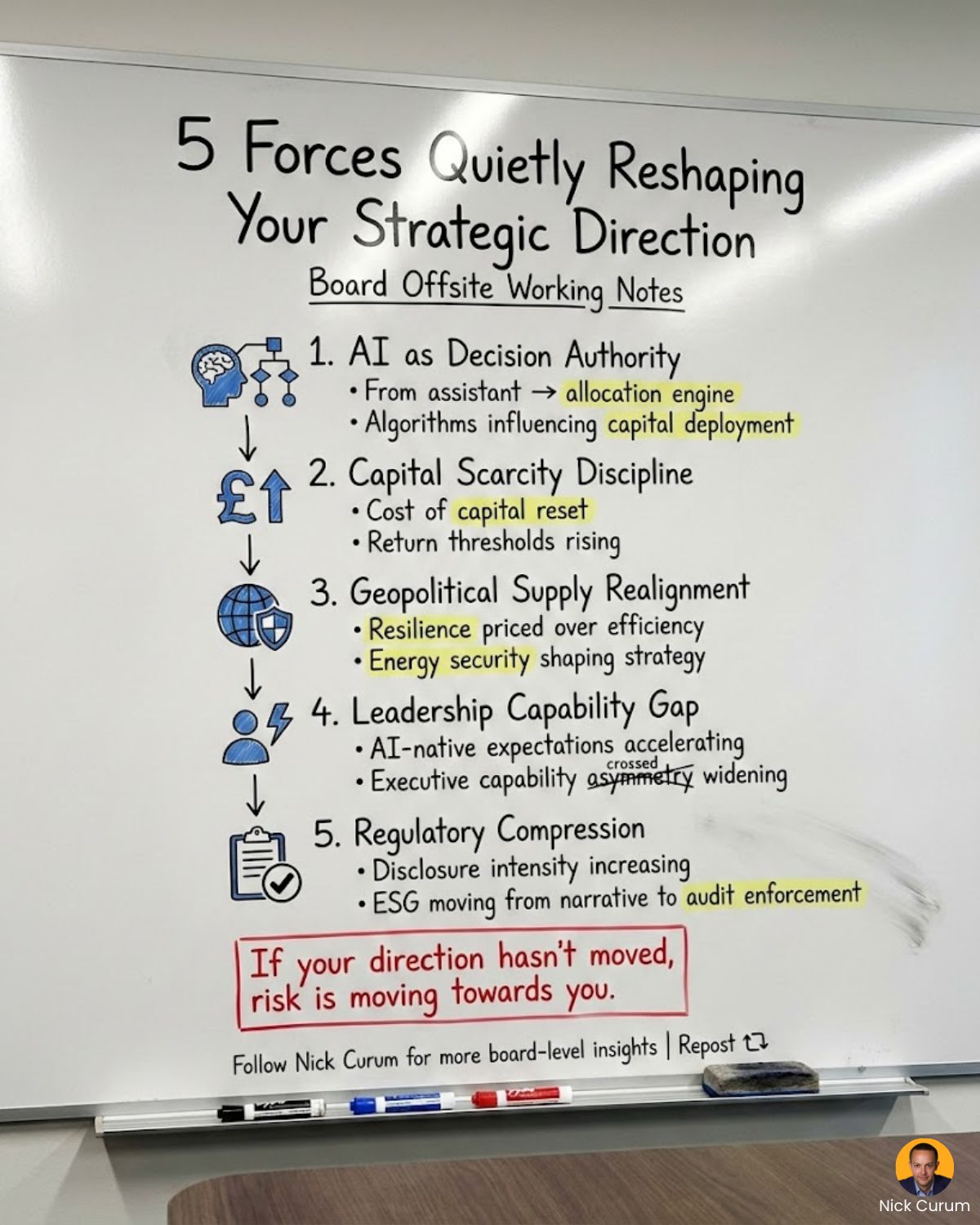
In a recent LinkedIn post, Nick Curum discusses a critical disconnect he observes between how boards perceive their role in setting strategic direction and the reality of how that direction is actually being shaped. Curum argues that many boards operate under the assumption they are in control of strategic decisions, when in fact, powerful, often unseen structural forces are quietly and irreversibly altering the company’s course.
Curum highlights that this shift is not typically driven by dramatic announcements but by subtle, cumulative changes. He points to several key factors currently influencing capital allocation and strategic choices before formal board discussions even occur. These include the pervasive impact of Artificial Intelligence (AI), a fundamental reset in the cost of capital, the imperative of energy security reshaping supply chains, and the rapid compression of strategic options due to regulation.
“AI is influencing capital allocation before committees even meet. The cost of capital has reset what returns are worth pursuing. Energy security is rewriting supply chain logic from the ground up. Regulation is compressing strategic optionality, fast. Capability gaps are widening faster than most leadership teams will admit out loud.”
The Subtle Erosion of Board-Set Direction
The core of Curum’s argument centers on the uncomfortable observation that even when strategy decks appear robust, actual decision-making can reveal a significant ‘drift.’ As Nick Curum notes, tracing decisions over a 12-month period often exposes a divergence from the stated strategy.
He elaborates on this phenomenon:
Evidence of Strategic Drift
- Capital Allocation: Funds may flow into areas not explicitly prioritized in the formal strategy.
- Risk Tolerance: The board’s or executive team’s appetite for risk may shift without a formal re-evaluation.
- Hiring and Partnerships: Decisions about talent acquisition and strategic alliances can subtly alter the company’s trajectory.
According to Nick Curum, this drift is not necessarily a failure of governance in the traditional sense. Instead, it represents what happens when significant external forces reshape the operating environment, and the board has not explicitly re-underwritten its strategic position against these new realities.
“Direction moved. No one named it. And capital kept flowing as if nothing had changed. That is how mispriced risk compounds.”
The Imperative of Re-Underwriting Strategy
This observation leads Curum to pose a challenging question for modern boards: Should they be formally re-underwriting their strategic direction at regular intervals, perhaps every 12 to 18 months, given the current volatile environment? He contrasts this with the possibility that the need for such frequent resets might indicate that the original strategic conviction was never robust enough.
Nick Curum emphasizes that he is observing a prevalence of this ‘quiet drift’ over explicit strategic resets. This raises a critical concern for organizational leadership and governance.
“Is your board proactively reshaping direction, or defending a version set three years ago? Worth pressure-testing before your next board offsite.”
Curum’s analysis suggests that boards must move beyond the assumption of continuous control and actively engage with the dynamic forces shaping their industries. Proactive re-evaluation, rather than passive adherence to outdated plans, is essential to ensure that strategic direction remains relevant and aligned with the evolving business landscape. He encourages leaders to critically assess whether their board’s direction is a product of current realities or a relic of past assumptions.
📝 About This Content
This article is based on insights shared by Nick Curum on LinkedIn.
📅 Originally posted on March 3, 2026 | View original post on LinkedIn →