
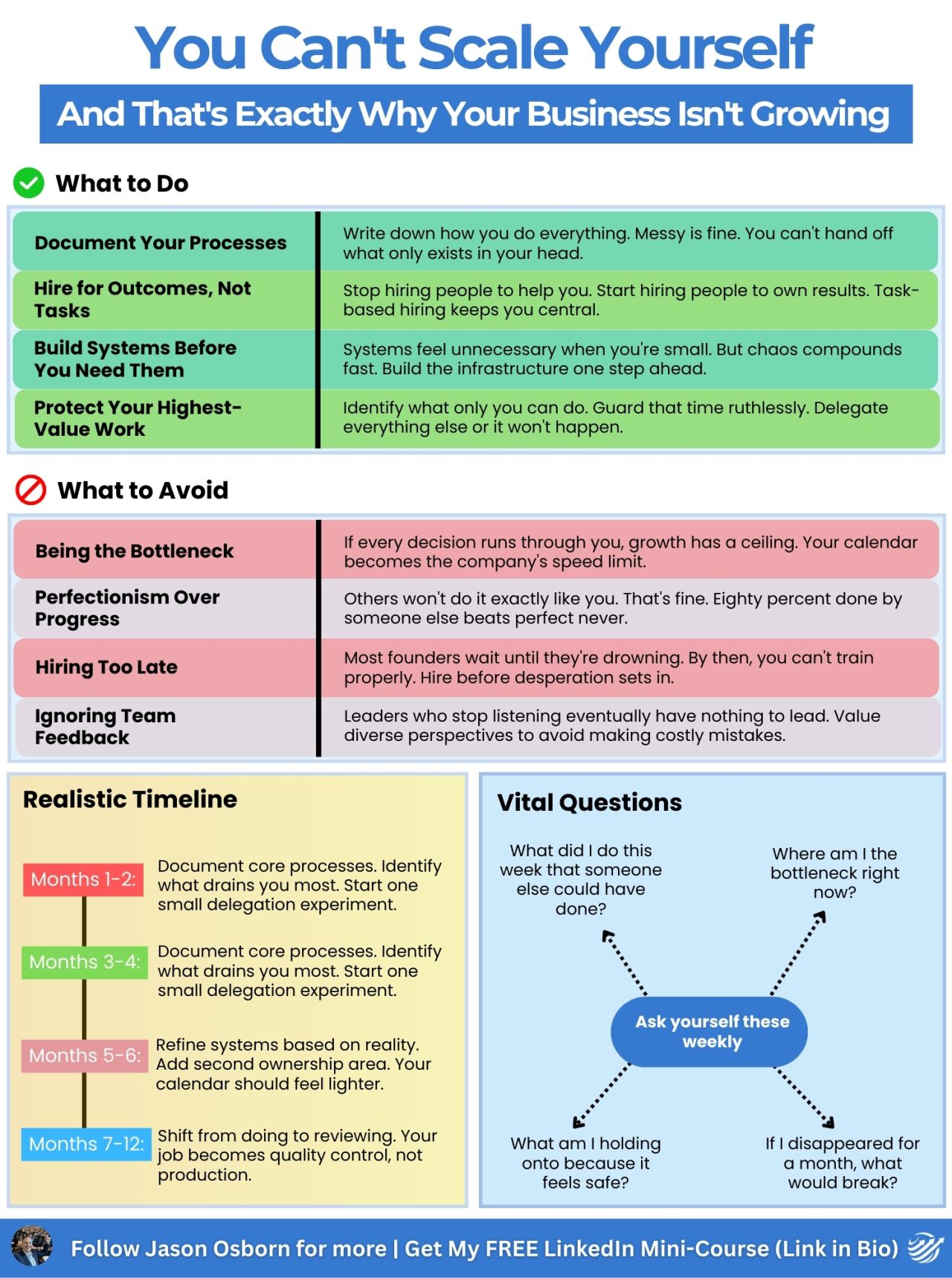
In a recent LinkedIn post, Jason Osborn tackles a common yet critical challenge faced by many entrepreneurs: the inability to scale their business because they, as the founder, have become indispensable. Osborn argues that this perceived success in being essential is, in fact, a significant bottleneck to growth, trapping founders in a cycle of overwork and stalled revenue.
Osborn highlights the paradox that founders often find themselves in. While their dedication and involvement are crucial in the early stages, this very indispensability becomes a barrier as the business aims for expansion. He points out that this situation isn’t necessarily due to a lack of a good idea or market demand, but rather stems from the founder’s central role in every aspect of the operation.
The Founder Trap: Becoming the Business
According to Osborn, many businesses don’t fail due to poor strategy or market conditions, but because the founder becomes synonymous with the business itself. This often manifests in several ways, creating what he terms “The Founder Trap”:
- Every client relationship runs through the founder.
- Every significant decision requires their approval.
- Every problem ultimately lands on their desk.
- Every critical process exists primarily within their own knowledge.
Osborn contends that while this might feel like control, it functions more like a cage. The founder’s personal capacity then becomes the absolute ceiling for the company’s growth potential. He elaborates on this point:
“Your capacity becomes the company’s ceiling. And there’s no way to grow past that without changing how you operate.”
This dependency, Osborn explains, prevents the business from operating autonomously and achieving scalable growth.
Scaling by Becoming Less Necessary
The core of Osborn’s argument is that true scalability comes not from working harder, but from strategically reducing one’s own necessity within the business. This counter-intuitive idea is central to his advice for founders stuck in the growth plateau.
Shifting Focus from Doing to Enabling
Osborn challenges the traditional mindset of founders. Instead of asking, “How do I get this done faster?” he urges them to ask, “Who else could own this completely?” This shift in perspective is crucial for moving away from being the central executor and towards building a system that can thrive independently.
He emphasizes that the goal is not simply to delegate tasks, but to delegate ownership. This involves hiring individuals who are empowered to make decisions and own outcomes, rather than just performing assigned duties. Osborn states:
“Don’t delegate tasks. Delegate ownership.”
This approach, he argues, frees up the founder’s time and mental energy to focus on strategic direction and higher-level growth initiatives, rather than getting bogged down in day-to-day operations.
The Messy Transition to Scalability
Osborn acknowledges that this transition is not easy and involves a period of discomfort and potential chaos. He outlines a timeline for this shift:
- Month One: This phase involves the uncomfortable process of documenting seemingly obvious processes and letting go of tasks the founder could do themselves, even if imperfectly executed by others.
- Month Three: The business may feel chaotic as things are not done to the founder’s exact standard, leading to self-doubt. However, space begins to appear on the founder’s calendar, and problems start getting solved without their direct intervention.
- Month Six: The business operates with greater speed and efficiency. The founder is less involved in daily minutiae but more effective in driving growth, finally working *on* the business rather than just *in* it.
Osborn concludes by reinforcing the central message:
“You can’t scale yourself. But you can scale a business that doesn’t need you for everything.”
His post serves as a call to action for founders to identify one task or area of ownership they can hand off completely each week, thereby initiating the process of building a truly scalable enterprise.
📝 About This Content
This article is based on insights shared by Jason Osborn on LinkedIn.
📅 Originally posted on January 17, 2026 | View original post on LinkedIn →