
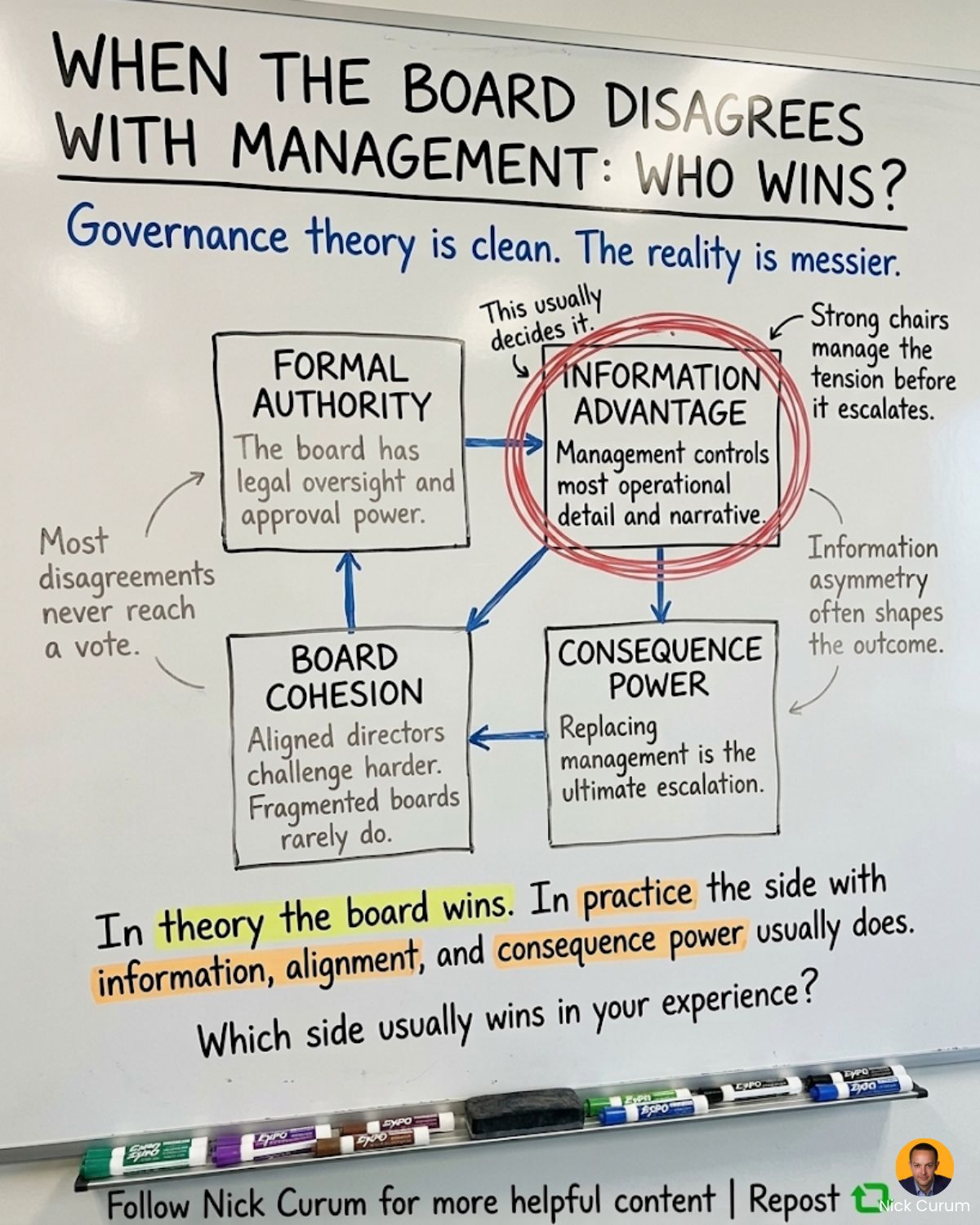
In a recent LinkedIn post, Nick Curum delves into the often-overlooked dynamics that truly influence board-level decisions, challenging the conventional view of hierarchical governance. Curum argues that while boards hold formal authority, it is often management’s control over information that ultimately shapes outcomes.
The traditional model of corporate governance, as Curum points out, typically assumes a clear division of roles: the board oversees and approves, while management executes. However, he contends that the reality is far more complex and influenced by several key factors when disagreements arise.
“The board has formal authority. Management has the information. Guess which one usually shapes the outcome.”
The Information Advantage in Boardroom Negotiations
Curum highlights that the theoretical power of the board, vested in its formal authority, is frequently counterbalanced by management’s strategic control over information. This control extends to the operational details, the narrative presented, and the timing of when information reaches the board.
As Nick Curum notes, “Management controls the operational detail, the narrative, and the timing of what surfaces. Whoever frames the information usually shapes the decision.” This suggests that the way issues are presented and the data provided can be more influential than the final vote itself.
The Role of Board Cohesion and Consequence Power
Beyond the information flow, Curum identifies two other critical dynamics: board cohesion and consequence power. He posits that a united board is more likely to challenge management effectively, whereas a fragmented board may struggle to leverage its formal authority.
“Aligned directors challenge harder. Fragmented boards rarely do. Unity determines whether formal authority actually gets used.”
The ultimate power of the board, its consequence power—the ability to replace management—is a rarely used but constantly credible threat. Curum suggests that the perceived credibility of this option plays a significant role in the ongoing negotiation between management and the board.
Beyond Formal Approval: Focusing on Information Flow
Curum emphasizes that most board-management disagreements are resolved long before they reach a formal vote. The crucial junctures, he argues, occur earlier in the process—during the framing of the issue, the selection of presented data, and the nature of the questions that are answered.
This leads to why experienced directors often place a significant emphasis on understanding the information pipeline. “Who prepared the pack. What surfaced early. What arrived two days before the meeting,” Curum writes, illustrating the granular details that inform a director’s perspective.
“In theory the board decides. In practice the side controlling the information often shapes the outcome.”
In conclusion, Nick Curum’s analysis on LinkedIn provides a compelling perspective on corporate governance, shifting the focus from formal authority to the strategic control of information. He suggests that effective board participation requires not only critical oversight but also a keen understanding of how information is managed and presented by the executive team.
📝 About This Content
This article is based on insights shared by Nick Curum on LinkedIn.
📅 Originally posted on March 10, 2026 | View original post on LinkedIn →