
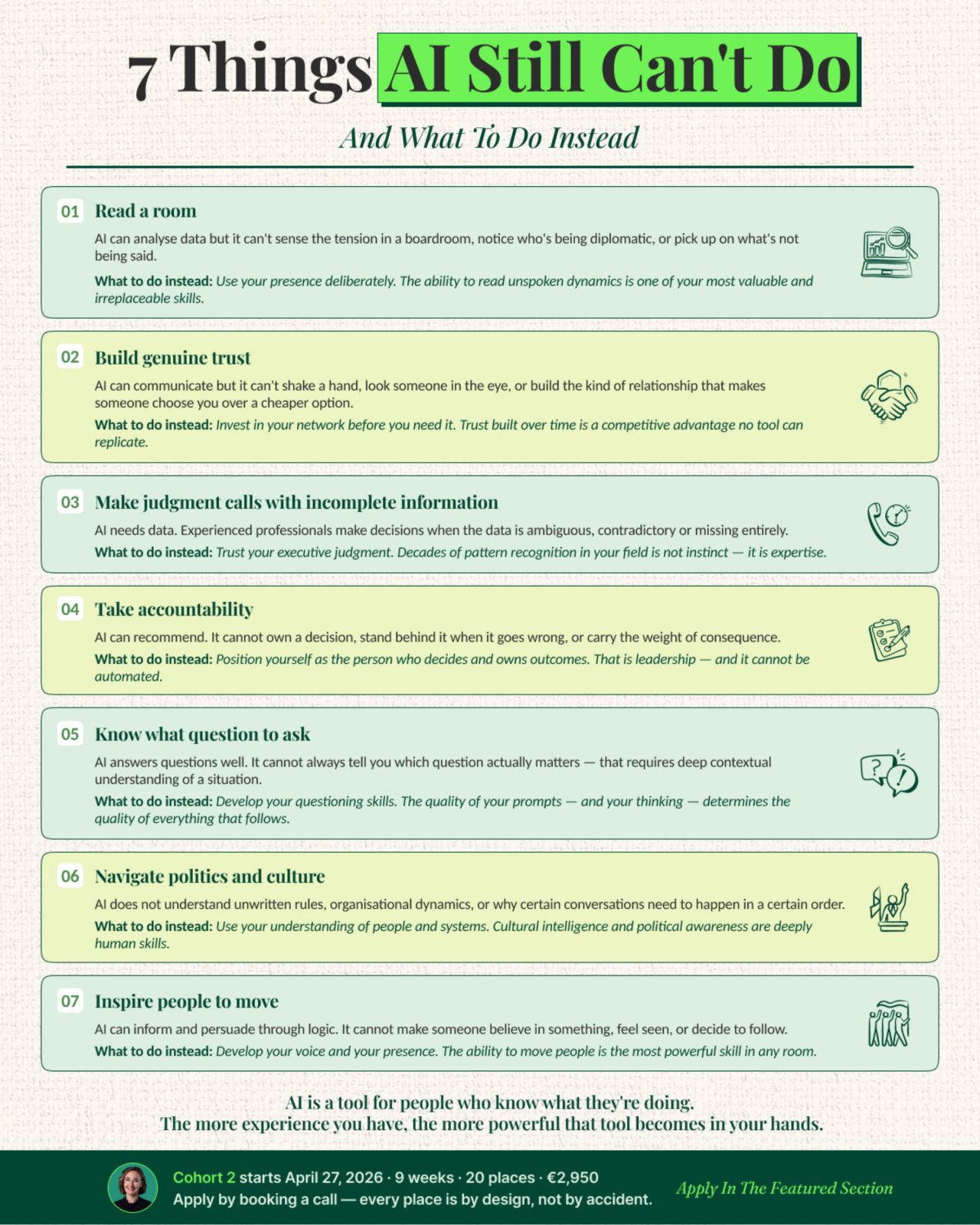
In a recent LinkedIn post, Ani Filipova discusses the limitations of Artificial Intelligence (AI) and emphasizes the enduring value of uniquely human skills, particularly for senior professionals. While the conversation often centers on AI’s capabilities, Filipova argues that the more critical discussion revolves around what AI *cannot* do – the very skills that experienced professionals have honed over decades.
Filipova highlights several key areas where AI falls short, suggesting these are precisely the domains where human expertise remains paramount. She writes:
“Reading a room. Building real trust. Making judgment calls when the data is incomplete. Taking accountability when things go wrong. Knowing which question actually matters. Navigating the unwritten rules of an organisation. Moving people to act.”
According to Filipova, these are not merely ‘soft skills’ but rather the ‘hardest skills there are,’ developed over years of dedicated practice and experience. The prevailing narrative that AI will replace experienced professionals, she contends, misses a fundamental point about the synergy between human expertise and AI tools.
The Crucial Role of Human Judgment in an AI-Driven World
Filipova’s analysis centers on the idea that AI is most effective when wielded by individuals who already possess deep knowledge and judgment. She posits that AI’s power is amplified, not supplanted, by experienced professionals who can effectively guide its application.
As Ani Filipova notes:
“AI is most powerful in the hands of someone who already knows what they are doing.”
This perspective reframes the discourse from one of replacement to one of augmentation. Filipova elaborates on the critical functions that humans perform in conjunction with AI:
- Asking the right questions to guide AI analysis.
- Interpreting the output generated by AI tools.
- Applying nuanced judgment to AI-driven results.
In Filipova’s view, the true challenge for senior professionals is not to compete with AI, but to master its use before less experienced individuals do. This proactive approach ensures that their accumulated wisdom is enhanced, rather than overshadowed, by technological advancements.
Navigating the Future: Skill Development and AI Integration
Filipova underscores that the skills AI struggles with – such as emotional intelligence, strategic intuition, and ethical decision-making – are the cornerstones of senior leadership. These are the competencies that enable professionals to lead teams, build lasting relationships, and drive organizational change in ways that algorithms cannot replicate.
She further emphasizes the time and effort invested in developing these critical human capabilities:
“And they took you years to develop.”
This highlights the significant, often underestimated, value of experience. Filipova’s message is a call to action for senior professionals to recognize the unique strengths they bring to the table and to embrace AI as a tool that can amplify their impact, rather than a threat to their careers. The question, as she frames it, is one of adaptation and strategic integration, ensuring that human expertise remains at the forefront of decision-making, even in an increasingly automated landscape.
📝 About This Content
This article is based on insights shared by Ani Filipova on LinkedIn.
📅 Originally posted on April 23, 2026 | View original post on LinkedIn →