
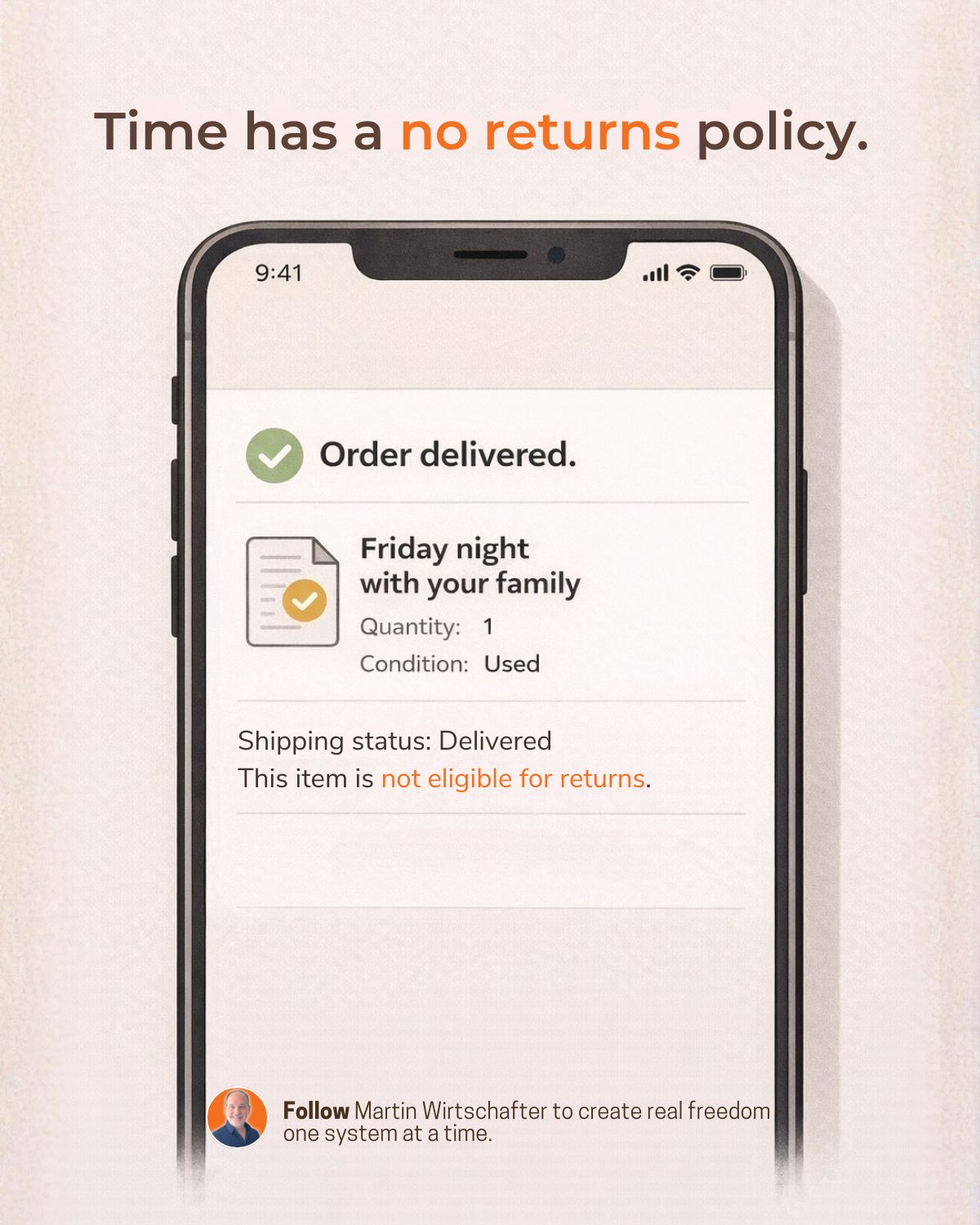
In a recent LinkedIn post, Martin Wirtschafter explores the irretrievable nature of time and the critical importance of present attention, drawing a parallel to the finality of online purchases with no return policies.
Wirtschafter uses the common experience of buying an item on Amazon with a “no returns” policy as a relatable analogy for how time operates. He points out that such a policy forces a buyer to scrutinize every detail before committing. This mirrors his central argument about how we engage with our own time.
“Did you ever buy something on Amazon and see ‘no returns’? Suddenly you read everything twice. Because once you click buy, that’s it. No returns. No second chance.”
The business leader extends this analogy to everyday life and work, suggesting that time, like a non-refundable purchase, offers no second chances. Wirtschafter highlights how easily our attention can be fragmented, leading to missed moments even when physically present.
The Cost of Rented Attention
Wirtschafter argues that in both professional and personal spheres, a distracted mind leads to an absence of true engagement. He criticizes the habit of being physically present but mentally preoccupied with work-related tasks that could wait, such as answering emails or refreshing data.
“You can be at dinner. At the game. On the couch. And still miss it because you’re: Answering emails in your head. Drafting replies no one asked for. Refreshing numbers that can wait. The moment still passes. Delivered. No refund,” Wirtschafter writes.
According to Wirtschafter, this state of “rented attention” is particularly detrimental for individuals whose businesses rely on their direct involvement. He emphasizes that for such entrepreneurs or key personnel, the mind is never truly off duty, leading to a constant, unrecoverable expenditure of presence.
Rethinking Work-Life Integration
The core of Wirtschafter’s message is a critique of conventional approaches to work-life balance. He suggests that the problem isn’t necessarily about finding better balance, but about fundamentally restructuring our relationship with our work and our time.
“If your business depends on you, your mind never clocks out. And rented attention feels a lot like absence,” he states. Wirtschafter proposes a proactive solution:
“The fix isn’t better balance. It’s building something that doesn’t charge you for every second you’re home. Optional at work. Available in life. No refunds.”
Wirtschafter concludes by framing this approach as “freedom by design.” This implies a deliberate creation of work structures and personal boundaries that allow for genuine presence in life without the constant, unrecouped cost of divided attention. His insights serve as a powerful reminder for business leaders and professionals to critically assess how they allocate their most finite resource: their attention.
📝 About This Content
This article is based on insights shared by Martin Wirtschafter on LinkedIn.
📅 Originally posted on February 27, 2026 | View original post on LinkedIn →