
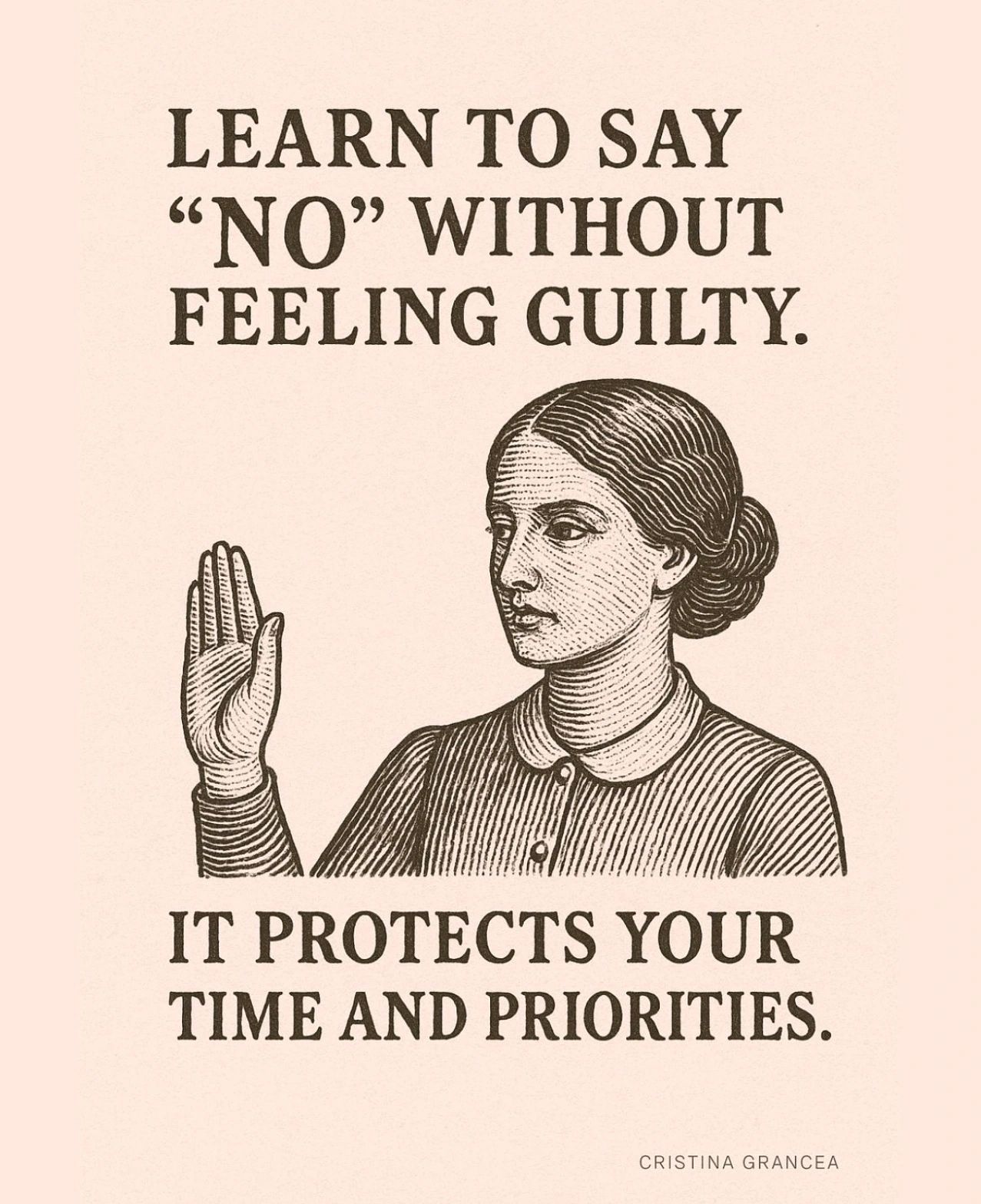
In a recent LinkedIn post, Cristina Grancea explores the critical, yet often challenging, aspect of leadership: setting healthy boundaries. Grancea, a proponent of purpose-driven leadership, argues that the ability to say “no” without guilt is a learned skill that significantly impacts a leader’s effectiveness and their team’s well-being.
Grancea begins by reflecting on a past tendency to equate good leadership with constant availability, a mindset that led to personal stress and burnout. She writes:
“I used to think being a good boss meant being always on: Open door, Always available, Always responding. But behind the scenes? I was stressed, stretched thin, barely holding it together Telling myself it just comes with the title.”
The post emphasizes a fundamental shift in perspective, moving from viewing boundaries as external impositions to recognizing them as internal tools for self-management. According to Grancea, setting boundaries begins with oneself.
The Link Between Personal Boundaries and Team Performance
Grancea argues that a leader’s personal energy levels directly influence their team’s performance and overall culture. When leaders consistently operate on empty, they inadvertently set a precedent for burnout within the organization.
She highlights the importance of protective energy:
“Protecting my energy isn’t a personal indulgence. It’s a leadership responsibility. Because how I show up affects everyone else. If I’m always running on empty, I set that pace for the whole team.”
This perspective reframes boundary-setting not as an act of self-interest, but as a strategic leadership responsibility. Grancea advocates for moving away from the glorification of burnout and embracing boundaries as a proactive leadership strategy.
Practical Strategies for Implementing Boundaries
To facilitate this shift, Grancea outlines several practical steps leaders can take:
- Define firm limits: Establish clear times when communication ceases and ensure these are communicated to and respected by the team.
- Model the behaviour: Leaders should avoid sending communications outside of work hours to give their team permission to disconnect. As Grancea puts it, “Your example gives others permission to switch off.”
- Utilize scheduling tools: If an idea or communication needs to be sent immediately, Grancea suggests using scheduling tools to send it at an appropriate time later. “The message can wait. Their wellbeing shouldn’t,” she notes.
- Encourage offline time: Grancea stresses that rest should be the norm, not the exception, stating, “Teams that recharge, perform.”
Reframing Leadership: Consistency Over Constant Availability
Grancea concludes by challenging the traditional notion that constant availability defines a good leader. Instead, she posits that true leadership lies in showing up as one’s best self, consistently. This requires self-care and effective boundary management.
She asserts:
“Being a good leader doesn’t mean burning yourself out It means showing up as your best self, consistently For yourself, your family and your team.”
Cristina Grancea’s insights offer a valuable framework for leaders seeking to foster healthier, more sustainable work environments by prioritizing personal well-being as a cornerstone of effective leadership.
📝 About This Content
This article is based on insights shared by Cristina Grancea on LinkedIn.
📅 Originally posted on May 11, 2026 | View original post on LinkedIn →