
In a recent LinkedIn post, Dror Allouche tackles a common pitfall for managers: the tendency to solve problems for their team members, inadvertently hindering their development. He argues that this well-intentioned but misguided approach can be more detrimental than outright neglect.
Dror Allouche highlights the critical difference between being a manager and being a leader, emphasizing that true leadership lies in fostering the growth and independence of one’s team. He begins by stating a provocative premise:
The most dangerous manager is not the one who ignores their team. It’s the one who does everything for them.
The author recounts his own early career experience, admitting that his impatience led him to immediately step in and provide solutions whenever a team member encountered an obstacle. He realized that this action, while seemingly helpful for expediency, was actively undermining his team’s ability to think critically and develop problem-solving skills. “By handing out answers, I was training my team to stop thinking,” Dror Allouche writes. “I became the bottleneck.”
Shifting the Focus from Task Completion to Leader Development
Dror Allouche proposes a fundamental shift in how managers should measure success and reward their teams. Instead of solely focusing on departmental results or task completion, he advocates for a new primary metric: the number of independent leaders created within the team. This perspective reframes the manager’s role from a task completer to a developer of talent.
He elaborates on this by suggesting that leaders should prioritize building new leaders, which involves empowering individuals to take responsibility and bring out the best in others. This contrasts with a traditional managerial view of simply giving orders.
Cultivating Growth Through New Challenges and Ownership
A key strategy Dror Allouche suggests for fostering growth is to deliberately present team members with new and challenging problems. He believes that leaders should “bet on brains over experience” and intentionally place individuals in unfamiliar roles that push them to expand their capabilities. This approach encourages proactive problem-solving rather than relying on past successes.
Furthermore, Dror Allouche stresses the importance of “Stop Giving Answers.” When a team member presents a problem, he advises against providing an immediate solution. Instead, he suggests posing a question that shifts the cognitive load back to the employee, such as: “If I weren’t here, what approach would you take?” This encourages independent thinking and self-reliance.
The Distinction Between Bosses and Leaders
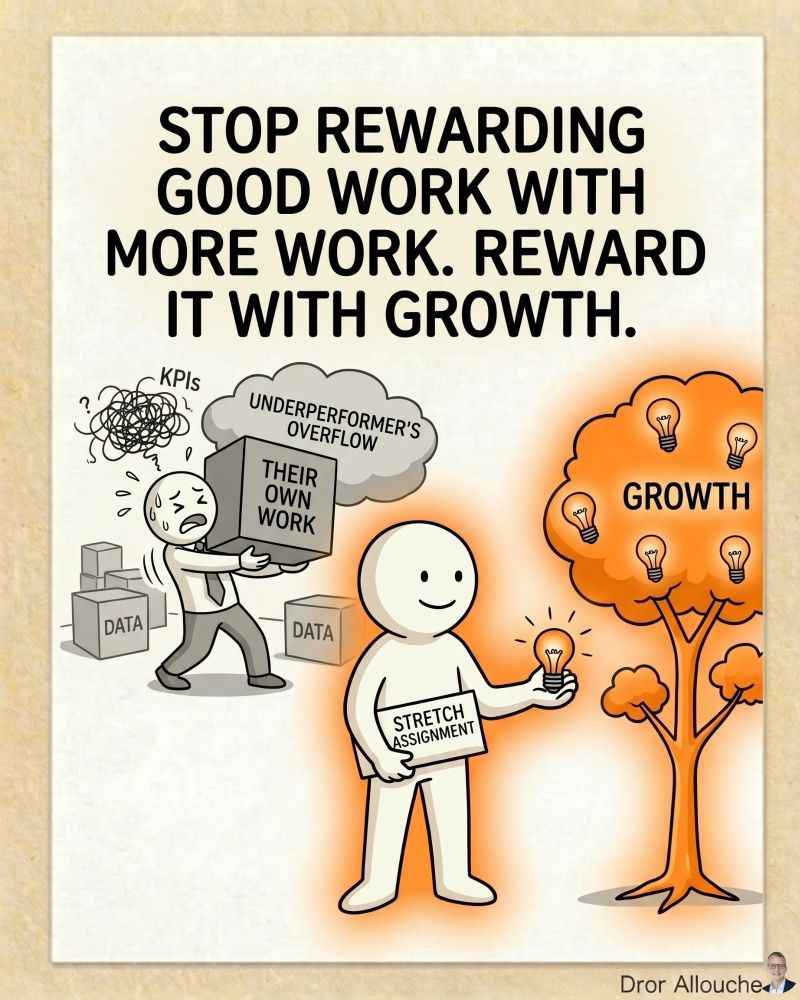
The post also draws a clear line between the actions of a boss and those of a leader. Dror Allouche argues that bosses often act as “owners” who leverage people to achieve a job, whereas leaders function as “investors” who grant ownership to individuals, enabling their independent success. He prompts leaders to audit their high-performers’ workloads, questioning whether they are being given autonomy or simply more of the manager’s overflow work.
“A title makes you a manager. Your ability to elevate others makes you a leader,” Dror Allouche concludes. He urges professionals to move beyond rewarding good work with more work and instead, to reward it with growth opportunities.
📝 About This Content
This article is based on insights shared by Dror Allouche on LinkedIn.
📅 Originally posted on June 20, 2026 | View original post on LinkedIn →