
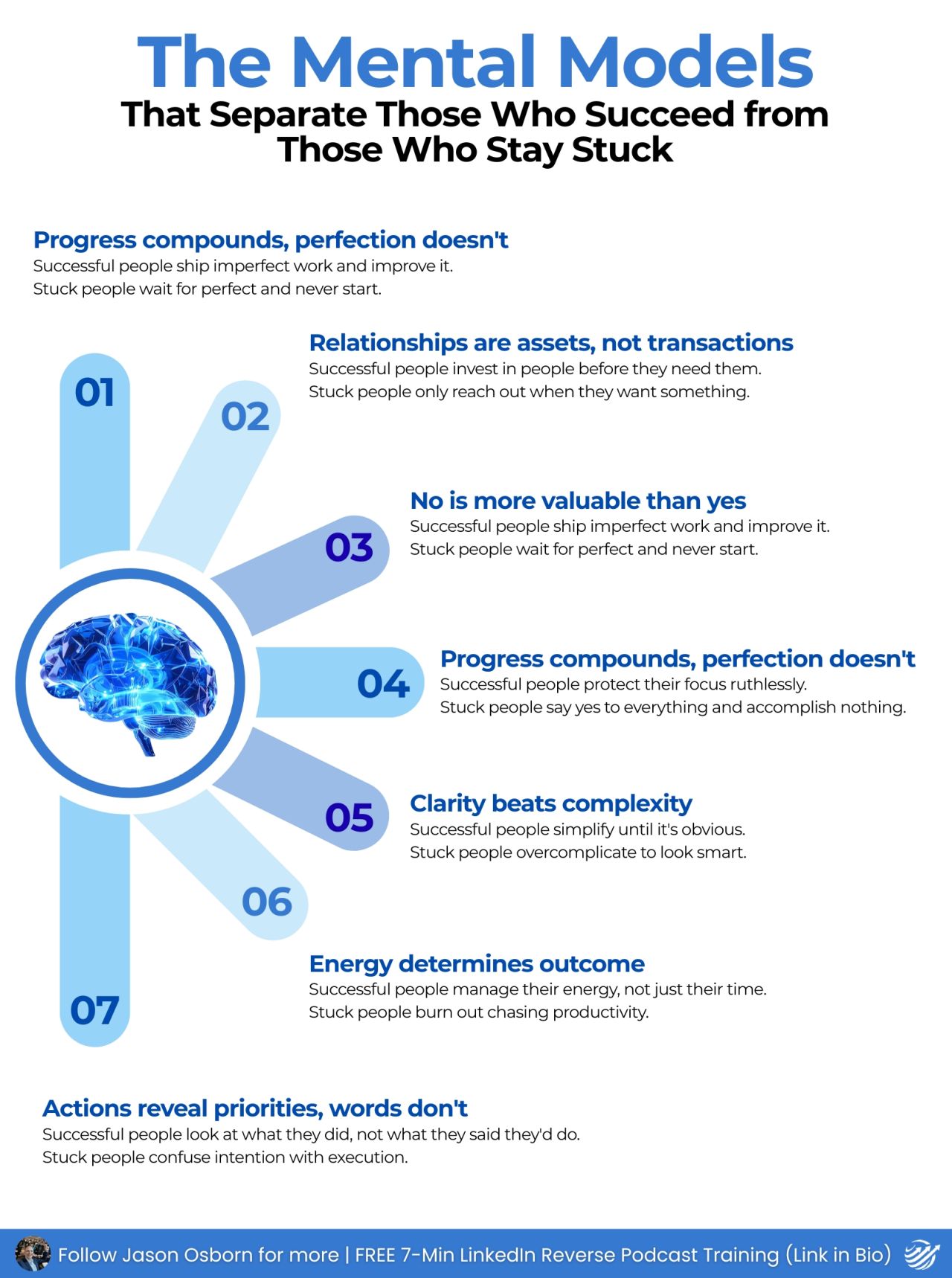
In a recent LinkedIn post, Jason Osborn delves into the fundamental differences in thinking that distinguish individuals who achieve success from those who remain stagnant. Osborn posits that the gap isn’t typically due to a lack of information, but rather a divergence in how problems are approached and processed. “Same Information. Different Thinking. Completely Different Results,” he writes, setting the stage for an exploration of the cognitive frameworks that drive divergent outcomes.
Osborn highlights that many individuals remain stuck not because they are unaware of what needs to be done, but because their thought processes are fundamentally different from those who succeed. He identifies seven key mental models that create this critical distinction.
The Power of Imperfect Action and Compounding Progress
One of the primary distinctions Osborn identifies is the approach to progress versus perfection. He argues that successful individuals embrace imperfection to initiate action, understanding that progress compounds over time. In contrast, those who are stuck often delay action indefinitely in pursuit of an unattainable perfect state.
“Successful people ship imperfect work and improve it. Stuck people wait for perfect and never start,” Osborn states. He elaborates on this, noting that “One creates momentum. The other creates delay.” This echoes the sentiment that “Perfect is the enemy of done. Done is the enemy of stuck.” Osborn’s insight suggests that initiating and iterating is far more effective than waiting for an ideal launch condition.
Relationships as Strategic Assets
Another crucial mental model discussed by Osborn revolves around the perception of relationships. He contrasts the transactional approach of those who remain stuck with the asset-building perspective of successful individuals.
According to Osborn, successful people cultivate relationships proactively, investing in connections before they are needed. Those who are stuck, however, tend to reach out only when they require something. “Stuck people only reach out when they want something,” Osborn points out. He uses a powerful analogy to drive this home: “Relationships aren’t vending machines. You can’t deposit nothing and expect a return.” This highlights the long-term, reciprocal nature of valuable professional networks.
The Strategic Value of “No” and Focused Clarity
Osborn also emphasizes the importance of selective engagement and clear communication. He argues that knowing when to say “no” is more valuable than an indiscriminate “yes.” Successful individuals, in his view, protect their focus ruthlessly, understanding that every commitment made is a commitment forgone elsewhere.
“Successful people protect their focus ruthlessly. Stuck people say yes to everything and accomplish nothing,” Osborn writes. He further explains this by stating, “Every yes is a hidden no to something more important.” This principle extends to clarity, where Osborn asserts that successful people simplify complex ideas until they are obvious. “Complexity is a hiding place. Clarity is courage,” he notes, suggesting that true understanding is demonstrated through simple explanation.
Energy Management and Action-Driven Priorities
Beyond strategic thinking, Osborn touches upon the critical roles of energy and action. He posits that time management alone is insufficient; effective energy management is paramount. Successful individuals, he argues, learn to manage their energy levels to sustain productivity, recognizing that rest is a strategic component of performance rather than a sign of laziness.
Furthermore, Osborn stresses that actions, not words, reveal true priorities. He observes that individuals often confuse their intentions with their execution. “Your calendar shows your priorities. Not your to-do list,” he asserts, concluding that “What you actually do reveals what actually matters to you.” This underscores the idea that consistent action is the ultimate indicator of commitment and focus.
In conclusion, Jason Osborn’s analysis on LinkedIn provides a compelling framework for understanding the cognitive and behavioral patterns that underpin success. He encourages a re-evaluation of one’s own mental models, suggesting that by questioning and updating these underlying thought processes, individuals can indeed achieve different and better results, even when faced with the same information.
📝 About This Content
This article is based on insights shared by Jason Osborn on LinkedIn.
📅 Originally posted on April 20, 2026 | View original post on LinkedIn →