
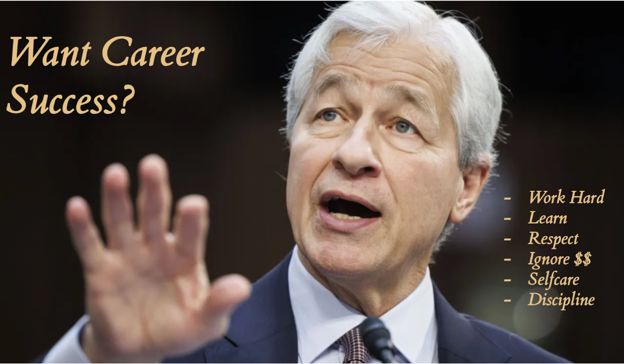
In a recent LinkedIn post, Callum Laing critiques conventional career advice, arguing that while common tenets like hard work and continuous learning are important, they are insufficient for achieving significant career success on their own. Laing contrasts the widely circulated advice of figures like Jamie Dimon with the actual trajectory of Dimon’s career, suggesting that access to the right people and opportunities is the often-overlooked differentiator.
Laing begins by outlining Dimon’s commonly shared rules for success: working hard, continuous learning, respecting colleagues, chasing responsibility over salary, prioritizing health, and maintaining discipline. Laing quotes the sentiment behind this advice, noting:
“Work hard
Learn as much as you can
Respect colleagues
Chase responsibility, not salaries
Look after your health
Be disciplined”
However, Laing immediately questions the efficacy of these rules in isolation. He posits that these are not differentiators but rather basic requirements for entry into competitive fields. The core of Laing’s argument is that without strategic relationship-building and access to influential networks, even exceptional effort can fall short.
The Power of Mentorship and Access
Callum Laing points to Jamie Dimon’s early career as a prime example of how crucial relationships can be. Laing highlights that Dimon’s rise was significantly influenced by his relationship with Sandy Weill, who took Dimon under his wing at a young age. Laing details this connection:
“At 26, Sandy Weill spotted him and made him his protégé.
When Weill left American Express, Dimon followed.
When Weill bought Commercial Credit, Dimon was his right-hand man.
Through Smith Barney, Travelers, Citigroup, Dimon wasn’t just changing jobs. He was following access.”
According to Laing, this single relationship, rather than Dimon’s MBA or long hours, was instrumental in shaping his career trajectory. Laing emphasizes that this pattern underscores a critical truth in professional development: proximity to the right people often trumps individual performance metrics.
Access as an Engineering Discipline
Laing argues that the conventional advice, while not incorrect, is fundamentally incomplete. He states:
“Dimon’s advice isn’t wrong, it’s just incomplete.
If you’re not in the room with the right people, everything else is noise.”
This perspective suggests that individuals can possess all the requisite skills and work ethic but still be overlooked if they lack the necessary connections. Laing uses the analogy of a game, asserting that one can be a skilled player but remain on the sidelines if not properly introduced or included. He elaborates on this by noting:
“You can out-work, out-learn, and out-perform everyone… and still get passed over for the person who is known and trusted by the right people.”
To address this gap, Laing introduces the concept of “Access Engineering,” framing relationship-building not as a passive occurrence but as a deliberate and systematic process. He encourages readers to be proactive in cultivating the right relationships and positioning themselves within influential circles. While acknowledging that performance (scoring goals) is still essential, Laing stresses that securing a place on the “pitch” through strategic networking is a prerequisite for showcasing that performance.
Callum Laing concludes his post by offering resources and a workshop focused on “Access Engineering,” inviting those interested to connect with him for further guidance. His insights challenge professionals to look beyond traditional metrics of success and focus on the strategic cultivation of access and relationships as a key driver of career advancement.
📝 About This Content
This article is based on insights shared by Callum Laing on LinkedIn.
📅 Originally posted on December 12, 2025 | View original post on LinkedIn →