

Elon Musk is considered a transformative business leader due to his visionary, high-risk approach combined with relentless execution and a first-principles thinking model. His leadership style fuses long-term strategic goals with hands-on engineering involvement, enabling him to drive radical innovation across multiple global industries like automotive, aerospace, and artificial intelligence.
In the fast-changing world of 2025, where change is constant, the strategies of transformative figures offer important lessons for global leaders. Few people get as much attention or cause as much debate as Elon Musk. His success goes beyond the headlines. He has succeeded in many industries, from changing the car industry with Tesla to leading private space travel with SpaceX. These ventures provide many examples of his leadership principles. For executives in tough markets and entrepreneurs trying to grow, it is vital to understand the strategy behind Musk’s unique success.
This article does more than just observe. It analyzes the key ideas that define Elon Musk as a business leader. We will break down his strategic decisions, new approaches, and unique leadership style that made his companies world leaders. Our goal is not just to report, but to find actionable strategies and insights for the future. You can adapt these for your own company’s growth and career. This gives you a key perspective on how to lead and innovate in the competitive world of 2026 and beyond.
By looking at his unique journey and the keys to his success, we aim to find practical lessons for mastering market disruption and building a culture of constant innovation. Get ready to explore the playbook of a leader who challenges the norm and redefines what is possible in business and technology.
What Defines Elon Musk as a Business Leader?
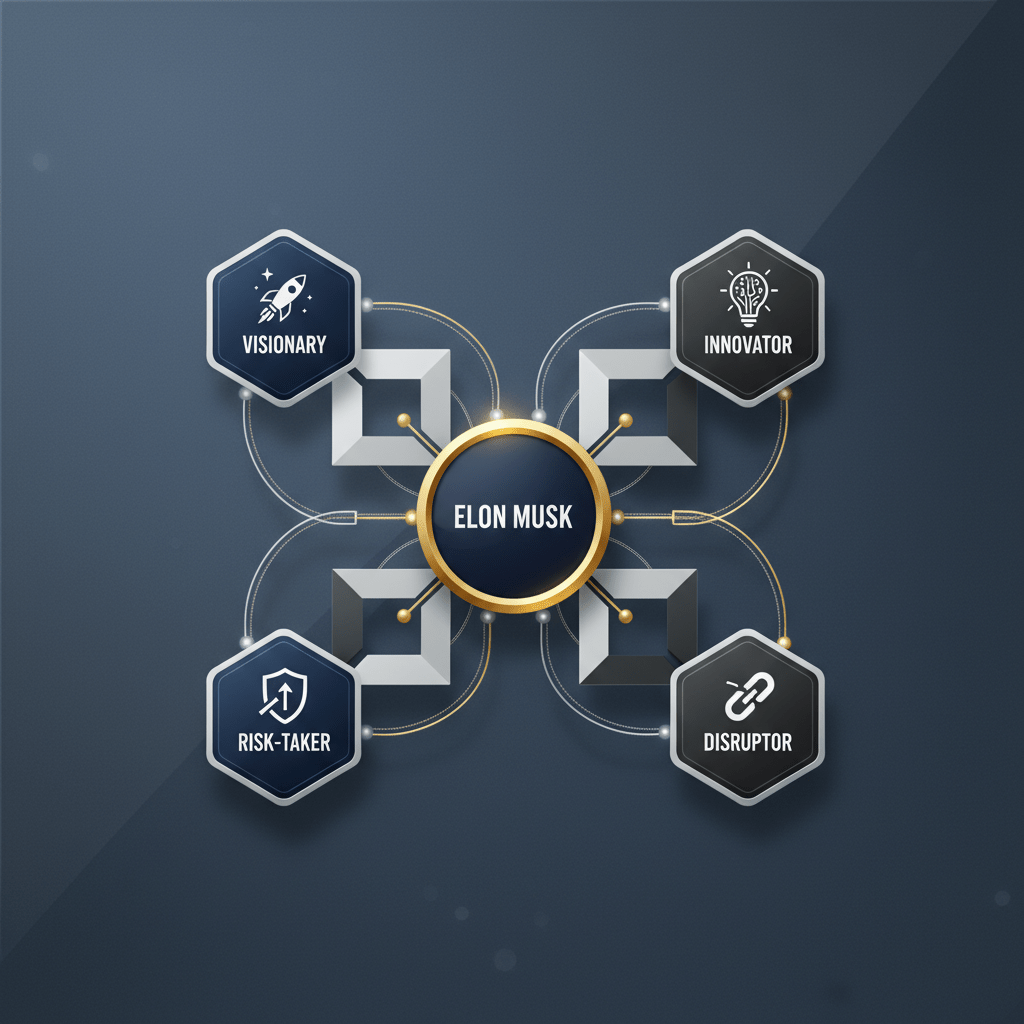
Visionary Goals vs. Pragmatic Execution
Elon Musk’s leadership is defined by a key tension. He sets audacious, future-defining goals that often seem impossible. These big visions, however, are not just dreams. They are matched with a relentless drive for pragmatic, often brutal, execution.
Top leaders see this two-part approach. It starts with sharing a grand vision. Then, he pushes teams carefully and sometimes controversially to reach it. For example, Musk’s goals to colonize Mars or achieve full self-driving cars are not just for marketing. They are key directives that guide daily work at SpaceX and Tesla.
This creates a workplace where failure is expected, but progress is the top priority. Experts note that most leaders avoid such extreme goals. However, Musk shows that pushing boundaries is essential for major breakthroughs [source: Harvard Business Review].
Key Strategic Takeaways for 2026 Leaders:
- Embrace Boldness: Do not let limits define your company’s ambition. Set “moonshot” goals that inspire and stretch your teams.
- Demand Rigorous Execution: A vision without action is a fantasy. Build strong systems to track progress, make quick changes, and solve problems. This turns your vision into reality.
- Cultivate Resilience: Expect problems when chasing big goals. Create a culture that learns from failures quickly and adapts, rather than getting stuck.
The Role of First-Principles Thinking in His Strategy
A key part of Elon Musk’s strategy is his strong belief in first-principles thinking. This method involves breaking down hard problems to their basic truths. You question every assumption and then build new solutions from scratch.
Many leaders work by analogy, or “how it’s always been done.” Musk challenges this common thinking. For example, he famously questioned the high cost of rockets. He broke them down to the price of their raw materials to find ways to cut costs dramatically [source: Inc.com]. Similarly, Tesla’s approach to batteries comes from studying basic physics and chemistry, not just improving old methods.
This method leads to major disruption and new ideas. By ignoring easy answers, Musk’s companies find new and better ways to work. This creates a competitive advantage that is hard for others to copy.
Applying First-Principles Thinking in Your Organization for 2026:
- Deconstruct Core Problems: Avoid small fixes. Instead, take your industry’s biggest problems and break them down to their basic parts.
- Question All Assumptions: Challenge every belief about cost, time, and methods. Ask “why” over and over until you find a core truth.
- Rebuild from Fundamentals: Use these basic truths to design completely new solutions. This often leads to huge gains in efficiency or new products.
- Empower Analytical Teams: Create a workplace that values deep thinking. Encourage your teams to explore new ideas without being stuck in old ways.
Synthesizing Engineering and Executive Leadership
What truly sets Elon Musk apart is his rare mix of deep engineering acumen and decisive executive leadership. He is not just a CEO who gives out technical tasks. He deeply understands the engineering, physics, and materials that his companies are built on.
This technical knowledge lets him be deeply involved in product design and problem-solving. When a technical challenge comes up, Musk often works directly with engineers. He asks sharp questions and even suggests solutions. This direct approach earns him great respect from his teams and helps him make very smart decisions.
This blend of skills offers clear advantages for speed and innovation. Leaders who understand the technology can avoid delays and make fast, effective decisions. They can also better judge technical risks and opportunities. This is vital in fast-moving fields like AI, aerospace, and sustainable energy [source: Forbes].
Actionable Strategies for Leaders in 2026:
- Cultivate Technical Depth: No matter your industry, work to understand the main technologies that drive your business. This can happen through training, mentorship, or working with your R&D teams.
- Bridge the Executive-Engineer Divide: Take part in technical meetings, understand engineering plans, and create open communication between leaders and technical staff.
- Lead with Informed Confidence: When leaders show they understand the technology, it builds trust in their plans. This creates a culture of innovation driven by shared knowledge.
- Invest in Technical Literacy: For non-technical leaders, look for programs to improve your executive team’s tech skills. This will help them succeed in today’s tech-driven world.
What is Elon Musk’s Leadership Style?
The autocratic technologist: A Hands-On Approach
Elon Musk’s leadership style is often called that of an autocratic technologist. He is deeply involved in engineering and design. His approach is very different from leaders who delegate work. Experts often debate the benefits of his method. They discuss its impact on innovation and team autonomy.
Musk is famous for his daily focus on technical details. He often dives into specific design problems. He also makes key engineering decisions himself. This close watch makes sure projects align with his vision. However, it also puts great pressure on his teams. Senior leaders must explain their choices directly to him. This builds a culture of strict accountability. It also requires deep technical knowledge from everyone.
Balancing Technical Depth with Executive Oversight
- Direct Technical Engagement: Musk often works on key engineering problems. This helps him fully understand project challenges. It leads to quick fixes and rapid progress.
- Centralized Decision-Making: Key technical and strategic decisions often come directly from Musk. This can speed up important projects. But it can also cause delays and limit input from the wider team.
- High Performance Expectation: He expects top performance and dedication from his teams. This constant drive for excellence is a key part of his companies. It pushes boundaries but can also lead to burnout [1].
For executives in 2025/2026, the lesson is clear. It is vital to develop strong technical literacy. Leaders must understand the core of their products. This allows them to make informed decisions. However, a top-down style may not scale well. Smart leaders know when to step in and when to delegate. They must balance their own technical input with empowering their expert teams.
Fostering a Culture of High-Stakes Innovation
Musk’s companies are built on high-stakes innovation. He sets huge goals that often seem impossible. This creates a sense of urgency and extreme challenge. Leaders around the world know this kind of culture is hard to create. It needs a special mix of inspiration and pressure. Many executives try to copy this drive to disrupt industries.
He repeatedly pushes his teams beyond normal limits. The expectation is to redefine whole industries. This constant push for breakthroughs defines his companies. For example, SpaceX wants to make humanity multi-planetary [2]. Tesla wants to speed up the world’s move to sustainable energy [3]. These bold missions attract top talent. They also demand great dedication and resilience. Failure is seen as a learning opportunity, but it often has serious results.
Elements of a Moonshot Culture
- Mission-Driven Focus: Every project connects to a larger, world-changing mission. This gives employees a strong sense of purpose and motivation.
- Tolerance for Risk: Musk encourages taking smart risks. He accepts that not all experiments will work. This creates a willingness to try bold new ideas.
- Rapid Iteration and Feedback: Teams must build, test, and improve products quickly. This process speeds up learning. It ensures the company is always getting better and adapting.
- Demanding Work Ethic: A strong work ethic is the norm. Long hours and hard problems are part of the job. This commitment is key to reaching massive goals.
To build this kind of culture by 2026, leaders need a clear purpose. They must define a bold vision that inspires people. They should also set up ways to quickly test ideas and get feedback. Leaders can empower teams to take smart risks. At the same time, they must provide support to help manage those risks. This balance drives innovation and helps prevent burnout.
Communication Strategy: Transparency and Controversy
Elon Musk’s communication style is unique. It mixes extreme transparency with frequent controversy. He mostly avoids traditional media. Instead, he engages directly with the public, mainly on social media. This method gets a lot of attention. It also shapes how the public views his companies.
His direct style has several benefits. It helps him seem authentic to customers and followers. It also lets him share news very quickly. This approach bypasses the media. However, being so unfiltered has big risks. Impulsive comments can make markets unstable. They can also damage his brand’s reputation. Sometimes, they lead to legal problems [4]. Balancing openness with caution is a constant challenge for him.
Navigating Direct Public Engagement in 2025
- Leveraging Social Platforms: Musk is an expert at using platforms like X (formerly Twitter). He uses it to share updates, ask for feedback, and defend his views. This creates a powerful and immediate way to communicate.
- Transparency at Scale: He often shares his honest opinions and internal thoughts. This level of openness can build trust. But it can also upset key partners or employees.
- Managing Public Perception: His controversial comments often make headlines. Leaders must weigh the benefits of speaking directly against the risk of negative results.
- Impact on Employee Morale: Public comments can have a big impact on company culture. Leaders must think about how their statements affect how employees feel and their loyalty.
For top executives in 2025, direct communication is vital. Digital platforms offer a huge reach. Leaders need a clear plan for their public presence. This includes setting clear guidelines for what to say. They must balance being authentic with having a purpose. Leaders also need strong ways to communicate internally. This keeps teams aligned, even when there is noise outside the company. In the end, good communication requires planning and control. This ensures every message supports the company’s goals.
How did Elon Musk start his business?
From Zip2 to PayPal: The Early Victories
Elon Musk did not start with rockets or electric cars. His journey began with the rise of the internet economy. His first companies, Zip2 and PayPal, gave him money and taught him important lessons about growing new kinds of technology.
- Zip2 Corporation (1995-1999): Musk and his brother Kimbal started Zip2. The company made online city guide software for newspapers, including maps and business listings. This helped businesses get ready for the growing internet age. Zip2’s goal was to help companies succeed in a new digital world. In 1999, Compaq bought Zip2 for about $307 million in cash and stock [5]. Musk’s share of the sale gave him his first major funding.
- X.com and PayPal (1999-2002): After Zip2, Musk started X.com. It was an online banking and payment company. His goal was to change banking by bringing it to the internet. X.com later joined with a company called Confinity to create PayPal. Together, they became a leader in online payments. PayPal gave people a safe and easy way to pay for things online. This helped more people feel comfortable using the internet for shopping. In 2002, eBay bought PayPal for $1.5 billion in stock [6]. Musk made over $100 million, which gave him the money for his next big ideas.
Strategic Takeaway for Leaders: Musk’s early success shows the power of finding and growing new market ideas. Leaders in 2025 should watch for new digital trends. Early projects can be a great way to raise money and gain experience for bigger, game-changing goals. These first wins paid for much bigger dreams.
The Foundational Pillars: Launching SpaceX and Tesla
With the money he made from his internet companies, Musk moved on to bigger challenges. He started SpaceX and Tesla. These companies changed the future of space travel and clean energy.
- SpaceX (2002): Musk started Space Exploration Technologies Corp. (SpaceX) with a big goal: to help humans live on other planets. He saw that the space industry was too expensive and slow. Musk used first-principles thinking. He broke down rocket science to its basic parts. This let him build rockets in a new way, which lowered costs and made parts reusable. By 2025, SpaceX is a leader in rocket launches and is working on its Starship rocket [7].
- Tesla, Inc. (2003): Musk joined Tesla, first as Chairman and later as CEO. The main goal was to speed up the world’s move to clean energy. Tesla’s first car, the Roadster, proved that electric cars could be fast, cool, and practical. This went against what most car companies believed. Tesla then grew by making the Model S, 3, X, and Y. These cars used new battery and self-driving technology. The company also changed how cars are sold by selling directly to customers.
Strategic Takeaway for Leaders: Elon Musk’s story shows a focus on impact over immediate profit. His companies worked on major problems facing society. Executives in 2026 should think about their own “moonshot” projects. These big projects can change whole industries, even if they cost a lot to start. A clear and exciting mission helps attract the best people and keeps them dedicated.
Investing Personal Capital to Fuel Growth
A key part of Musk’s style is that he was willing to invest almost all of his own money into his big projects. This showed his strong belief and comfort with taking big risks.
- The All-In Bet: After selling PayPal, Musk invested most of his money, over $100 million, into SpaceX and Tesla. He did not see them as just businesses. He saw them as important missions for the future of humanity. He was willing to bet on his own ideas. This provided key funding when other investors were afraid of the high risks.
- Navigating the 2008 Financial Crisis: Both SpaceX and Tesla almost went bankrupt during the 2008-2009 global financial crisis. Musk put his last bit of money into the companies to save them. He even had to borrow money to pay his employees [8]. This showed his strong commitment and personal sacrifice. His own money was a lifeline that kept the companies going when other funding was gone.
Actionable Strategy for Executives: Musk’s story shows the power of a founder’s belief backed by personal investment. This is a key lesson for leaders who want to shake up markets in 2026. Not every leader has a personal fortune to invest. But they can show the same commitment in other ways. They can dedicate company resources, strongly support the vision, and lead high-risk projects themselves. This inspires teams and shows true belief in the mission. That belief is needed to get through tough times and succeed in the long run.
What are Elon Musk’s characteristics as an entrepreneur?

Unwavering Resilience in the Face of Failure
One of Elon Musk‘s key traits as an entrepreneur is his amazing resilience. He has shown this strength through major setbacks. His companies have often faced the risk of bankruptcy.
For example, early SpaceX launches failed many times, which almost ruined the company. In the same way, Tesla’s “production hell” created huge problems during the Model 3 launch [9]. These issues could have destroyed other companies. Instead, they seemed to energize Musk and his teams.
Many leaders believe this resilience comes from a deep belief in the mission. When the goal is more than just making money, the drive to push through hard times is very strong. Musk also sees failure as a chance to learn, not as an end. This view creates a culture where teams are always improving.
- Strategic Takeaway for 2026: To build this kind of resilience in your company, leaders need a clear, long-term mission. This goal should inspire everyone to keep trying [10].
- Actionable Strategy: Create a system to quickly review failures. Ask teams to find lessons and make changes fast. Share what you learn openly with everyone. This turns problems into smart ideas.
- Leadership Principle: Let your teams take smart risks, and understand that not every new idea will work. Support them when they fail and focus on continuous learning and change.
An Intense Focus on Product and Engineering
Musk’s approach is all about great product and engineering. He gets involved in the technical details himself. He often works directly on design, materials, and how things are made. This close attention helps his companies create new and high-quality products.
He often uses first-principles thinking. This is a key part of his method. Instead of copying what others have done, he breaks problems down to their basic facts. Then, he builds new solutions from the ground up. This led to big breakthroughs in rocket design at SpaceX and battery tech at Tesla [11].
This strong focus creates a company culture that values great engineering and science. The teams ignore old ways of thinking. They look for the best solutions, not just small improvements. Top leaders, like CTOs and heads of R&D, can learn a lot from this.
- Strategic Takeaway for 2026: Build a culture that rewards technical skill and new ideas in engineering at every level.
- Actionable Strategy: Run “first-principles workshops” for your tech and product teams. Question old ideas and dig deep into technical problems. Spend money on new research, not just on small fixes to old products.
- Leadership Principle: Work closely with your technical teams. Learn about their challenges and opportunities directly. This helps find new ideas and avoid major mistakes.
Long-Term Vision Over Short-Term Profitability
Musk is known for his big, long-term visions. He often focuses on these goals instead of making money right away. He cares more about goals that take decades, like making humans a space-faring species or moving the world to clean energy [12].
This approach takes great courage. He must also be good at keeping investors confident while the company spends a lot of money and waits for profits. For example, SpaceX and Tesla both spent years and a lot of cash on research before they made steady profits.
Leaders can learn from Musk’s planning. It shows the value of having a big mission. A strong purpose can motivate workers and attract investors for the long run. This method is not just about competing; it is about changing whole industries.
- Strategic Takeaway for 2026: Create and share a powerful, long-term vision that looks beyond today’s market. Use it to guide your spending and inspire your team and investors.
- Actionable Strategy: Hold a “vision 2050” meeting with your leaders. Set big goals that could change your industry, like using AI or fighting climate change. Then, plan the steps and money needed to get there, starting with 2026.
- Leadership Principle: Clearly explain your long-term story to investors, employees, and the public. Show how the money you spend today helps build that future. This builds trust and gets support for your big projects.
What Actionable Strategies Can Leaders Adapt from Musk for 2026?

Implementing First-Principles Thinking to Disrupt Your Market
Elon Musk has a unique ability to challenge old ideas. He does this by using first-principles thinking. This means breaking down big problems to their basic truths. It’s different from just copying what others have done. To innovate in 2026, leaders must use this strategy.
Musk used first principles to change the space industry. He asked a simple question: Why are rockets so expensive? Instead of just paying high prices to suppliers, he looked at the cost of a rocket’s raw materials. This showed him how to build rockets for much less [source: https://www.businessinsider.com/elon-musk-first-principles-thinking-2019-2].
To use this powerful strategy in your company by 2026, follow these steps:
- Identify Core Assumptions: Find the basic beliefs in your industry. Question everything you’ve been told is true.
- Break Down Problems: Break challenges into their simplest parts. Don’t just rely on old solutions or what competitors do.
- Rebuild from the Ground Up: Create new solutions from these basic parts. This often leads to fresh, better, and game-changing results.
- Build a Culture of Curiosity: Encourage your team to always ask “why.” This helps everyone understand problems better and find new ideas.
Using first-principles thinking helps leaders make big leaps, not just small steps. It opens the door to major innovation and gives you a strong competitive edge. This is why many top executives now support it.
Building a Mission-Driven Culture for Elite Talent
Musk’s companies have bold missions. SpaceX wants to make humanity multi-planetary. Tesla wants to speed up the world’s move to sustainable energy. These big goals attract and keep the world’s best talent. In today’s job market, a powerful mission matters more than just money.
Smart leaders know that purpose drives people. A workplace with a clear purpose improves employee engagement and loyalty. By 2026, companies need a mission that top talent believes in. A great mission turns a job into a passion [source: https://hbr.org/2023/11/why-purpose-driven-companies-outperform-the-rest].
Leaders can build a culture like this through these strategies:
- Define a Bold Mission: Create a vision that is big, inspiring, and about more than just profit. It should make people feel they are part of something important.
- Communicate Constantly: Make the mission part of everything your company does. Tell stories about how your team helps achieve the big goal.
- Align Goals with the Mission: Make sure team and individual goals support the main mission. Reward people for actions that help achieve it.
- Give People Ownership: Let your best talent solve hard problems on their own. Show them how their work pushes the mission forward.
- Demand High Performance: A strong mission needs a culture of excellence. Hold people accountable to show you are serious about reaching your goals.
This approach turns employees into passionate supporters. They become key to your company’s success and strength in 2026 and beyond.
Mastering Vertical Integration for Control and Speed
A key part of Elon Musk’s strategy is vertical integration. His companies make most of their own critical parts. This is different from most companies, which outsource work. For example, Tesla designs its own chips. And SpaceX builds its own rocket engines and parts in-house [source: https://www.bloomberg.com/news/articles/2023-01-26/why-tesla-s-vertical-integration-strategy-is-so-different-from-others].
This strategy has big benefits. It leads to better quality control, faster improvements, and a more reliable supply chain. Since global supply chains are still shaky, smart leaders are rethinking their use of outside partners.
To use vertical integration effectively by 2026, leaders should consider:
- Find Key Bottlenecks: Look at the important parts or processes you currently outsource. See how they affect your speed, quality, and ability to innovate.
- Know Your Strengths: Figure out what skills give you an edge over competitors. Focus on bringing those skills in-house.
- Build In-House Skills: Spend money to grow your own manufacturing, R&D, and engineering teams. This means hiring the right people and buying the right tools.
- Improve Teamwork: When you do more in-house, your design and production teams can work together better. Use this to build great teamwork across departments.
- Strengthen Your Supply Chain: Controlling more of your own production makes you more flexible. You can react faster to problems and market changes.
Using vertical integration gives leaders more control over their product’s future. It speeds up innovation and builds a stronger, more self-reliant company ready for any challenge.
Frequently Asked Questions
What are Elon Musk’s Businesses?
Elon Musk’s business empire is a diverse group of companies. They aim to change major industries for the future by combining strong engineering with a big vision. His companies tackle some of humanity’s biggest problems and future goals. These businesses use the latest technology and often shake up existing industries [13].
Currently, his main companies include:
- Tesla, Inc.: A leader in electric vehicles (EVs), battery storage, and solar power. Tesla’s goal is to speed up the world’s move to sustainable energy. It uses advanced manufacturing and AI for its self-driving features [3].
- SpaceX (Space Exploration Technologies Corp.): Works to lower the cost of space travel and make it possible to live on Mars. SpaceX is known for its reusable rockets and the Starlink satellite internet service [14].
- Neuralink Corporation: A neurotechnology company that develops brain-computer implants. Its main goal is to help people with paralysis and improve human brainpower.
- The Boring Company: Focuses on new ways to build tunnels and infrastructure. The company aims to reduce city traffic and create high-speed travel systems like the Hyperloop.
- X (formerly Twitter): A global platform for public conversation. Musk wants X to become an “everything app” that combines communication, payments, and other services.
Each business shows Musk’s core strategy: find a big problem and use bold, basic principles to solve it. Leaders can learn from his approach of making his companies work together. This could help them find new ways to succeed with their own businesses by 2026.
Was Elon Musk Born Rich?
Elon Musk’s early life background is often discussed. Understanding his background helps explain his journey. While he did not grow up poor, he earned his own wealth. He grew up in Pretoria, South Africa, and his parents were professionals [15]. His father was an engineer, and his mother was a model and dietitian.
Key points about his financial start:
- Comfortable Upbringing: Musk had a comfortable, upper-middle-class childhood. This gave him access to a good education and resources.
- Self-Made Entrepreneurship: Despite his background, Musk built his great wealth through hard work and risky projects. He moved to Canada at 17 and then to the United States for college.
- Early Successes: He first became successful after co-founding Zip2 Corporation, a software company, and later X.com, which became PayPal. This money helped him fund bigger projects like SpaceX and Tesla [16].
In short, his family gave him a good start. But he became a global business leader through his own vision, willingness to take risks, and hard work. Leaders can learn from him. He reinvested almost all of his early money into big ideas for the future instead of choosing a safer path.
What is the Core of Elon Musk’s Business Journey?
At the heart of Elon Musk’s business journey are three things: a big vision, a simple way of thinking, and a drive to achieve goals that seem impossible. His career offers important lessons for leaders who want to create big changes from 2025 onward.
His strategy is defined by a few key ideas:
- Mission-Driven Goals: Musk focuses on big, long-term goals instead of short-term profits. For example, SpaceX wants to make humans a multi-planetary species, and Tesla works to speed up the move to sustainable energy. This strong sense of mission attracts the best employees.
- First-Principles Thinking: Instead of copying what others have done, Musk breaks down problems to their most basic parts. This lets him find completely new solutions. It has led to successes like reusable rockets and building electric cars from the ground up [17].
- Relentless Risk-Taking and Execution: He often invests a lot of money and takes big, calculated risks. His companies are also known for their fast work and a culture that sees small failures as part of the process to succeed.
- Vertical Integration and Control: Musk’s companies often control their entire production process, from designing computer chips to building charging stations. This gives them more speed, better quality control, and lower costs.
The key lesson for leaders is to mix a big vision with simple, direct problem-solving. By always asking “why” and staying focused on important goals, companies can create new ideas and become leaders in their fields by 2026.
Sources
- https://hbr.org/2023/07/why-some-leaders-get-better-results-from-their-teams-than-others
- https://www.spacex.com/mission/
- https://www.tesla.com/about
- https://www.sec.gov/news/press-release/2018-226
- https://www.nytimes.com/1999/02/17/business/compaq-buys-zip2-for-307-million.html
- https://www.cnet.com/tech/tech-industry/ebay-buys-paypal/
- https://www.spacex.com/
- https://www.cnbc.com/2018/09/06/elon-musk-i-had-to-borrow-money-for-rent-in-2008.html
- https://www.nytimes.com/2018/03/30/business/tesla-production-hell-elon-musk.html
- https://hbr.org/2014/10/the-business-case-for-purpose
- https://www.businessinsider.com/elon-musk-first-principles-thinking-2020-5
- https://www.spacex.com/updates/mars-update-2022/
- https://hbr.org/2023/05/understanding-elon-musks-leadership-style
- https://www.spacex.com/about/
- https://www.businessinsider.com/elon-musk-parents-2016-5
- https://www.forbes.com/profile/elon-musk/
- https://www.inc.com/bill-murphy-jr/elon-musk-says-this-one-simple-thinking-tool-is-key-to-his-success-and-it-will-make-you-smarter.html