
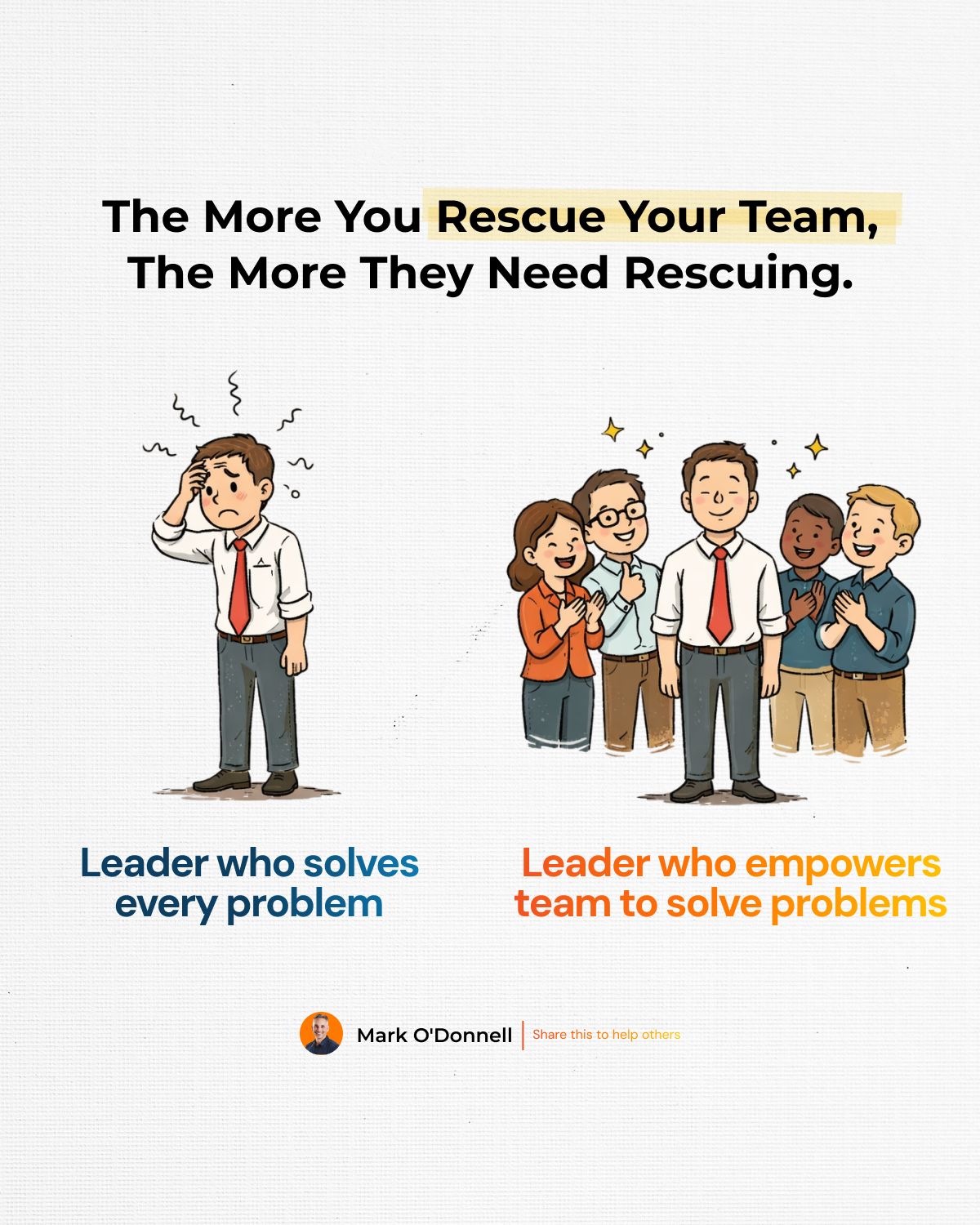
In a recent LinkedIn post, Mark O’Donnell explores a counterintuitive aspect of leadership: how well-intentioned helpfulness can inadvertently create dependent teams. O’Donnell, a proponent of clear thinking and effective leadership tools, highlights what he terms the “Law of Heroic Leadership.” This principle suggests that leaders who consistently step in to solve their team’s problems, while often driven by a desire to help, may be hindering their team’s long-term capability and self-reliance.
The ‘Law of Heroic Leadership’ Explained
O’Donnell begins by identifying a common leadership trait: being the go-to person, always available to assist when challenges arise. While this might seem like a hallmark of good leadership, he argues it can lead to unintended negative consequences. The core of his argument lies in the message this behavior sends to the team.
“Even if nobody says it out loud, your team gets a message: ‘This is above you. Let the leader handle it.'”
According to O’Donnell, repeated instances of a leader swooping in to solve problems can train a team to rely on that intervention, diminishing their own problem-solving initiative. He outlines a detrimental cycle:
- Leader steps in → problem gets solved → team waits for leader next time → leader steps in again.
This pattern, O’Donnell suggests, fosters dependency and erodes a team’s confidence in their own abilities. He emphasizes that this trap is often sprung by leaders who are genuinely invested in their team’s success.
Shifting from ‘Hero’ to Empowerer
The challenge, as O’Donnell points out, is that these leaders are not motivated by a desire for control but by a genuine wish for their team to succeed. This makes it difficult for them to alter their approach.
“Ironically, the leaders who fall into this trap are usually the ones who care the most. They’re not stepping in for control. They just want things to go well for their people.”
O’Donnell proposes an alternative approach, one that prioritizes team development over immediate problem resolution. He contrasts the problematic cycle with a more empowering one:
- Leader steps back → team sits with the problem → team works it out → team trusts themselves to do it again.
This shift, he argues, requires a conscious decision from the leader to allow the team the space to grapple with challenges and find their own solutions. This builds resilience and self-trust within the team.
The Leader’s Crucial Question
O’Donnell poses a critical question for leaders to consider:
“So, the big question worth reflecting on: are you solving problems, or are you the reason your team stopped solving them?”
He encourages leaders to examine their own behaviors and identify if they are unintentionally creating a dependency. O’Donnell also references his book, “Issues,” which delves into how leaders can establish structures for permanent problem-solving rather than constantly intervening. His newsletter, “Clarity Break Thoughts,” further explores tools for enhancing thinking and leadership.
Ultimately, Mark O’Donnell’s insights on LinkedIn serve as a timely reminder for leaders to balance support with empowerment, ensuring that their helpfulness cultivates capability rather than dependence.
📝 About This Content
This article is based on insights shared by Mark O'Donnell on LinkedIn.
📅 Originally posted on March 23, 2026 | View original post on LinkedIn →